

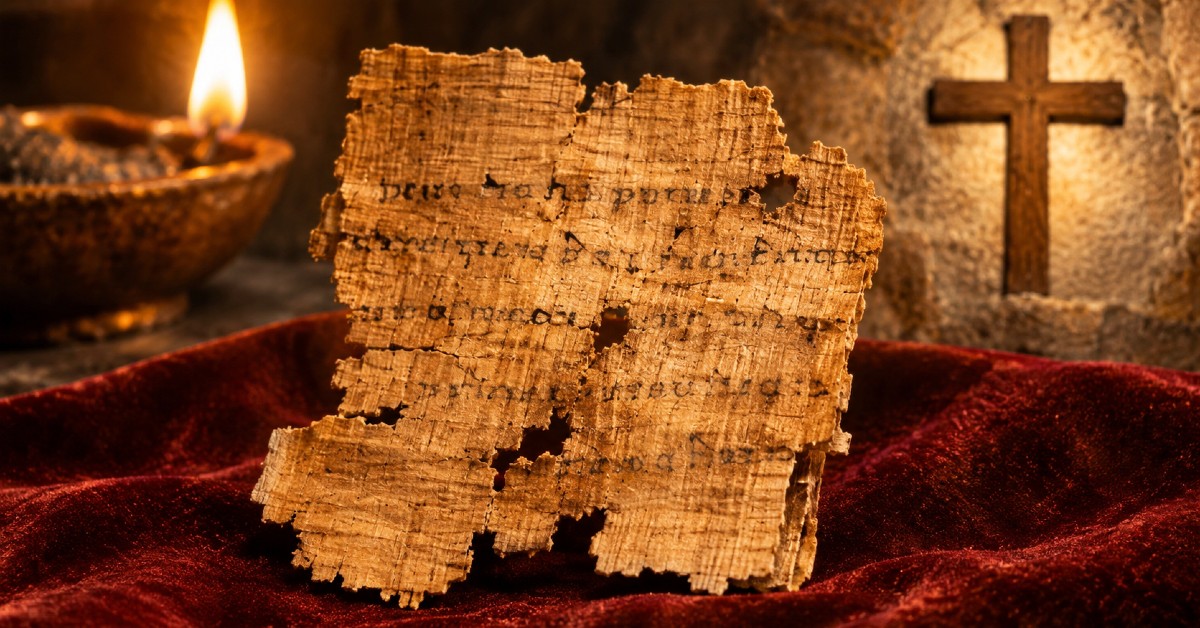
A small fragment of ancient papyrus, preserved for centuries and only recently examined by scholars, may contain part of a previously unknown Christian text describing Jesus Christ’s triumph over death.
The roughly 1,600-year-old manuscript, written in Greek, appears to reference Christ’s death, His descent into the realm of the dead, and His return through the Resurrection. If the researchers’ interpretation is correct, the discovery could offer a rare glimpse into how Christians in the early centuries of the Church understood and proclaimed one of the central mysteries of their faith.
According to the Daily Mail, the fragment was identified among unpublished papyri housed at the Austrian National Library in Vienna. Measuring approximately two by three inches, the damaged manuscript contains only a handful of surviving lines, but researchers believe its religious significance could be substantial.
The study was conducted by Amphilochios Papathomas and Marianna Thoma of the University of Athens in Greece. Their findings were published on January 19, 2026, in the scholarly journal Tyche.
The manuscript, catalogued as P.Vindob. G 29289, is believed to date to the fourth or fifth century, although researchers acknowledge that it could have been produced as early as the late third century.
Its age places the surviving copy within a formative period of Christian history, when the Church was developing its theological writings, preserving apostolic traditions, and defending its teachings about the person and saving work of Jesus Christ.
A Mysterious Reference to Christ’s Victory Over Death
One of the most significant passages appears on the reverse side of the papyrus, where scholars identified a possible reference to a figure descending into the realm of the dead and subsequently returning.
According to the Daily Mail’s reporting on the study, the researchers offered this tentative translation:
“… alone (?) he who descended (into Hades) ascended again (?) …”
The translation remains uncertain because several letters are missing. The phrase “into Hades” was supplied by the researchers as part of their interpretation, while the word translated as “ascended” was partially reconstructed.
Nevertheless, the scholars believe the passage most likely refers to Jesus.
“The sense of the passage is probably that only Jesus and no one else went into Hades and returned through his resurrection,” the researchers wrote, according to the Daily Mail’s English translation of their German-language analysis.
For Catholics, this interpretation is particularly meaningful because it echoes the ancient Christian teaching that Christ descended to the dead between His Crucifixion and Resurrection.
The Apostles’ Creed professes that Jesus “descended into hell” before rising from the dead on the third day.
In Catholic teaching, this descent does not mean that Christ entered the place of eternal damnation to suffer further punishment. Rather, He entered the realm of the dead to announce His victory and open the gates of Heaven to the righteous who had died before His saving sacrifice.
The Catechism of the Catholic Church explains this mystery in paragraphs 631–637, emphasizing that Christ’s descent represents the fulfillment of His mission to bring salvation to humanity.
The newly studied papyrus may preserve an early literary expression of this same belief.
Could the Fragment Belong to a Lost Christian Sermon?
Although the surviving writing is too incomplete to identify its original author, researchers believe it may have formed part of a Christian sermon, hymn, or other religious composition.
According to the Daily Mail, the scholars compared the fragment with writings attributed to Eusebius, an influential early Christian historian and theologian, as well as ancient hymns celebrating Christ’s conquest of death.
These comparisons revealed similarities between the manuscript’s language and early Christian descriptions of the Savior descending into the realm of the dead.
Another surviving word appears to mean “swallowed,” which researchers suggest could refer to death itself.
Ancient Christian authors frequently portrayed death as a power that consumes humanity but ultimately proves unable to hold Jesus Christ.
Such imagery reflects the Christian proclamation that through His death and Resurrection, Christ defeated the power of death and made eternal life possible.
The front side of the manuscript contains what may be a moral exhortation, addressing a “wanderer” and warning against following the “broad road” while hoping to obtain life.
Researchers identified similarities between this language and a sermon by St. John Chrysostom, the fourth-century Archbishop of Constantinople and one of the Church’s great early preachers.
However, the scholars cautioned that the damaged wording could also refer to events in Christ’s own earthly life rather than instructions directed toward believers.
Both sides of the papyrus appear to have been written by the same scribe, suggesting that the fragment originally belonged to a carefully prepared religious text.
A Rare Window Into Early Christian Belief
The manuscript’s precise origins remain unknown.
Researchers suspect it may have come from Egypt’s Fayum region or the ancient city of Hermopolis, both of which contributed papyri to the Austrian National Library’s collection.
However, surviving records do not establish where the fragment was originally discovered.
The scholars examined the papyrus in Vienna, studied its Greek handwriting, and compared its language and writing style with other ancient manuscripts.
According to the Daily Mail, their analysis favors a fourth- or fifth-century date, although no radiocarbon testing was reported.
The manuscript also contains distinctive double-slash marks separating portions of the text. Similar markings appear in other early Christian writings, including hymns, raising the possibility that the fragment belonged to a poetic or liturgical composition.
If so, the passage may have been intended not simply to explain Christ’s Resurrection, but to celebrate His victory over death in language familiar to ancient Christian worshippers.
Importantly, the discovery does not establish that researchers have found a previously unknown eyewitness account of the Resurrection.
The papyrus was written centuries after the events described in the Gospels, and the surviving text does not contain a continuous narrative of the empty tomb or Christ’s appearances to His disciples.
Instead, its potential significance lies in preserving a Christian reflection on the meaning of those events, possibly from a work that was never copied and transmitted into the medieval period.
An Ancient Witness to an Enduring Faith
For the Catholic Church, the mystery of Christ’s death and Resurrection stands at the heart of salvation history.
The belief that Jesus entered the realm of the dead and rose victorious is not a newly discovered doctrine. It has been proclaimed in Christian creeds, reflected in ancient theological writings, and celebrated in the Church’s liturgy for centuries.
What makes this papyrus noteworthy is the possibility that it preserves another voice from that early Christian world, offering scholars an additional example of how believers expressed their faith in the risen Christ.
Its damaged condition leaves important questions unanswered. Researchers cannot yet identify the author, establish the original literary work, or determine with certainty whether the passage describes Christ’s descent into the dead or another aspect of His saving mission.
The scholars hope that publication of the fragment will encourage further investigation and perhaps lead to the identification of related manuscripts.
For now, the discovery offers a potentially valuable connection to the faith of Christians who lived approximately 1,600 years ago.
Though only a few broken lines remain, the manuscript may preserve an ancient proclamation of the same mystery Catholics celebrate today: that Jesus Christ entered into death, conquered its power, and rose again, opening the way to eternal life.
Your support brings the truth to the world.
Catholic Online News exists because of donors like you. We are 100% funded by people who believe the world deserves real, uncensored news rooted in faith and truth — not corporate agendas. Your gift ensures millions can continue to access the news they can trust — stories that defend life, faith, family, and freedom.
When truth is silenced, your support speaks louder.