
For nearly 2,000 years, Christians have journeyed to the Jordan River to remember one of the most significant moments in the life of Jesus Christ: His baptism by John the Baptist. Now, archaeological research is offering compelling new evidence that a site on the eastern bank of the river may be the very place where that sacred event occurred.
A study by archaeologist Waheeb of Jordan’s Hashemite University identifies Bethany beyond the Jordan, known today as Al-Maghtas, as the location that most closely corresponds with biblical descriptions, ancient pilgrimage accounts, and archaeological discoveries.
According to the Daily Mail, which reported the findings on October 20, 2026, the research was published in June in the Egyptian Journal of Archaeological and Restoration Studies.
The findings bring renewed attention to a location that has long held profound spiritual significance for Christians, offering a remarkable connection between the Gospel accounts and the physical landscape of the Holy Land.
Ancient Discoveries Point to a Sacred Location
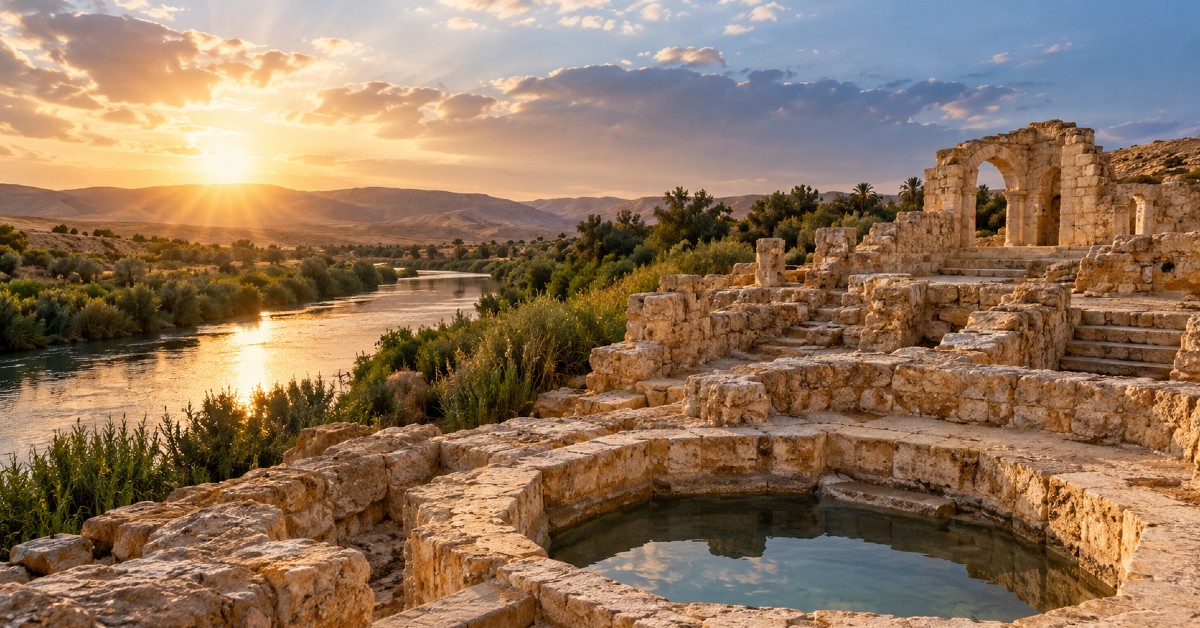
Situated approximately five miles north of the Dead Sea in modern-day Jordan, Al-Maghtas contains the remains of an ancient Christian worship center near the Jordan River.
Archaeological excavations conducted between 1996 and 2002 uncovered churches, baptismal pools, prayer halls, mosaics, and sophisticated water systems. These discoveries suggest that generations of early Christians regarded the location as a sacred destination for prayer, pilgrimage, and baptism.
The site also contains evidence of human occupation dating to the period when Jesus and John the Baptist lived.
“These remains indicate that the area was inhabited during the time of John the Baptist and Jesus,” Waheeb wrote, according to the Daily Mail.
Although the religious structures were constructed during later centuries, their presence demonstrates the importance of the location to early Christian communities.
For researchers, the significance lies not simply in the discovery of ancient buildings, but in how closely those structures correspond with descriptions preserved by Christian pilgrims centuries ago.
Ancient Pilgrims Left Behind an Important Clue
One of the strongest arguments supporting the identification of Al-Maghtas comes from written accounts dating back more than 1,500 years.
According to the Daily Mail’s reporting on the study, two early Christian travelers, the Pilgrim of Bordeaux in AD 333 and Theodosius in AD 530, described the place of Jesus’ baptism as being approximately five miles from the point where the Jordan River enters the Dead Sea.
The location of Al-Maghtas corresponds with that geographical description.
“From the site where the Lord was baptized, to the site where the river Jordan pours into the Dead Sea, there are five miles,” Theodosius wrote, as quoted in the study.
Another pilgrim, writing around AD 570, described a large monastery dedicated to St. John near the baptismal location. The complex reportedly included accommodations for travelers making their way to the sacred site.
Archaeologists have identified religious structures in the area that Waheeb believes correspond with these historical descriptions.
The research also addresses an important geographical complication: the Jordan River has changed course over the centuries.
Seasonal flooding, erosion, and shifting river channels may explain why some ancient structures associated with baptism now stand on dry land rather than directly beside flowing water.
These changes offer a possible explanation for discrepancies between the landscape described by early pilgrims and the location of surviving ruins today.
A Biblical Mystery Surrounding Two Locations
The Gospel of John provides a particularly important clue in identifying the location of Jesus’ baptism.
John 1:28 refers to “Bethany beyond the Jordan” as the place where John the Baptist was baptizing.
However, the precise identification of this location has been debated for centuries.
Part of the confusion stems from the existence of two places bearing the name Bethany.
One was the village near Jerusalem associated with Mary, Martha, and Lazarus. The other was Bethany beyond the Jordan, connected with the ministry of John the Baptist.
According to the Daily Mail, Waheeb’s research examines how the early Christian scholar Origen contributed to the geographical debate when he questioned the name Bethany and favored Bethabara instead.
Although many biblical manuscripts available to Origen identified the location as Bethany, he believed Bethabara was the more appropriate name.
The distinction became significant because Bethabara has been associated with the western bank of the Jordan, while the archaeological evidence examined in the new study supports a location on the eastern side.
Waheeb also studied the ancient Madaba Mosaic Map, which depicts biblical locations throughout the Holy Land.
The map’s separate geographical references to locations on opposite banks of the Jordan provide additional support for distinguishing Bethany beyond the Jordan from Bethabara.
Taken together, the biblical text, ancient geographical records, and archaeological findings strengthen the argument for the eastern-bank location.
Could This Be the Exact Place Where Jesus Was Baptized?
Waheeb believes the evidence provides a strong basis for identifying Al-Maghtas as the authentic baptismal site.
The excavations “have revealed the true place where Jesus was baptized by John the Baptist on the east bank of the river Jordan,” he wrote, according to the Daily Mail.
His conclusion draws upon multiple forms of evidence rather than a single archaeological discovery.
Ancient churches and baptismal installations demonstrate the site’s importance to early Christians. Historical pilgrimage accounts establish a longstanding tradition associating the location with Christ’s baptism. Geographical descriptions correspond with the surrounding landscape, while evidence of earlier occupation connects the area to the first century.
“The results obtained are consistent with the accounts of ancient pilgrims, Madaba map, and Holy Scriptures,” the study concluded.
Nevertheless, the findings should be understood within the limits of archaeological research.
The presence of ancient Christian buildings and their correspondence with historical accounts cannot independently establish the precise spot where John baptized Jesus.
Rather, the research strengthens the historical case for a location that Christians have venerated for centuries.
A Powerful Reminder of Christ’s Baptism
For Catholics, the significance of this research extends beyond the identification of an ancient geographical landmark.
The baptism of Jesus marks the beginning of His public ministry and is remembered in the Church as the Baptism of the Lord.
The Gospel accounts describe Jesus entering the waters of the Jordan, the Holy Spirit descending upon Him, and the Father’s voice declaring His divine Sonship.
The event holds a central place in Christian understanding of Christ’s identity and mission, while also directing the faithful toward the significance of the Sacrament of Baptism.
The possibility of identifying the landscape where this event occurred offers Catholics an opportunity to reflect upon the historical setting of the Gospels.
Al-Maghtas is not an entirely new discovery. The site has long been associated with the baptism of Jesus and recognized as an important Christian pilgrimage destination.
What makes the latest study noteworthy is its effort to bring together biblical references, archaeological remains, ancient maps, and eyewitness descriptions preserved through centuries of Christian tradition.
While archaeology cannot prove every detail of an event recorded nearly two millennia ago, the research provides additional historical context for one of Christianity’s most sacred moments.
For the faithful, the findings serve as a reminder that the events recorded in Scripture unfolded in real places, among real communities, within the history of the Holy Land.
And along the banks of the Jordan River, the ancient testimony of pilgrims and the discoveries of modern archaeologists continue to illuminate the setting of the moment when Jesus entered the waters to be baptized by John.