

There is something profoundly disturbing about watching children being encouraged to destroy an image of the Blessed Virgin Mary while adults look on approvingly.
Not because Catholics believe a statue is God. Not because a piece of plaster or stone possesses divine power. But because of what such an act teaches a child about faith, about other Christians, and about the woman whom Scripture itself calls blessed among women.
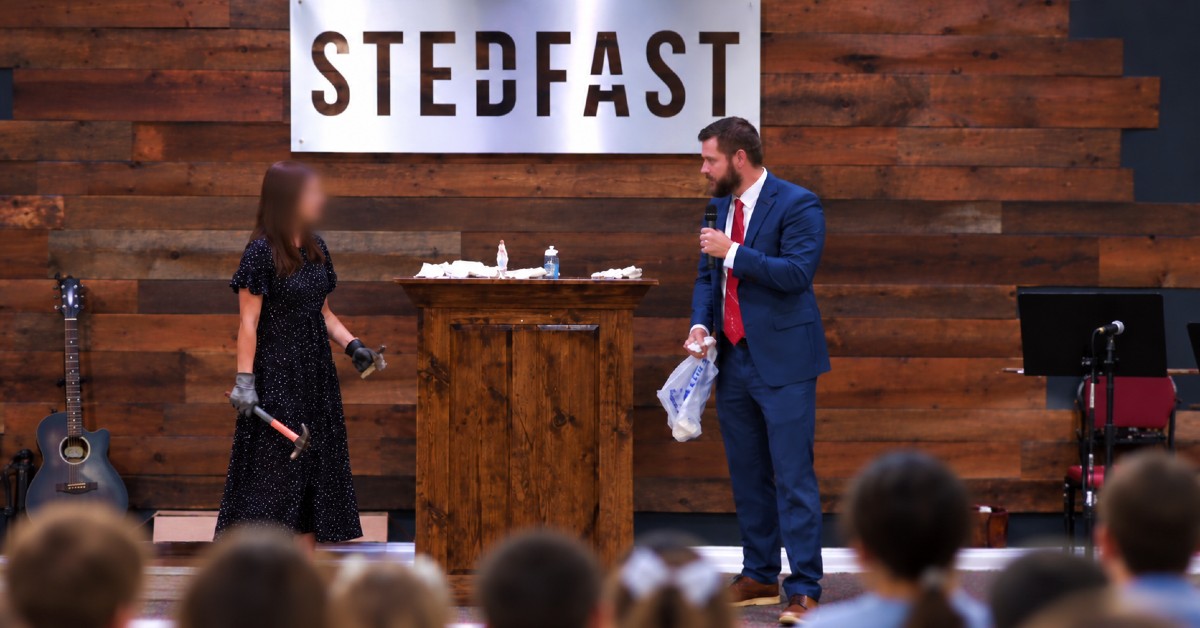
At Stedfast Baptist Church in Cedar Hill, Texas, that troubling lesson became part of a church activity.
According to LifeSiteNews, pastor Jonathan Shelley permitted children to smash statues depicting the Virgin Mary and angels during a church gathering, using the destruction as a reward in a “Bible drills” exercise.
Videos shared by Shelley through his X account, @bannedpastor, on October 12 and 13 reportedly show children striking Catholic religious statues with a hammer in front of the congregation. In one clip described by LifeSiteNews, Shelley smiles as a young girl attacks a statue of Mary near the pulpit.
The pastor characterized the objects as “Catholic Mary Statues” and “Catholic Idols,” according to LifeSiteNews, presenting the destruction as an expression of obedience to the Second Commandment.
But there is a serious difference between teaching children what one believes about religious images and encouraging them to destroy sacred representations associated with another Christian tradition.
And that difference matters.
When Religious Disagreement Becomes a Spectacle of Destruction
Christian denominations have disagreed about religious imagery for centuries. Those disagreements are real, and they deserve serious theological discussion.
But what happened in this Texas church raises a question that reaches far beyond denominational differences.
What exactly are children learning when destroying another Christian community’s sacred images becomes something to celebrate?
Are they being taught to understand Scripture more deeply? To defend their convictions with reason and charity? To recognize the dignity of people whose beliefs differ from their own?
Or are they being taught that contempt is a legitimate expression of religious devotion?
According to LifeSiteNews, the statue-smashing followed a sermon in which Shelley addressed the Second Commandment and idol worship.
Yet the Catholic Church has never taught that statues of Mary or the saints are gods.
The Catechism of the Catholic Church, paragraph 2132, explains that honor shown to sacred images is directed toward the persons represented, not toward the physical objects themselves. Such veneration is fundamentally different from the adoration owed to God alone.
Catholics worship God. They honor Mary as the Mother of Jesus Christ. They venerate the saints as examples of lives transformed by God’s grace.
That distinction is not an obscure technicality. It is foundational Catholic teaching.
One may disagree with Catholic theology. One may reject the Catholic understanding of sacred images. But deliberately presenting Catholic devotion as though it were simply the worship of manufactured objects misrepresents what Catholics actually believe.
And turning that misrepresentation into an activity for children is especially troubling.
The Woman They Were Teaching Children to Strike
The image at the center of this controversy represents the Blessed Virgin Mary.
Mary is not an incidental figure in Christianity.
She is the woman who said yes to God when the angel Gabriel announced that she would bear the Savior. She carried Jesus in her womb, gave birth to Him, stood near His Cross, and remained faithful amid suffering that few human beings could imagine.
In Luke 1:48, Mary declares, “For behold, henceforth all generations will call me blessed.”
Catholics take those words seriously.
Mary’s importance does not come from an attempt to elevate her above God. It comes from her relationship with Jesus Christ and her extraordinary obedience to the will of the Father.
She points believers toward her Son.
When Catholics see an image of Mary, they do not see a rival to Christ. They see His mother, a woman whose entire life was ordered toward Him.
That is why the spectacle described in the Texas church is so painful.
A child may not understand the centuries of theological disagreement surrounding religious imagery. A child may not understand the distinction between worship and veneration.
But a child can understand that adults are celebrating the destruction of something another community holds sacred.
And that lesson can endure long after the broken pieces have been swept away.
Children Should Not Be Turned Into Instruments of Religious Hostility
Perhaps the most disturbing element of this incident is not the destruction itself, but the involvement of children.
Adults are responsible for teaching children how to practice their faith. That responsibility should never be taken lightly.
Religious education should form the conscience, cultivate wisdom, encourage reverence, and teach young believers how to defend their convictions without abandoning Christian charity.
Instead, this exercise appears to have transformed an act of destruction into a reward.
Consider the message that sends.
A child completes a Bible exercise and receives the opportunity to strike a representation of another Christian tradition’s sacred figure.
The connection between religious accomplishment and physical destruction is not merely unfortunate. It risks teaching young minds to associate faithfulness with hostility.
Jesus did not command His followers to humiliate those who misunderstand Him.
He commanded them to love their neighbors and even their enemies.
In Matthew 5:44, Christ teaches, “Love your enemies, and pray for those who persecute you.”
That command does not disappear when Christians disagree about doctrine.
It becomes even more important.
A pastor has every right to explain why his denomination rejects Catholic teachings about religious images. He has every right to preach his understanding of the Commandments.
But the freedom to preach one’s beliefs carries a moral responsibility to avoid nurturing contempt.
The question is not whether Jonathan Shelley is entitled to disagree with Catholicism.
Of course he is.
The question is why children needed hammers to learn that disagreement.
A Pattern of Controversy Raises Deeper Concerns
This incident also comes amid a history of controversy surrounding Shelley’s ministry.
According to LifeSiteNews, Shelley previously preached that homosexuals were “worthy of death,” remarks that contributed to his church’s eviction from a building in 2022 following allegations involving threats and incitement to violence.
LifeSiteNews reported that Shelley defended those remarks as “believing what the Bible says.”
Those earlier controversies are separate from the destruction of Catholic statues. Nevertheless, they raise serious concerns about the rhetoric and example being offered to a congregation, particularly its youngest members.
Christian preaching should never be confused with the cultivation of cruelty.
The Gospel contains hard teachings. It calls believers to repentance, sacrifice, moral courage, and fidelity to truth.
But moral conviction does not require contempt for other human beings.
Nor does defending Scripture require staging the destruction of another Christian community’s religious symbols.
The Backlash Reveals That This Is Not Simply a Catholic Concern
According to LifeSiteNews, footage circulated by the Protestant outlet Protestia attracted more than 100,000 views and criticism from both Catholics and Protestants.
That response matters.
This is not merely a dispute in which Catholics are offended and Protestants are defending their own.
The reported backlash from within Protestant circles suggests that many Christians recognize the difference between rejecting Catholic doctrine and celebrating the destruction of Catholic religious imagery.
Disagreement is not hatred.
Conviction is not cruelty.
And defending one’s faith does not require teaching children to ridicule another’s.
Christians who reject the Catholic veneration of Mary can still recognize her extraordinary place in salvation history. They can still speak of her with the respect due to the mother of Jesus.
Indeed, Christians who take the Bible seriously should have little difficulty acknowledging that Mary deserves to be called blessed.
The Real Tragedy Is What the Children May Remember
Long after the online outrage fades, the children involved in this incident may remember standing before a congregation with a hammer in their hands.
They may remember the excitement of being rewarded.
They may remember adults smiling as religious images were shattered.
What they may not remember is any careful explanation of Catholic theology, any meaningful distinction between worship and veneration, or any instruction about treating fellow Christians with dignity.
That is the tragedy.
A moment that could have been used to teach Scripture, history, and theological discernment instead became a public spectacle of destruction.
Catholics do not need to respond by returning contempt with contempt.
But neither should they pretend this was harmless entertainment.
The Blessed Virgin Mary is not a disposable prop in someone else’s religious performance. She is the mother of Jesus Christ, honored by generations of Christians and explicitly called blessed in Sacred Scripture.
And children deserve better than being taught to swing a hammer at her image as though doing so brings them closer to God.
The measure of Christian faith is not how forcefully one can destroy an object associated with another denomination.
It is how faithfully one follows Jesus Christ.
If a church teaches children to express religious conviction through the destruction of another Christian community’s sacred images, it should expect difficult questions about the kind of disciples it is forming.
Because a broken statue can be replaced.
But the attitudes planted in a child’s heart may last a lifetime.
Your support brings the truth to the world.
Catholic Online News exists because of donors like you. We are 100% funded by people who believe the world deserves real, uncensored news rooted in faith and truth — not corporate agendas. Your gift ensures millions can continue to access the news they can trust — stories that defend life, faith, family, and freedom.
When truth is silenced, your support speaks louder.