

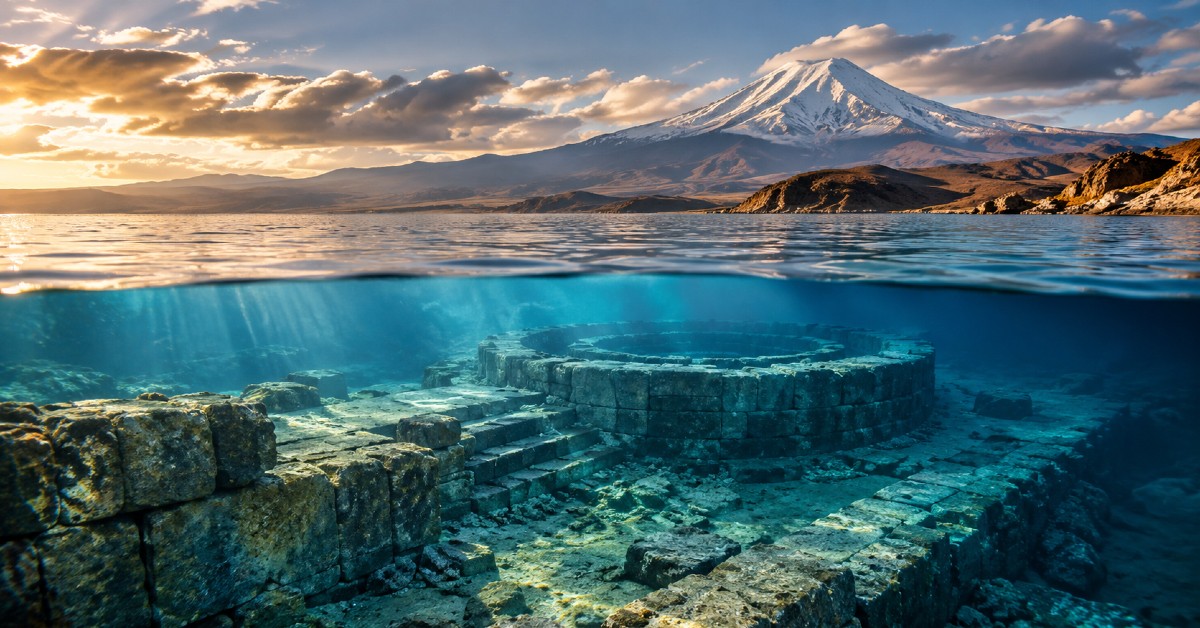
A mysterious complex of stone structures beneath Turkey’s Lake Van is drawing renewed attention after divers documented what appears to be an extensive wall, a circular structure and a long stone passage disappearing into the darkness of the lake.
The discovery is especially intriguing because Lake Van lies in eastern Turkey, roughly 90 miles southwest of Mount Ararat, the mountain traditionally associated with the resting place of Noah’s Ark.
According to the Daily Mail, researcher Matthew LaCroix believes the submerged ruins could be evidence of a much older settlement than archaeologists have previously recognized.
“What we know of the underwater ruins may just be a tiny piece of something much larger,” LaCroix told the Daily Mail.
Divers have documented stonework approximately 75 feet beneath the lake’s surface, including a wall made from interlocking blocks. According to the report, three steps lead toward a circular structure, while seven courses of stone rise more than eight feet from the lakebed.
LaCroix said the apparent causeway continues for a considerable distance.
“I measured over 150 feet that this causeway continues,” he told the Daily Mail. “Over 150 feet, and it leads into the darkness.”
He believes the structure could ultimately connect with additional buildings or even a larger submerged settlement.
But that possibility remains unproven.
No stone from the newly discussed structures has been independently dated, and archaeological excavation has not established that the formations belong to a previously unknown city. LaCroix’s proposed age of at least 11,700 years — and possibly much older — is based on his interpretation of geological evidence concerning Lake Van and volcanic activity in the region, rather than direct dating of the masonry.
That distinction is significant.
Researchers have known for years that Lake Van contains submerged archaeological remains. In 2017, a diving team led by Turkish underwater photographer Tahsin Ceylan documented extensive stone fortifications beneath the lake. At the time, the remains were widely described as possibly belonging to the ancient kingdom of Urartu, which flourished in the region during the Iron Age. National Geographic
Subsequent archaeological research has complicated that picture. A published underwater survey conducted in 2019 concluded that structures examined near Adilcevaz were portions of the southern walls of the Outer Castle. The region contains remains from several historical periods, including Urartian and later medieval occupation. Tek Edebiyat Dergisi
Other archaeologists have similarly cautioned that some submerged walls may be medieval constructions incorporating much older Urartian stone blocks. Reports describing such remains around Lake Van existed decades before the widely publicized 2017 dives. Live Science
The latest observations, however, have renewed questions about what else may remain beneath the enormous lake.
LaCroix argues that the scale of the stonework suggests it was not constructed in isolation.
“It can’t just go to nothing,” he told the Daily Mail. “There would have to be a major urban area that this was a nodal point that it went to.”
For Catholics and other Christians fascinated by biblical archaeology, the location naturally invites interest because of its proximity to Mount Ararat.
Genesis recounts that after the Flood, “the ark came to rest on the mountains of Ararat” (Genesis 8:4). The biblical wording refers to the “mountains of Ararat,” rather than identifying the modern summit of Mount Ararat specifically. The Lake Van discoveries therefore do not constitute evidence that Noah’s Ark has been found, nor do they presently establish a connection between the submerged structures and the Genesis Flood.
Still, the wider region has an extraordinarily ancient human history, and the possibility of additional submerged settlements makes continued archaeological investigation significant regardless of whether any biblical connection is ultimately established.
Exploration is difficult. According to the Daily Mail, sediment in Lake Van sharply restricts underwater visibility, giving divers only a limited window in which conditions are clear enough to document the structures.
For now, the most dramatic possibility — that an unknown ancient city lies preserved beneath Lake Van — remains a hypothesis.
Further dives, sonar mapping and examination by underwater archaeologists will be necessary to establish whether the newly highlighted structures are human-made, determine their age and discover where the mysterious stone passage actually leads.
Until then, the ruins remain an intriguing archaeological mystery in a region whose landscape has been associated with the story of Noah for thousands of years.