

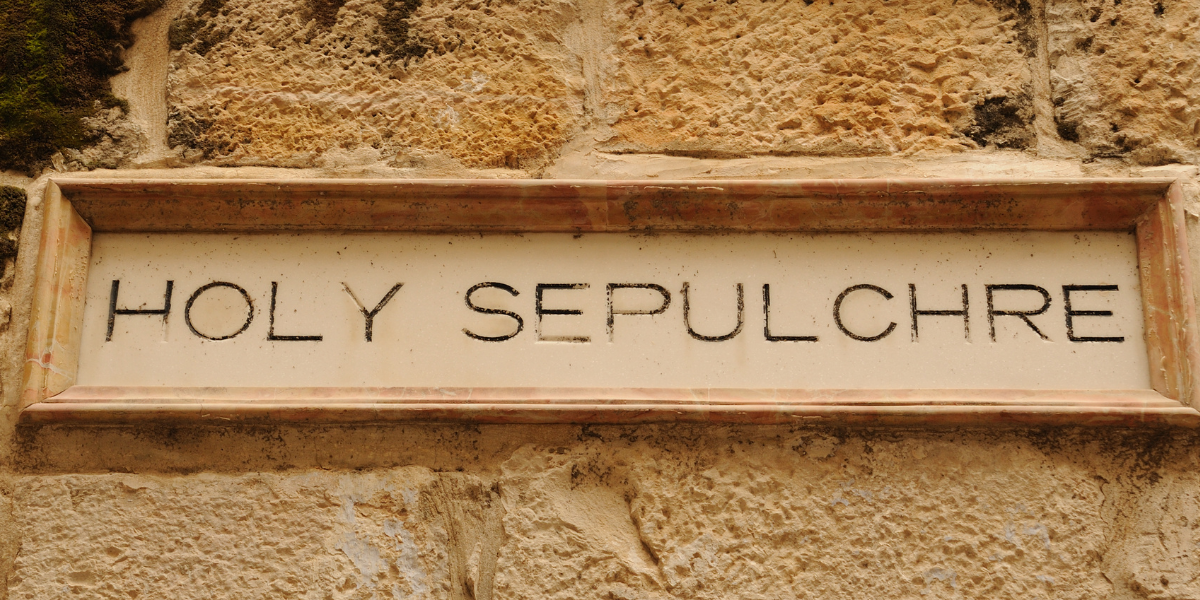
A remarkable archaeological discovery beneath Jerusalem’s Church of the Holy Sepulchre is shedding new light on one of Christianity’s most sacred locations, revealing how early generations of believers preserved and honored the tomb traditionally identified as the burial place of Jesus Christ.
According to the Daily Mail, archaeologists have uncovered portions of an ancient circular marble monument surrounding the rock-cut burial chamber inside the historic church. Measuring approximately 20 feet across, the structure provides important physical evidence of the efforts made to distinguish this particular tomb from other burial sites in the area.
The discovery is especially significant because the Church of the Holy Sepulchre has been venerated by Christians for nearly 1,700 years as the location of Christ’s Crucifixion, burial, and Resurrection.
The newly uncovered remains may help researchers better understand how that tradition developed and why the burial chamber became the focus of such extraordinary devotion.
An Ancient Monument Built to Preserve a Sacred Tomb
The excavation, led by archaeologist Francesca Romana Stasolla, revealed that ancient builders deliberately removed portions of the surrounding rock to isolate and preserve the burial chamber.
According to the Daily Mail, Stasolla identified the preserved space as “the chamber in which tradition recalled the deposition of Christ.”
Researchers discovered that the monument had been constructed using carefully arranged marble slabs, joined with mortar to create a circular platform centered on the tomb.
The structure’s design bears similarities to ancient representations of the original shrine associated with Roman Emperor Constantine, who commissioned the first major Christian church at the site during the fourth century.
Constantine’s church was dedicated in AD 335, approximately three centuries after the death and Resurrection of Jesus.
During its construction, workers uncovered a rock-cut tomb that was identified as Christ’s burial place. Rather than removing the chamber, they carefully separated it from the surrounding rock and incorporated it into a sacred monument.
Stasolla explained that “the monumentalization was kept to a minimum, in an effort to preserve as far as possible the original appearance of the venerated Tomb.”
This deliberate preservation suggests that maintaining the integrity of the burial chamber was an important consideration for those responsible for constructing the shrine.
Could the Memory of Jesus’ Burial Have Survived for Centuries?
One of the most intriguing questions raised by the discovery concerns how the tomb came to be identified with Jesus centuries after His Crucifixion.
According to the Daily Mail, researchers are examining the possibility that knowledge of the burial location survived within Jerusalem’s earliest Christian communities and was transmitted from one generation to the next.
Stasolla addressed this possibility in the excavation report, writing, “It is nonetheless possible that the memory of this tomb had crystallized within the early community and had been transmitted across generations.”
If that tradition was preserved, it could help explain why Constantine’s builders focused their attention on one particular burial chamber rather than the numerous other ancient tombs in the surrounding area.
However, the archaeological findings do not independently establish that the chamber held the body of Jesus. Instead, they offer valuable evidence about the history of the site and the extraordinary efforts made to preserve a tomb that Christians had come to regard as sacred.
The researchers described the newly discovered structure as “the earliest archaeologically documented monument built around the venerated tomb.”
Evidence of Destruction, Restoration, and Centuries of Devotion
The marble remains also reveal clues about the complicated history of the Church of the Holy Sepulchre.
According to the Daily Mail, two surviving marble slabs contain traces of decorative patterns that appear to date from a period after Constantine’s reign.
This raises the possibility that portions of the monument were repaired or reconstructed following the Persian attack on Jerusalem in AD 614, which caused extensive damage to the Christian holy site.
Researchers are currently examining the mortar between the marble slabs to determine when different sections of the structure were assembled.
Archaeologists also identified a narrow channel carved into the marble, apparently intended to direct water around the monument toward a collection system.
Although only part of the circular platform remains, its shape resembles early artistic depictions of the tomb’s shrine.
Researchers believe the original monument may also have included a surrounding arrangement of small columns, although the surviving archaeological evidence is insufficient to reconstruct its complete appearance with certainty.
Ancient Road Raises New Questions About the Path to Calvary
The excavation has produced another discovery that may be connected to the landscape of Jerusalem during the time of Christ.
According to the Daily Mail, archaeologists uncovered a section of an ancient road beneath a Crusader-era walkway inside the church.
The surviving portion measures approximately 10 by 12 feet and appears to have followed a curved, upward-sloping route toward the southwest.
Researchers are considering whether the road may once have provided access to the area traditionally associated with Calvary, where Jesus was crucified.
Stasolla emphasized that this interpretation remains preliminary.
“One possibility – at present no more than a hypothesis – is that this was a suburban road ascending toward the area of the Calvary, assuming that the site functioned as a place of public executions,” she wrote.
The discovery is particularly interesting because the Gospels describe Jesus being led to the place of His Crucifixion outside the city.
However, archaeologists have not established that Jesus Himself traveled along the newly discovered road.
The ancient pathway remains an important subject for further investigation as researchers attempt to reconstruct the historical landscape surrounding the Crucifixion.
Archaeology Offers a New Window Into Christianity’s Sacred History
The findings are presented in a 605-page archaeological report documenting excavations conducted between May 2022 and October 2025.
The Church of the Holy Sepulchre remains among Christianity’s most important pilgrimage destinations, attracting millions of visitors who come to pray at the places traditionally associated with the final events of Christ’s earthly life.
The Gospel of John records that Jesus was buried in a new tomb located in a garden near the place of His Crucifixion (John 19:41–42).
Archaeological evidence of ancient rock-cut tombs beneath the Church of the Holy Sepulchre has contributed to scholarly interest in the site’s historical authenticity.
For Catholics, the significance of the church extends beyond the identification of an ancient burial chamber. It is a place of prayer and pilgrimage intimately connected with the central mystery of the Christian faith: the Passion, death, and Resurrection of Jesus Christ.
While archaeology cannot prove the Resurrection or establish with certainty that a particular tomb belonged to Jesus, discoveries such as this one can illuminate the historical setting in which Christianity first emerged.
The newly uncovered marble monument offers a compelling glimpse into how Christians of antiquity sought to protect a place they believed had witnessed the greatest event in salvation history.
Nearly two thousand years after the events described in the Gospels, the stones beneath Jerusalem continue to reveal new chapters in the story of Christianity’s earliest sacred traditions.
Your support brings the truth to the world.
Catholic Online News exists because of donors like you. We are 100% funded by people who believe the world deserves real, uncensored news rooted in faith and truth — not corporate agendas. Your gift ensures millions can continue to access the news they can trust — stories that defend life, faith, family, and freedom.
When truth is silenced, your support speaks louder.