
As violent unrest shakes France, Catholic leaders are warning that the nation’s troubles extend far beyond political disagreements and economic frustrations. They believe a growing crisis of meaning, particularly among young people, is contributing to widespread anxiety, division, and disillusionment.
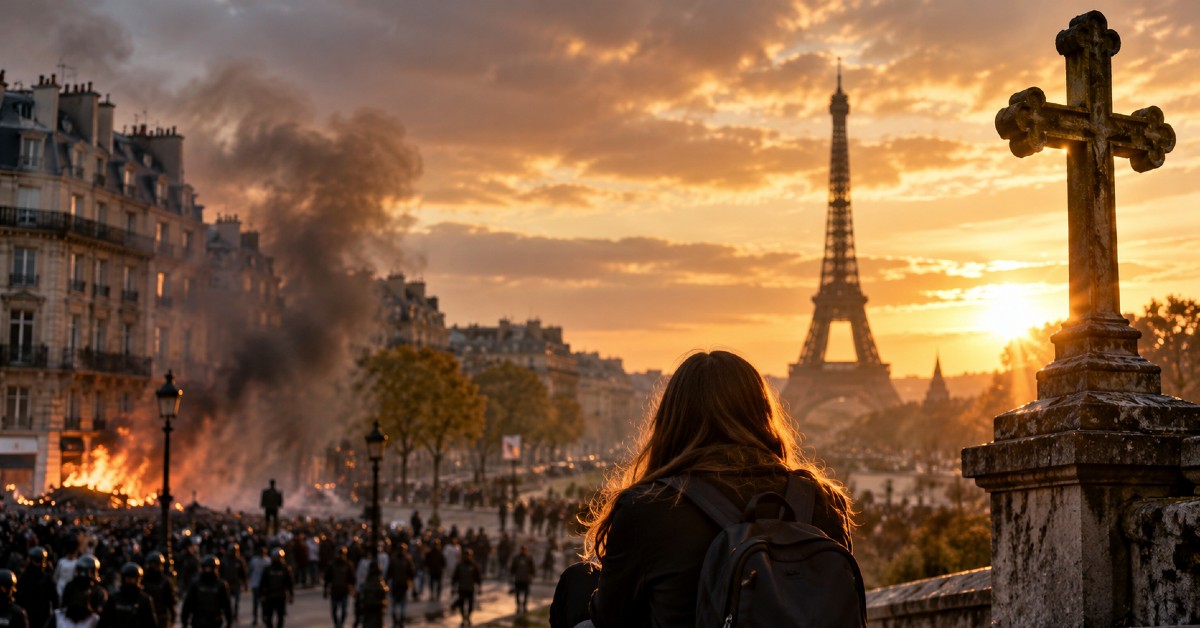
Following violent demonstrations on October 17, the French Bishops’ Conference issued an appeal for peace, urging the country to confront the deeper suffering behind the unrest while firmly rejecting destruction and violence.
“Our country has fallen prey to unacceptable violence,” the bishops declared in a statement reported by Vatican News.
The demonstrations left law enforcement officers injured, businesses looted, and public buildings damaged. The violence followed weeks of protests by high school students frustrated with deteriorating educational conditions, including teacher shortages, absenteeism, and inadequate resources.
Yet Church leaders say the unrest reflects something more troubling than dissatisfaction with public institutions. They see a society increasingly struggling to answer fundamental questions about happiness, purpose, and the future.
Archbishop Vincent Jordy of Tours, vice-president of the French Bishops’ Conference, acknowledged that many protesters have legitimate concerns. Speaking to Vatican News, he described a climate of uncertainty fueled by international conflicts, economic instability, environmental concerns, and declining confidence in society’s institutions.
For many young people, these pressures have created a profound sense of uncertainty about their futures.
“People today wonder what the future will look like—why have children, or even why get up in the morning to face life as it is now?” Archbishop Jordy explained, according to Vatican News.
The archbishop expressed concern that society has become increasingly fragmented, with individuals and groups focusing on their own struggles while losing sight of their shared responsibilities.
He emphasized the importance of recovering a commitment to the common good, a principle central to Catholic social teaching that recognizes the dignity of every person and the responsibility of society to create conditions in which all can flourish.
While recognizing the suffering that has fueled public frustration, the bishops strongly condemned those exploiting the demonstrations to engage in violence.
According to Vatican News, the French Bishops’ Conference warned against a destructive cycle in which legitimate grievances become overshadowed by attacks on individuals, businesses, and public institutions.
The bishops called for dialogue, justice, and a peaceful response that takes the concerns of struggling communities seriously.
But Archbishop Olivier de Germay of Lyon believes France’s difficulties reveal an even deeper spiritual problem.
“I have the feeling that we are reaching the end of a system that fails to address the quest for happiness and meaning that resides in the heart of every human being,” he told Vatican News.
The archbishop questioned whether a society increasingly organized around material possessions, personal pleasure, and individual interests can provide the lasting fulfillment people seek.
He pointed to consumerism, hedonism, and individualism as powerful influences that have contributed to frustration, inequality, and a growing sense of emptiness.
Even those who enjoy material comfort, he observed, may continue searching for something that possessions cannot provide.
For Archbishop de Germay, the Church has an essential role in responding to this spiritual hunger.
“The solution is God,” he declared.
His message was not simply a call for greater religious participation, but an appeal to rediscover the spiritual foundation of human dignity and solidarity.
The archbishop emphasized that people of different cultures, religions, and political convictions share a common humanity, making mutual respect and peaceful coexistence essential.
Archbishop Jordy similarly argued that France must create more opportunities for meaningful dialogue, including strengthening associations, unions, and other organizations that connect ordinary citizens with public institutions.
He also questioned the tendency to look exclusively to politics or technological progress for solutions to humanity’s deepest concerns.
According to Vatican News, the archbishop believes questions about the purpose of life, the direction of society, and the meaning of human existence deserve a place in public conversation.
These concerns are especially important for young people, who face constant messages suggesting that happiness depends on consumption, material success, and personal gratification.
Rather than abandoning the younger generation to discouragement, Archbishop de Germay urged Christians to recognize their generosity and desire to make a difference.
He pointed to the experiences of young pilgrims who travel to Lourdes and dedicate their time to assisting the sick.
“I am struck, for instance, by the young people we take to Lourdes, who dedicate themselves to caring for the sick,” he said, according to Vatican News.
The archbishop explained that some teenagers initially approach these experiences reluctantly, only to return with a dramatically different outlook.
“Teenagers in their first or second year of high school sometimes go quite reluctantly, but when they return, they are transformed because they have experienced the joy of being of service,” he said.
For the archbishop, such experiences demonstrate that young people can discover genuine happiness through generosity, compassion, and service rather than material possessions.
As France approaches its 2027 presidential election, Archbishop de Germay also expressed hope that religious communities could demonstrate unity by organizing a march for peace involving Christians, Jews, and Muslims.
Such an initiative, he suggested, could show that differences in faith, culture, and opinion do not have to produce hostility.
The Church’s response to the unrest ultimately centers on a message that reaches beyond France’s immediate political and social difficulties.
Peace cannot be sustained through political solutions alone if people continue to feel isolated, hopeless, and uncertain about the meaning of their lives.
For France’s Catholic bishops, rebuilding trust requires listening to those who suffer, protecting the dignity of every person, rejecting violence, and restoring opportunities for genuine human connection.
Above all, they believe the Church must help a generation searching for happiness discover that its worth is not measured by wealth, possessions, or social status, but by the dignity of human life and the capacity to love and serve others.
As Archbishop de Germay’s message makes clear, the Church sees an opportunity amid France’s turmoil to remind society that lasting hope begins with something greater than material progress: a renewed understanding of humanity’s relationship with God and one another.
Your support brings the truth to the world.
Catholic Online News exists because of donors like you. We are 100% funded by people who believe the world deserves real, uncensored news rooted in faith and truth — not corporate agendas. Your gift ensures millions can continue to access the news they can trust — stories that defend life, faith, family, and freedom.
When truth is silenced, your support speaks louder.