

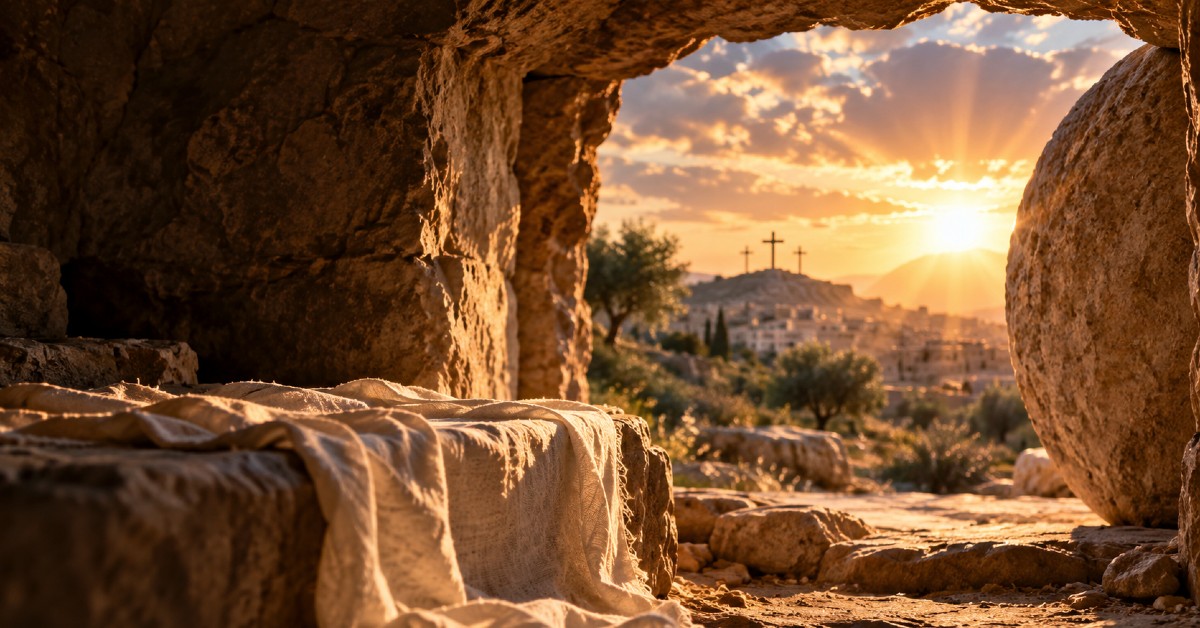
A nearly 2,000-year-old historical account of Jesus Christ is drawing renewed attention after a researcher identified evidence suggesting that a Jewish historian may have recorded early reports of Christ appearing alive to His followers following the Crucifixion.
According to a report published by the Daily Mail, independent Spanish researcher Jesús Fernández-Pedrera Correa has examined ancient versions of a passage attributed to Flavius Josephus, a first-century Jewish historian whose writings provide an important non-Christian perspective on the world in which Jesus lived.
The findings raise an intriguing historical question: Did Josephus preserve an early account of the disciples’ testimony to the Resurrection, even though he was not himself a Christian?
The passage at the center of the research is known as the Testimonium Flavianum, found in Josephus’s Jewish Antiquities, a historical work completed around AD 93 or 94.
The surviving Greek version contains a remarkable statement concerning Jesus:
“He appeared to them alive again on the third day, the divine prophets having foretold these and countless other wonders about him.”
For Christians, the passage reflects the central proclamation of the Gospel: that Jesus Christ rose from the dead on the third day and appeared to His followers.
However, historians have long debated whether Josephus originally wrote those words or whether later Christian scribes modified the passage as his writings were preserved through the centuries.
According to the Daily Mail, Fernández-Pedrera Correa’s new analysis examines versions of the passage preserved in four languages: Greek, Latin, Arabic, and Syriac.
Although the original manuscript written by Josephus no longer survives, these later accounts offer researchers an opportunity to investigate how his description of Jesus may have changed over time.
One particularly significant finding involves the way the different versions describe Christ’s appearance following His death.
The Latin version states that “he appeared to them the third day alive,” while the Arabic account presents the appearance as something reported by Jesus’ disciples rather than an event independently affirmed by Josephus.
This distinction is central to the researcher’s argument.
Fernández-Pedrera Correa suggests that Josephus may originally have documented the testimony of Jesus’ followers, recording their claims that they had seen Him alive after His crucifixion without personally declaring the Resurrection to be a historical fact.
According to the Daily Mail, the researcher considers it possible that later Christian scribes strengthened the language, transforming an account of the disciples’ beliefs into a more direct affirmation of Christ’s Resurrection.
The study also examines other statements within the passage that have raised questions among historians.
One concerns the declaration that Jesus “was the Christ.”
Because Josephus was a Jewish historian who did not embrace Christianity, scholars have questioned whether he would have made such an explicit profession of Christian belief.
The researcher notes that the Latin, Syriac, and Arabic versions express the statement with varying degrees of certainty, describing Jesus as someone believed or thought to be the Messiah.
He also points to the early Christian writer Origen, who stated that Josephus did not accept Jesus as the Messiah.
These differences support the possibility that some of the passage’s stronger Christian declarations were introduced or altered during later transmission.
Another disputed expression suggests that Jesus was more than an ordinary man. While versions of this language appear in the Latin and Syriac accounts, it is absent from the Arabic version.
However, Fernández-Pedrera Correa cautions that such differences do not automatically establish which words were added or removed. Some variations may simply reflect decisions made by later writers who shortened or summarized the original material.
The researcher also identifies a portion of the passage that he considers more consistent with Josephus’s historical writing: the statement that Jesus’ followers continued to exist during the historian’s own lifetime.
According to the Daily Mail, this closing observation appears consistently across the surviving versions and fits Josephus’s practice of describing religious communities and their beliefs.
For Catholics, the renewed examination of this ancient text offers an opportunity to consider the historical setting of the Resurrection proclamation.
The Church’s belief in the Resurrection rests upon the apostolic witness handed down through Sacred Scripture and Tradition. The Gospels recount the discovery of the empty tomb and the appearances of the risen Christ, while the earliest Christian communities proclaimed His victory over death as the foundation of their faith.
Josephus’s writings are significant because they come from outside that Christian tradition.
If the researcher’s proposed reconstruction is correct, the passage could represent a first-century non-Christian historian’s acknowledgment that Jesus’ followers were already reporting encounters with Him after His crucifixion.
Such a finding would not independently prove that the Resurrection occurred. Rather, it would provide additional historical context for understanding how the earliest Christians proclaimed their belief in the risen Lord.
The study remains a preprint, and its conclusions are not established historical consensus. Because Josephus’s original manuscript has been lost, researchers cannot determine with certainty exactly what he wrote concerning Jesus’ Resurrection.
Nevertheless, the analysis highlights the continuing historical importance of the Testimonium Flavianum and the questions surrounding one of antiquity’s most widely discussed references to Jesus Christ.
Nearly two millennia after the events described in the Gospels, scholars continue to investigate the historical testimony surrounding the beginnings of Christianity.
For believers, the central message remains the same: the proclamation that Jesus Christ rose from the dead became the foundation of a faith that continues to reach across the world today.
Your support brings the truth to the world.
Catholic Online News exists because of donors like you. We are 100% funded by people who believe the world deserves real, uncensored news rooted in faith and truth — not corporate agendas. Your gift ensures millions can continue to access the news they can trust — stories that defend life, faith, family, and freedom.
When truth is silenced, your support speaks louder.