
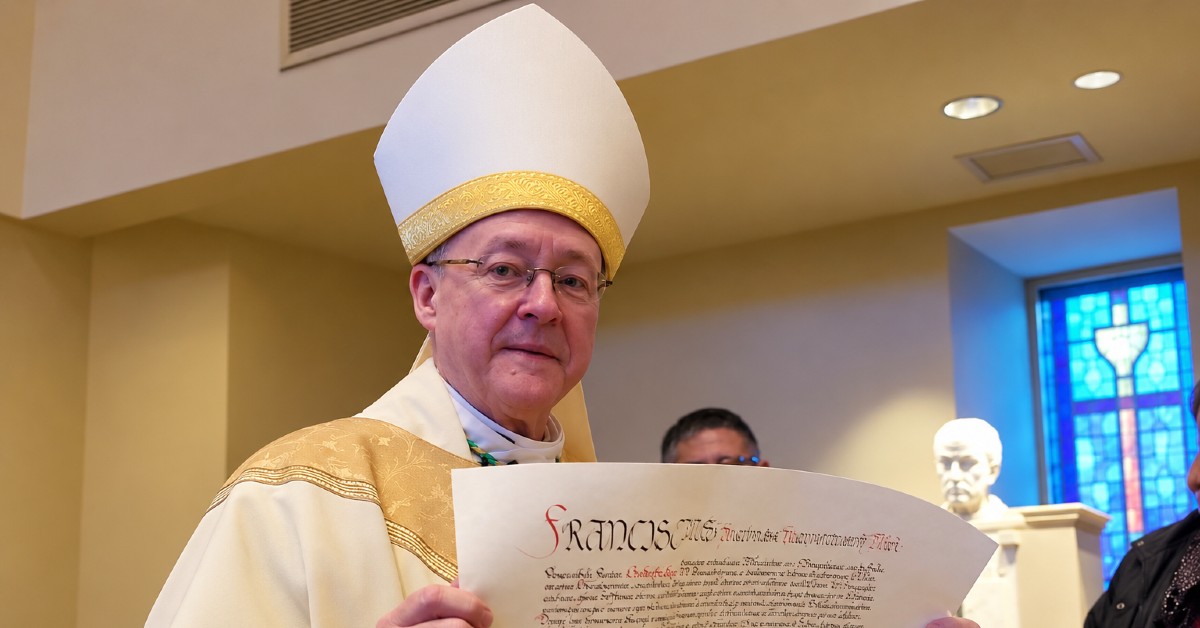
A gathering of Catholic bishops at the White House has prompted an unusual public apology from Archbishop Jeffrey Grob of Milwaukee, who says a private meeting intended to address important Church concerns was unexpectedly publicized, raising questions about the appearance of political endorsement.
In a statement released October 25, Archbishop Grob expressed regret over his participation in the October 22 meeting with President Donald Trump, explaining that the bishops had gathered in good faith to discuss issues affecting Catholics and the broader public.
According to EWTN News, Grob was among 12 bishops who attended the meeting, which included discussions with White House officials before the group entered the Oval Office for prayer with the president.
The archbishop emphasized that the gathering “was in no way an endorsement of the president, his policies, or his party.”
The meeting was organized through the Heritage Foundation and was intended to address several matters of concern to the Catholic Church, including immigration enforcement, visas for religious workers, and human dignity.
According to Grob’s official statement, the bishops understood that the discussions would remain private. They had also been informed that Catholic members of the administration might participate and that there could be an opportunity to pray privately with President Trump.
Following approximately 90 minutes of discussions with White House staff and policy advisers, the bishops were brought into the Oval Office.
There, they greeted the president, received commemorative tokens, and were directed to stand behind him for prayer. Photographs were taken, but Grob said the bishops were unaware that the prayer was also being recorded on video.
“Unbeknownst to the group of bishops a video was also taken. But permission for the public distribution or posting of either the video or photos was not given by the bishops,” Grob explained.
The photographs and video subsequently appeared online, prompting criticism and concern among some Catholics.
Grob acknowledged receiving messages from individuals who questioned whether the gathering had become a political event, particularly because it occurred less than two weeks before a national election.
Others, he said, expressed personal pain because of the impact they believed the administration’s policies had on themselves or their families.
The archbishop said he was especially troubled that an act of prayer could be presented in a way that appeared to serve political purposes.
“I feel a heavy sadness, not only over the pain I caused, but also for the fact that something so sacred to a group of religious leaders, prayer to our Heavenly Father, would be manipulated in that way,” he stated.
Grob maintained that the bishops had approached the meeting with the intention of advancing the common good and addressing human suffering, rather than participating in a political publicity event.
“We came in good faith to try to work for the betterment of our fellow human beings, to ease their suffering, to build up the common good, and to pray with a president, not to pose for a political photo opportunity to benefit the few,” he said.
“We should never have been put in that position by the White House.”
EWTN News reported that it contacted the White House regarding Grob’s assertion that the images and video had been released without the bishops’ permission.
White House spokeswoman Taylor Rogers responded by defending President Trump’s record on issues important to Catholic Americans, including religious liberty, parental rights, and protections for pro-life activists. The response quoted by EWTN News did not directly address the question of consent for publication.
While Grob expressed regret over the circumstances, another bishop who attended the gathering offered a different perspective on the decision to participate.
Denver Archbishop James Golka, who led the prayer in the Oval Office, defended his involvement in remarks published October 23 by the Denver Catholic.
Golka acknowledged that he understood the gathering might generate criticism or be used for political purposes. Nevertheless, he explained that praying for government leaders remains an important part of Catholic life.
“But as I prayed about it, I thought that this is what Catholics do. We pray for people. No matter whether we agree or disagree on anything, we always pray for our country and leaders,” Golka said.
Like Grob, Golka rejected the suggestion that the bishops’ presence represented support for the president or his political agenda.
“The bishops of the United States teach that the Church cannot champion any candidate or party,” Golka explained.
He also reminded Catholics that their deepest identity is found not in political affiliation but in their relationship with Jesus Christ.
The differing responses from the two archbishops highlight the challenges Church leaders can face when engaging with political officials while maintaining the Church’s independence from partisan politics.
Catholic teaching recognizes the importance of praying for civil authorities and encouraging public policies that uphold human dignity and the common good. At the same time, the Church’s mission extends beyond political parties and administrations.
For Grob, the experience has become a moment of personal reflection.
In concluding his public statement, the Milwaukee archbishop acknowledged that he had reservations before attending the gathering and now wished he had listened to those concerns.
“I apologize for any damage my actions have done,” he said.
The controversy underscores a distinction both archbishops sought to make clear: praying with a political leader does not necessarily constitute an endorsement of that leader’s policies or party.
Sources: EWTN News, October 25, 2026; Archdiocese of Milwaukee, Archbishop Jeffrey Grob’s “A Public Apology”; Denver Catholic, October 23, 2026.


