
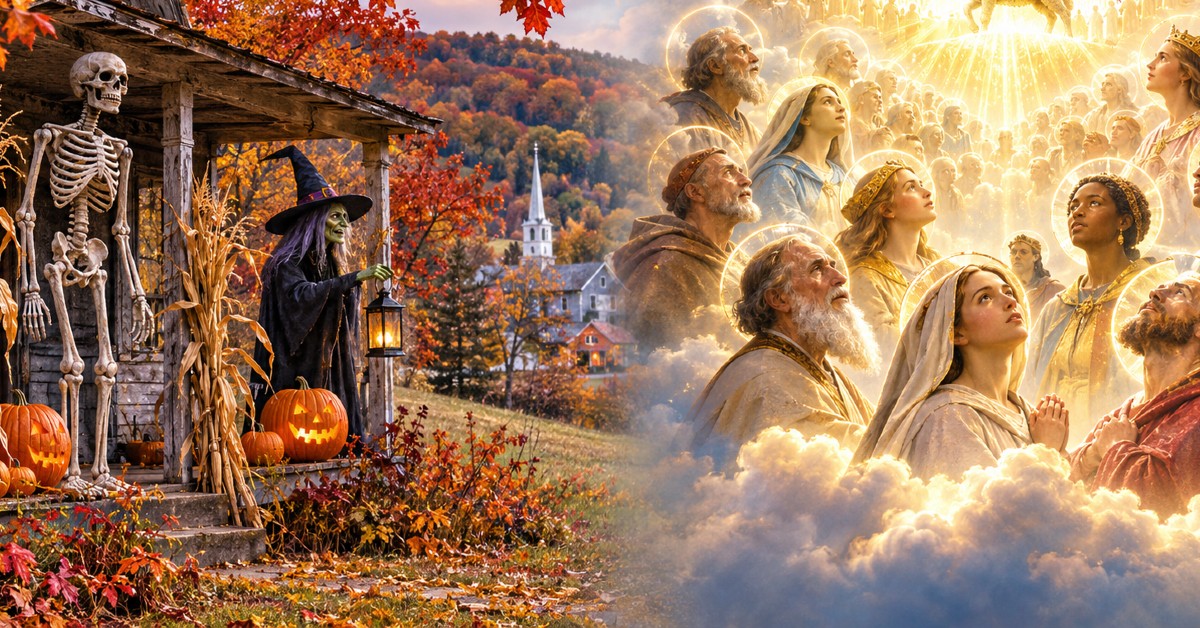
I ventured last week through a rural Pennsylvania foothills village off the beaten track, with old dilapidated wood-framed bungalows amid brilliant fall foliage. The latest electronic fads were not to be seen, but instead I came across 10-foot skeletons and black-hatted witches “gracing” the front footage of bygone homes, spooking my drive throughout the little country hamlet.
These were huge, foreboding October additions to porches, along with pumpkins and corn stalks. The fascination with the otherworldly was everywhere in an otherwise tranquil place of refuge.
Halloween is a layered holiday. From an ancient Celtic seasonal festival marking the turn towards winter and contact with what lingers on afterwards. Later it was Christianized as the eve of All Saints Day, which developed variously in observance in the “dark ages” of Europe, then crossed the Atlantic culture to children’s door-to-door “trick or treating” and elaborate parties with the cadavers and ghosts. Supporting it is a huge orange-and-black-market enterprise, evident as early as Labor Day.
Fascination with the unknown attracts
Modern Halloween often dwells on three things: 1) the grotesque and “unfinished” – corpses, skeletons; 2) Death as spectacle, fear or even frivolous entertainment; and 3) ghosts and lingering, incomplete or nasty presences. No culture can escape a fascination with death, but here it fixates about a floating restlessness. When the focus of life on eternity is blurred or denied, the imagination turns to the residue and the strange – the eerie, the “leftovers” after life. Death becomes an object of curiosity or horror instead of a passage, which even the ancients – Romans, Egyptians, Greeks – cultivated, beyond river and pyramid.
Saint Augustine begins his masterful Confessions alluding to this urge in each of us: “You have made us for Yourself, O Lord, and our heart is restless until it rests in You.” His discovery came after years of that wandering restlessness. Drawing from Scripture, he now realizes the Word made Flesh in Christ and His call to the Way, Truth and Life. Christian hope decries as “leftovers” of this world the discards tossed about on spooky holidays. The “cloud of witnesses” (Hebrews 12:1) who have finished the race are not vague remains but a myriad of persons who live before the throne praising the “Holy Lord of hosts.” They are not restless shades. They are fully alive.
From the early Church, the bones of martyrs have been revered, not entertained as holiday ornaments, but favored at the altar or church bearing their names. These relics are not ghoulish skeletons; they are reminders of the sacred destiny that awaits those converted to Christ. The original Christian imagination was not captivated by cadavers or ghostly “visits” but by the living, perduring communion with the redeemed. That is what the catacombs were all about. Not death but Life.
Our culture deserves a proper re-ordering of the Eternal Call. Scripture speaks of physical death as a “sleep.” The “transitus” or date of death rather than the day of birth is how the Church remembers its deceased. First it locates our final destiny in communion with the Triune God and the saints, and not an isolated malcontent stripped of all but bones and skull. Then it proclaims that every human life is ordered toward this eternal end. Halloween’s devils, however, in the afterlife are not fictitious entertainment, but derive from the reality of a dreaded estrangement meted out after this life’s behavior. The Catechism of the Catholic Church defines hell as “the state of definitive self-exclusion from communion with God and the blessed.” Scripture, of course, establishes the unending character of both heaven and hell.
The point stressed here in both cases is the reality of the person living on, not a cadaver or ghost that fascinates but is not real. We no longer need to linger over images of decay because we know the body is destined for glory, for those who follow God’s prescription for righteousness, unto eternity. And we treat the living with the dignity of those called to the same destiny, no matter how small.
Every human embryo is a person in the human family from the first fertilized cell directed towards eternal life. If we lose the sense of eternity in our material-consuming cultural mindset, the embryo we don’t see furthermore can be reduced to mere biological matter – small, dependent and disposable. But when the eternal call is rightly ordered, the embryo is seen as a person already on the pilgrimage that ends before the throne of God. The same hope that turns our eyes from cadavers and ghosts toward the holy witnesses also teaches us to revere, respect and protect the smallest human life.
The child in the womb is not a potential human being; he or she is already a human being with a potential ordered for eternal destiny. To destroy that life is not only to end a human existence but to cut short a call to develop that potential unique to him or her.
Beyond a one-day fun display of party wannabes or “trick or treat” children of all ages, Halloween’s seasonal fascination with the unfinished and ghoulish registers a symptom of disordered hope. The Christian vision replaces restless ghosts with the living saints and replaces indifference toward the tiniest life with reverence for every person already called to share their glory. When we recover the true end purpose of life — eternal life with the holy witnesses before the Lamb — we recover the capacity to see every human being, from the embryo to the elderly, not in a scared but sacred manner – destined for eternity.
Enter November 1, the Solemnity of All Saints, from fascination to celebration, from eerie darkness to splendid glory! And may we follow them in that cloud of witnesses into eternity.
Fr. Denis Wilde, OSA, Ph.D., is a full-time pastoral associate for Priests for Life. A concert pianist, he was formerly an associate professor of music at Villanova University.