

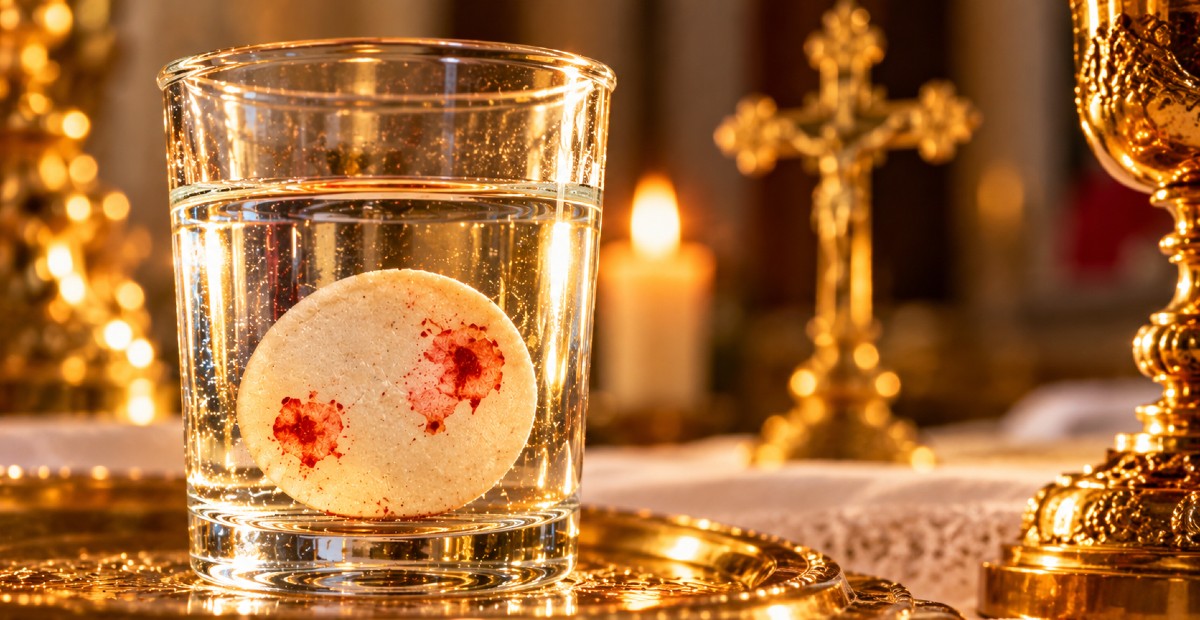
A possible Eucharistic miracle in Guatemala has prompted a formal Church investigation and renewed devotion to the Blessed Sacrament, as thousands of Catholics gather in prayer following reports that a consecrated host developed mysterious reddish markings while submerged in water.
The unusual occurrence took place in Cuilapa, Guatemala, where Church officials are now working to determine what happened to the host and whether there is a natural explanation for its appearance.
According to EWTN News, Bishop José Cayetano Parra of the Diocese of St. Rose of Lima has appointed a multidisciplinary team to examine the host, which reportedly remained intact in water for several days before reddish stains became visible.
The investigation includes a biologist, a physician familiar with similar cases, a psychologist, a nurse, a lay representative of the local Catholic community, and a priest from outside the parish.
Father José Alejandro García, parish priest at the Cathedral of the Child Jesus, told EWTN News Español that investigators hope to establish “whether the reddish stain is blood” and examine the possibility that “a piece of bread may be found to have certain human properties or characteristics.”
The events began July 30 during a Mass celebrated at a school in Cuilapa. A priest noticed that a young person had removed the consecrated host from his mouth and intervened to prevent it from being discarded on the floor.
After recovering the host, the priest placed it in a glass vessel filled with water inside a chapel at the cathedral’s rectory. This is a customary way of allowing a consecrated host that cannot be consumed to dissolve reverently.
However, when the vessel was examined on August 6, the host had reportedly not dissolved as expected. Instead, reddish markings had appeared on its surface.
The discovery attracted attention among local Catholics, raising questions about whether the phenomenon could have a supernatural explanation.
Despite the growing interest, Church authorities have emphasized that no miracle has been confirmed.
Father García explained that the investigation “will require time for study and reflection,” according to EWTN News. Neither the bishop nor the investigative team is currently in a position to declare the occurrence miraculous, and any eventual authorization for public veneration would require the involvement of the Holy See.
The priest has urged Catholics to approach the situation with patience rather than speculation, describing the period of investigation as an opportunity for “exercising prudence, for prayer, and reflection.”
While scientific and ecclesiastical examinations continue, the reported event has already had a significant effect on the local Catholic community.
According to Father García, thousands of people have begun participating more actively in parish life, attending Mass, seeking the Sacrament of Reconciliation, and spending time in Eucharistic adoration.
The increase in visitors has been so substantial that the cathedral’s adoration chapel now remains open from 5 a.m. until midnight to accommodate those wishing to pray before the Blessed Sacrament.
The parish has also witnessed renewed interest in confession, including among Catholics who had been away from the sacrament for many years.
“We offer confession, especially on Sundays, and we have ministered to a large number of people, including some who had not been to confession for years,” Father García told EWTN News.
The priest described the spiritual response as a remarkable moment for the parish.
“For my community, it has been a rebirth,” he said, explaining that the experience has strengthened devotion to Jesus in the Eucharist.
For Catholics, the Eucharist is not merely a symbol of Christ’s presence. The Church teaches that through the consecration at Mass, the bread and wine become the Body and Blood of Jesus Christ, even while retaining their outward appearances.
Reports of extraordinary Eucharistic phenomena naturally draw attention because of this central belief, but the Church approaches such claims with caution, recognizing the importance of careful investigation before making any determination.
In Guatemala, the outcome of the investigation remains unknown. Yet Father García believes the renewed participation in the sacraments has already provided an important opportunity for spiritual growth.
He encouraged Catholics to deepen their faith in the Real Presence of Christ and described the event as a message inviting others to encounter Jesus.
For those who are not Catholic, he said, “it is a cry from Jesus telling us: I am alive; I am the bread that has come down from heaven.”
As investigators continue their work, the Diocese of St. Rose of Lima is asking the faithful to remain prayerful and patient, allowing the Church to examine the evidence while keeping their attention focused on Christ in the Eucharist.
Source: EWTN News and EWTN News Español, reporting on the investigation of the alleged Eucharistic miracle in Cuilapa, Guatemala.