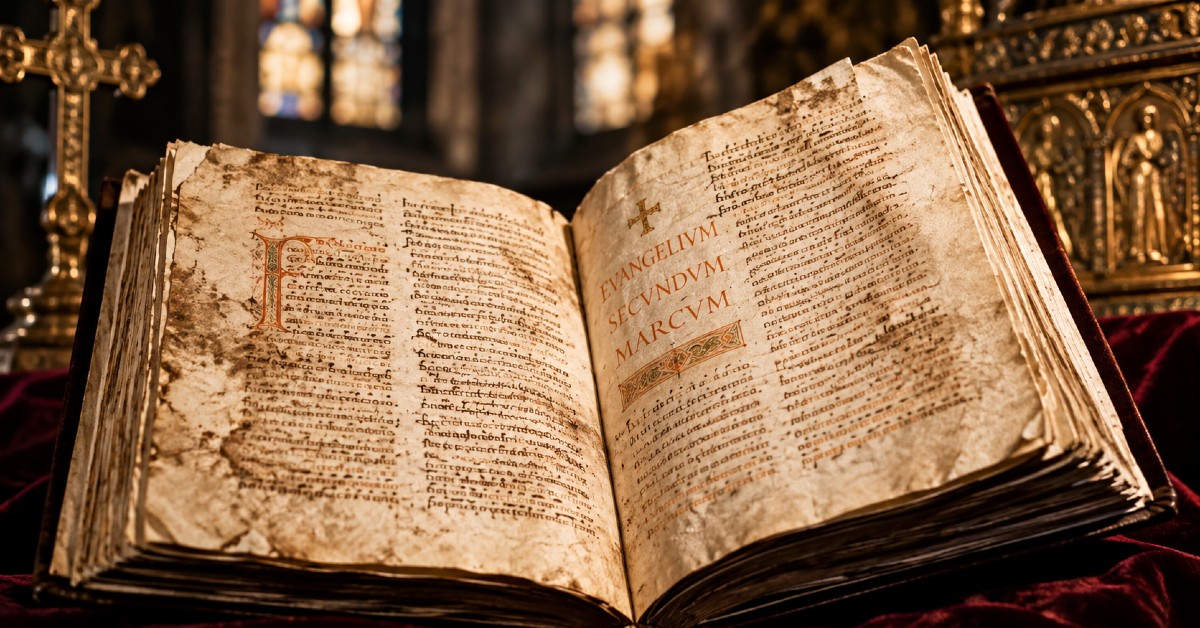
A remarkable piece of Christian history has been brought back together in Italy, as three surviving portions of a sixth-century Gospel manuscript have been reunited for the first time in roughly 700 years.
The ancient manuscript, known as the Codex Forojuliensis or Cividale Gospel Book, once contained all four Gospels in the Latin translation of St. Jerome. According to EWTN News, scholars believe the manuscript was most likely produced in Ravenna before arriving in Aquileia in northeastern Italy during the ninth century.
Today, its surviving pieces are normally preserved in three different places: Cividale del Friuli, Venice and Prague. Their temporary reunion in Aquileia offers Catholics and historians a rare opportunity to see portions of a manuscript that became deeply connected with medieval devotion to St. Mark the Evangelist.
Aquileia has a long Christian history and traditionally traces the founding of its Christian community to St. Mark. The city became an important center for the spread of Christianity into Central Europe and the Balkans following the Edict of Milan in A.D. 313.
“We preserve extraordinary medieval frescoes in the basilica depicting St. Mark arriving here to found the city’s first Christian community,” Aquileia tour guide Anna Sairu told EWTN Noticias, according to EWTN News. “That is why we believe he truly came to Aquileia.”
The manuscript itself became closely associated with that tradition.
During the 12th and 13th centuries, the seven quires containing the Gospel of Mark were separated from the larger Gospel book. The pages were rebound and given an elaborate gilded silver cover, transforming the manuscript into an object of religious veneration. Medieval Christians eventually came to believe the manuscript had been written by St. Mark himself.
“The Gospel was fragmented when it was removed from the Gospel book containing all four Gospels and began to be regarded as an autograph of the evangelist himself,” Cristiano Tiussi, director of the Aquileia Foundation and curator of the exhibition, told EWTN Noticias.
Tiussi explained that the belief was connected to the tradition of St. Mark evangelizing Aquileia and the surrounding region. “During the 12th and 13th centuries, the Gospel of Mark acquired a life of its own and came to be regarded as an extraordinary relic,” he said.
The manuscript began its centuries-long physical separation in 1354, when Holy Roman Emperor Charles IV visited Aquileia while traveling to Rome for his imperial coronation. According to EWTN News, Charles received two of the manuscript’s seven quires and brought them to Prague, where they were placed in St. Vitus Cathedral alongside the relics of St. Wenceslaus.
The remaining portions stayed in Aquileia until Venice conquered the city in 1420. Venice subsequently claimed additional fragments, maintaining that they belonged near the tomb of St. Mark in the Basilica of St. Mark.
The manuscript was ultimately divided among Cividale del Friuli, Venice and Prague. The pieces taken to Venice suffered significant damage from the lagoon’s humidity and are now preserved in a reliquary display case in the Treasury of St. Mark.
But the manuscript contains more than the Gospel text itself.
Before being divided, it also served as a “Liber Vitae,” or “Book of the Living.” More than 1,500 names were written into its pages by people seeking remembrance in the prayers and liturgical celebrations of the Christian community that safeguarded the book.
“There are more than 1,500 important figures who wrote their names in the Gospel, not merely to leave a record of themselves but because they believed that by doing so they would share in the liturgical celebrations every time the book was used in the church where it was kept,” exhibition curator Luca Villa told EWTN Noticias.
Those names include nobles, pilgrims, benefactors and rulers, offering historians a glimpse into the extensive religious and cultural connections that stretched across medieval Europe.
Now the surviving fragments have returned to one place.
For the reunion, the portions preserved in Prague have left the Czech Republic for the first time, while the Venetian fragments have temporarily left St. Mark’s Basilica. Together with the pages preserved in Friuli, they allow visitors to encounter a manuscript whose history spans centuries of Catholic faith, pilgrimage, political upheaval and devotion.
“What is beautiful is that, while acknowledging that each fragment has had a different history and followed a different path, by bringing them together we have chosen to embrace that shared history,” Czech curator Martina Dlabajová said.
The exhibition, titled “The Gospel of Mark: Seven Centuries. Three Fragments. One European Story,” is scheduled to remain open in Aquileia through April 2027.
Because of the extreme fragility of the ancient parchment, visitors will have only a limited opportunity to see the originals together. According to EWTN News, the manuscripts will be displayed during the exhibition’s first six weeks before being replaced with high-resolution digital reproductions.
Your support brings the truth to the world.
Catholic Online News exists because of donors like you. We are 100% funded by people who believe the world deserves real, uncensored news rooted in faith and truth — not corporate agendas. Your gift ensures millions can continue to access the news they can trust — stories that defend life, faith, family, and freedom.
When truth is silenced, your support speaks louder.