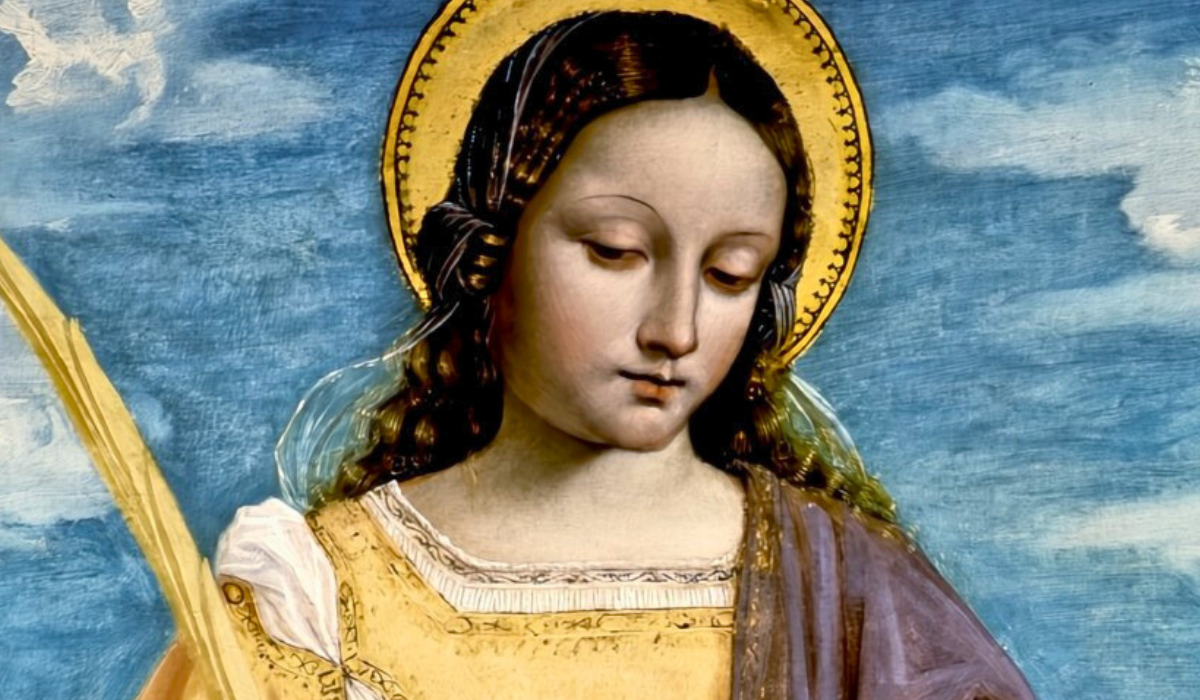
For generations, Catholics have turned to St. Philomena with extraordinary confidence, asking for her prayers in moments of illness, suffering, uncertainty, and seemingly impossible need.
Her story is unusual among the saints. We know remarkably little with historical certainty about her earthly life. Yet devotion to St. Philomena spread rapidly throughout the Catholic world, drew the attention of saints and popes, and inspired countless faithful to seek her intercession.
Her story reminds us of a beautiful truth: a life does not have to be famous in the eyes of the world to be precious in the eyes of God.
The Discovery of a Mysterious Tomb
The modern story of devotion to St. Philomena began in Rome in 1802, when workers in the Catacomb of Priscilla discovered a tomb sealed with three terracotta tiles.
The tiles bore an inscription which, when rearranged, was understood to read:
PAX TECUM FILUMENA — “Peace be with you, Philomena.”
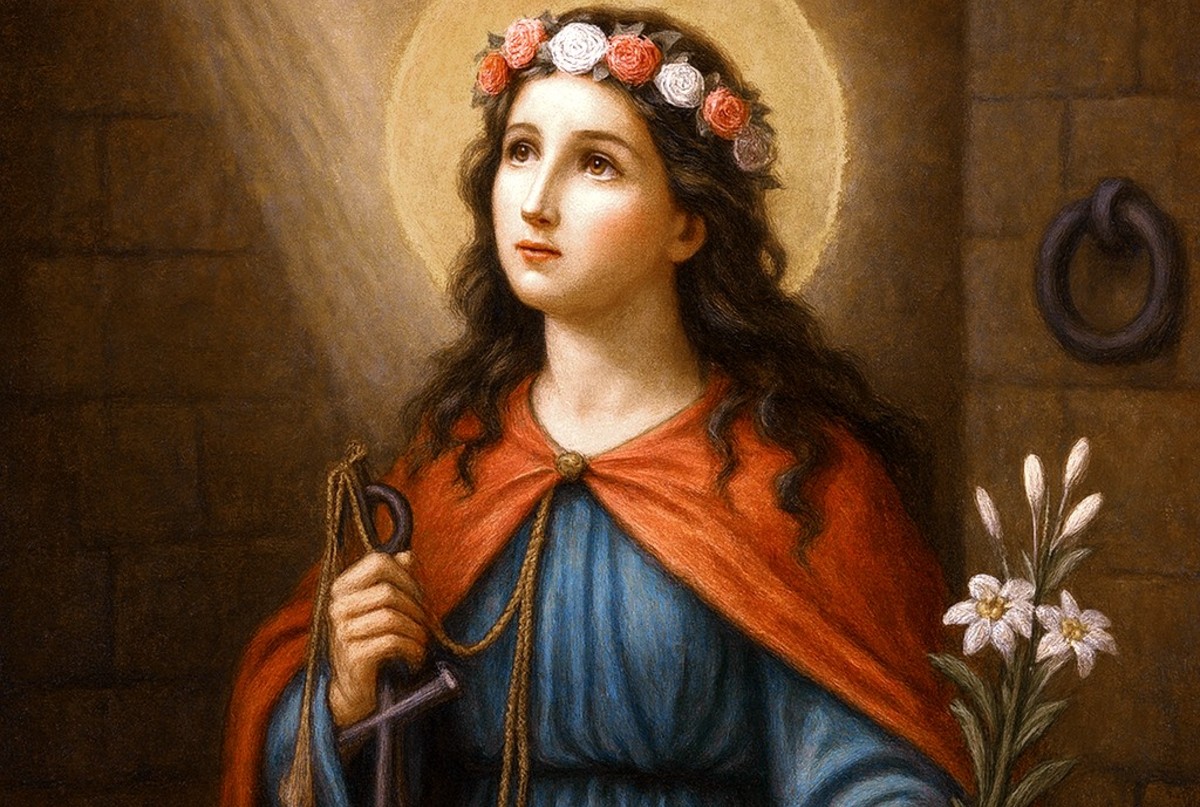
Symbols associated with martyrdom were also found on the tiles, including an anchor, arrows and a palm. Inside the tomb were the remains of a young person, along with a small vessel containing material that was believed at the time to be blood.
The discovery led to the belief that the remains belonged to an early Christian virgin and martyr named Philomena.
In 1805, the relics attributed to her were transferred to Mugnano del Cardinale, near Naples. It was there that devotion to the young saint began to flourish.
Reports of extraordinary favors and healings associated with her intercession quickly spread, and Catholics from far beyond the region began invoking the mysterious young martyr.
The Traditional Story of St. Philomena
Over time, a detailed account of Philomena’s life became associated with private revelations received by a nineteenth-century Italian religious sister.
According to this traditional account, Philomena was a young Christian princess who consecrated her virginity to Christ. When the Roman Emperor Diocletian desired to marry her, she refused because she had already given herself entirely to Jesus.
Her refusal reportedly brought terrible persecution.
Tradition recounts that she was scourged, thrown into water with an anchor around her neck and attacked with arrows. Each time, God miraculously preserved her until she was finally beheaded.
These details have inspired generations of Catholics, but they should not be treated as historically verified biography. The Church does not require Catholics to accept private revelations, and the surviving historical evidence does not allow us to reconstruct Philomena’s life with certainty.
What remains undeniable, however, is the remarkable devotion that arose around the relics attributed to her.
The Saint of the Curé of Ars
Among the most famous devotees of St. Philomena was St. John Vianney, the beloved Curé of Ars.
His devotion to her was profound.
He frequently invoked her intercession and encouraged others to seek her prayers. When extraordinary favors occurred, he often attributed them to his “dear little saint,” directing attention away from himself and toward the intercession of St. Philomena.
The connection between the Curé of Ars and Philomena became so strong that devotion to her spread rapidly throughout France and beyond.
And St. John Vianney was far from alone.
St. Peter Julian Eymard, St. Peter Chanel and other holy men and women were associated with devotion to her. Blessed Pauline Jaricot, founder of the Society for the Propagation of the Faith, also became one of Philomena’s most important early devotees after attributing a remarkable recovery from serious illness to her intercession.
Popes likewise permitted and encouraged various expressions of devotion associated with St. Philomena during the nineteenth and early twentieth centuries.
A Saint for Those Who Feel Small
Perhaps this is one reason St. Philomena continues to speak so powerfully to Catholics.
The world knows almost nothing about her.
There are no surviving books written by her. No great theological works bear her name. We cannot confidently reconstruct the events of her childhood or even the circumstances surrounding her death.
And yet her name has been whispered in churches, homes, hospitals and places of suffering across the world.
There is something deeply Christian about that.
God does not measure greatness as the world measures it.
The saints remind us that holiness is not about becoming important. It is about belonging completely to Christ.
The hidden life of St. Philomena therefore becomes a meditation on the hiddenness of holiness itself. Countless souls throughout history have loved God faithfully without leaving behind monuments, writings or earthly fame.
Heaven knows their names.
Courage in an Age of Compromise
The traditional image of Philomena is that of a young woman who would not surrender what belonged to Christ.
That message remains powerful.
Catholics today live in a culture that constantly pressures Christians to compromise — quietly at first, and sometimes more aggressively later. Faith can be treated as something that should remain private whenever it conflicts with the expectations of the world.
The witness associated with St. Philomena points in the opposite direction.
Christ comes first.
If we belong to Him, then our faith cannot simply be one part of our lives among many. It must shape everything: our relationships, our choices, our work, our suffering and our hopes.
Holiness requires courage.
Sometimes that courage appears dramatic. More often, it consists of small acts of fidelity repeated day after day.
Turn to Her in Difficult Moments
St. Philomena has long been invoked particularly in desperate or difficult circumstances.
But devotion to any saint ultimately leads beyond the saint.
The saints do not replace Jesus Christ. They point us toward Him.
When Catholics ask St. Philomena to pray for them, they are participating in the communion of saints — the great spiritual family united in Christ that death cannot destroy.
Her intercession should therefore deepen our trust in God, strengthen our commitment to prayer and lead us toward the sacramental life of the Church.
Bring your impossible situations to God.
Bring Him the child you are worried about, the marriage under strain, the illness you cannot control, the financial burden keeping you awake, the temptation you have struggled against for years, or the future you cannot see clearly.
Then ask the saints to stand beside you in prayer.
St. Philomena’s earthly story may remain largely hidden from us. But perhaps that hiddenness itself contains a lesson.
We do not need to know every detail of a life to recognize the beauty of total surrender to Christ.
And we do not need to be known by the world to become saints.
We need only to be faithful.
St. Philomena, powerful intercessor and faithful servant of Christ, pray for us.
Your support brings the truth to the world.
Catholic Online News exists because of donors like you. We are 100% funded by people who believe the world deserves real, uncensored news rooted in faith and truth — not corporate agendas. Your gift ensures millions can continue to access the news they can trust — stories that defend life, faith, family, and freedom.
When truth is silenced, your support speaks louder.