

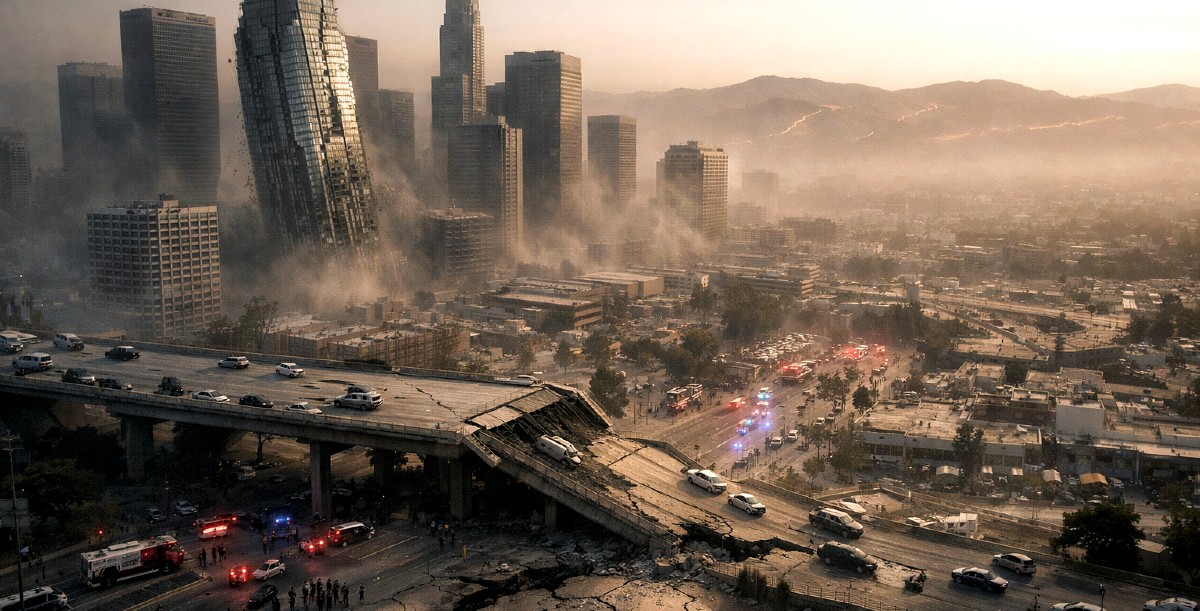
A California earthquake swarm early Friday morning, November 20, has raised renewed concerns about the state’s seismic vulnerability and the possibility of a devastating earthquake along the San Andreas Fault.
According to the Daily Mail, at least 50 earthquakes were detected in a concentrated area near the San Andreas Fault, including a magnitude 5.0 earthquake in Northern California and a separate magnitude 4.2 earthquake near downtown Los Angeles.
The widespread seismic activity has drawn attention to longstanding warnings from scientists about the potential for a major earthquake in California, where millions of residents live near active fault systems.
Powerful Earthquakes Shake Northern and Southern California
The strongest reported California earthquake, measuring magnitude 5.0, struck at approximately 10:49 p.m. Pacific time, roughly 100 miles south of San Francisco.
According to the U.S. Geological Survey (USGS), as reported by the Daily Mail, the earthquake’s epicenter was located approximately 25 miles east of Salinas and less than 10 miles from the San Andreas Fault.
The California earthquake reportedly produced strong shaking near its epicenter, with residents across a broad portion of California reporting that they felt the tremors.
The seismic activity also triggered earthquake warning systems, including the USGS ShakeAlert network, which provides alerts to residents when potentially dangerous shaking is detected.
The National Weather Service monitored the earthquake for possible tsunami activity but reported that no destructive waves had been detected.
Hours later, at approximately 3:25 a.m. Pacific time, a magnitude 4.2 earthquake struck about six miles east of downtown Los Angeles.
More than 12,000 people submitted reports to the USGS indicating they had felt the Southern California earthquake.
According to the Daily Mail, shaking was reported across Los Angeles, Long Beach, Inglewood, Huntington Beach, Mission Viejo, Simi Valley, and Santa Clarita.
Although the shaking was generally described as light, the earthquakes served as another reminder of the region’s exposure to seismic hazards.
No injuries or structural damage had been reported at the time of the initial coverage.
Scientists Warn California Faces Significant Earthquake Risk
The earthquakes have renewed public attention on the San Andreas Fault, an approximately 800-mile-long geological fracture extending through California.
Scientists have long warned that sections of the fault could produce a major California earthquake capable of causing widespread destruction.
According to the Daily Mail, USGS scientists have estimated a 95% probability of an earthquake stronger than magnitude 6.7 occurring near the San Francisco Bay Area by 2043.
The report also cited an increase in a separate long-term earthquake risk estimate for Northern California, from 72% to 74.1% over the next three decades.
These estimates concern long-term seismic hazards and do not establish that a catastrophic earthquake is imminent.
Ned Field, a seismologist with the USGS, previously warned about the importance of preparedness.
“Things seem to be pretty locked and loaded. We’d be wise to be ready,” Field told the San Francisco Chronicle, according to the Daily Mail.
Researchers have also expressed concerns about accumulating geological stress in Southern California.
In June, Liliane Burkhard of the University of Hawaiʻi at Mānoa described the region’s seismic conditions in particularly serious terms.
“Right now, with stress at historically high levels across the region and more than 160 years having elapsed since the last major rupture, the system is in a critically loaded state,” Burkhard said, according to the Daily Mail.
While such warnings highlight the importance of earthquake preparedness, scientists cannot reliably predict the precise date, location, or magnitude of a future major earthquake.
Could California Be Approaching the ‘Big One’?
The possibility of a catastrophic California earthquake, commonly called the “Big One,” has remained a concern for generations of Californians.
The San Andreas Fault is particularly significant because of its length, geological activity, and proximity to densely populated communities.
The Daily Mail also cited geophysicist Stefan Burns, who has publicly warned that California could face increased earthquake activity.
“California is super overdue,” Burns said during a YouTube livestream, according to the report.
Burns suggested that Southern California could face heightened risks and connected his concerns to recent major earthquakes elsewhere around the Pacific.
However, claims that earthquakes in distant regions indicate an impending California disaster should not be treated as established scientific predictions.
Earthquake swarms can occur without producing a larger destructive event, and the recent tremors do not, by themselves, demonstrate that the “Big One” is about to strike.
California’s history nevertheless illustrates the seriousness of the threat.
In 1989, the magnitude 6.9 Loma Prieta earthquake struck the San Francisco Bay Area, becoming one of the region’s most significant modern seismic disasters.
Today, scientists continue studying the forces that produce earthquakes while urging residents to prepare for potentially damaging shaking.
A Reminder for California Families and Catholic Communities to Prepare
For California’s Catholic families, parishes, schools, and charitable organizations, the recent earthquakes offer an important reminder of the responsibility to protect human life and care for vulnerable neighbors.
Churches, Catholic schools, and community ministries serve people across earthquake-prone regions, including communities where a major disaster could disrupt transportation, electricity, communications, and access to essential services.
Families are encouraged to maintain emergency supplies, establish communication plans, and identify safe locations within their homes.
During an earthquake, the recommended protective action is to drop, cover, and hold on, particularly when strong shaking makes movement dangerous.
For Catholics, practical preparation can also be accompanied by prayer, solidarity, and a willingness to assist neighbors who may be elderly, disabled, isolated, or otherwise vulnerable during an emergency.
The Church’s commitment to protecting human dignity and serving those in need remains especially important when natural disasters threaten entire communities.
While the latest earthquake swarm has understandably generated concern, there is no scientific basis for concluding that these tremors mean a catastrophic earthquake will occur immediately.
For millions of Californians, the message remains clear: preparation, accurate information, and community cooperation are essential in a state where earthquakes are an unavoidable part of life.
As scientists continue monitoring seismic activity, residents are encouraged to follow official updates from the U.S. Geological Survey and local emergency management authorities.
Your support brings the truth to the world.
Catholic Online News exists because of donors like you. We are 100% funded by people who believe the world deserves real, uncensored news rooted in faith and truth — not corporate agendas. Your gift ensures millions can continue to access the news they can trust — stories that defend life, faith, family, and freedom.
When truth is silenced, your support speaks louder.


