

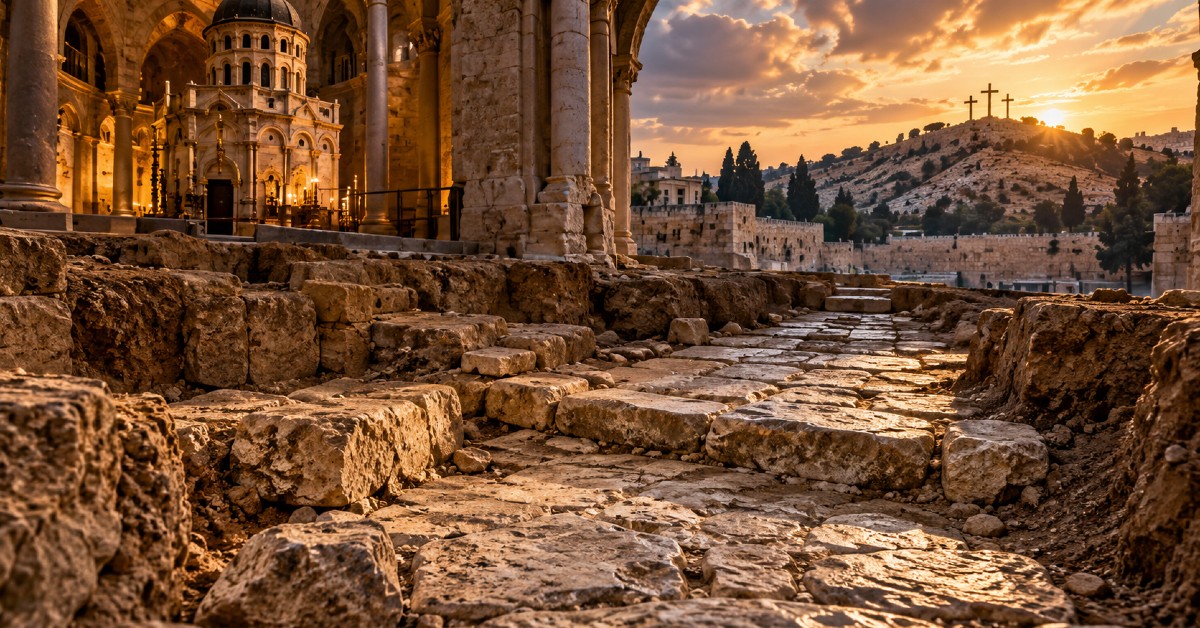
An ancient stone-paved road discovered beneath Jerusalem’s Church of the Holy Sepulchre is raising an extraordinary possibility: Could this forgotten passageway have been part of the route Jesus Christ traveled on His way to Calvary?
According to the Daily Mail, archaeologists excavating beneath one of Christianity’s holiest churches have uncovered a section of an ancient Roman-era road that may have once provided access to the site traditionally identified as the place of Christ’s Crucifixion.
Although researchers caution that the connection remains hypothetical, the discovery offers a fascinating new perspective on the landscape of Jerusalem during the time of Jesus.
The Church of the Holy Sepulchre, located in Jerusalem’s Old City, has been venerated by Christians for centuries as the site of both Christ’s Crucifixion and His burial. The original church was commissioned by Roman Emperor Constantine in the fourth century and inaugurated in A.D. 335.
Now, archaeological investigations beneath its ancient floors are revealing additional details about the area before the church was constructed.
According to the Daily Mail, researchers discovered a stone-paved surface measuring approximately 10 by 12 feet beneath a walkway dating to the Crusader period. The surviving section includes a broad, shallow step bordered by larger stones.
Although the road’s original boundaries have not survived, its curvature and steep incline suggest it once ascended toward the southwest, potentially in the direction of Calvary.
Professor Francesca Romana Stasolla of Sapienza University of Rome, who leads the archaeological investigation, has suggested that the road may have provided access to an area used for public executions.
“One possibility – at present no more than a hypothesis – is that this was a suburban road ascending toward the area of the Calvary, assuming that the site functioned as a place of public executions,” Stasolla wrote, according to the Daily Mail.
The possibility is particularly significant because the Gospels describe Jesus being led to Golgotha, also known as Calvary, where He was crucified.
In the Gospel of John, Scripture recounts that Jesus carried His Cross to the place called the Place of the Skull (John 19:17).
For Catholics, the journey to Calvary holds profound spiritual significance and is commemorated through the Stations of the Cross, a devotion that invites the faithful to meditate on Christ’s Passion and sacrifice for the salvation of humanity.
However, archaeologists have not established that Jesus personally walked along the newly discovered road, nor have they confirmed that it formed part of the route described in the Gospels.
The discovery nevertheless raises questions about how people approached the execution site during the Roman occupation of Jerusalem.
Roman crucifixions were deliberately public events, intended not only to punish condemned individuals but also to serve as warnings to others.
“What is certain is that the place of execution must have been public and accessible,” Stasolla wrote, according to the Daily Mail.
Researchers considered other explanations for the road, including whether it had been used to transport construction materials during the reign of Emperor Hadrian in the second century.
However, the presence of the broad step would have complicated the movement of heavy carts, making that interpretation less convincing.
The road belongs to an early Roman archaeological phase predating Hadrian’s redevelopment of Jerusalem, leaving open the possibility that it existed during the lifetime of Jesus.
It was eventually abandoned when Constantine’s church complex was constructed in the fourth century.
The road is not the only discovery drawing attention to the historical setting of Christ’s Passion.
In April 2025, Stasolla and her archaeological team announced the discovery of ancient plant remains beneath the Church of the Holy Sepulchre, suggesting that portions of the site had once been cultivated.
According to the Daily Mail, analysis placed the remains in the pre-Christian period, around the era traditionally associated with the Crucifixion and burial of Jesus.
That finding carries particular interest because the Gospel of John describes a garden near the place where Christ was crucified.
“Now in the place where he was crucified there was a garden, and in the garden a new tomb in which no one had yet been laid” (John 19:41).
The discovery of evidence for ancient cultivation does not prove that the garden described by St. John has been identified. Nevertheless, it adds archaeological context to the Gospel account and the longstanding Christian tradition surrounding the site.
The Church of the Holy Sepulchre is widely regarded by scholars as a strong candidate for the historical location of Jesus’ burial, partly because archaeological evidence indicates that rock-cut tombs existed in the surrounding area during the relevant period.
Another location, known as the Garden Tomb, has also been proposed by some Christians, although the Church of the Holy Sepulchre remains the more widely supported historical identification.
Excavations at the church have revealed further architectural remains, including part of a circular foundation made from reused marble beneath the shrine surrounding the traditional tomb of Christ.
According to the Daily Mail, the structure measures approximately 20 feet in diameter. Researchers are examining mortar samples to better understand when the foundation was constructed and how the sacred site changed over the centuries.
The archaeological project began in 2019, with excavations directed by Stasolla taking place between May 2022 and October 2025. Researchers continue to study the discoveries and documentation gathered during the investigation.
For Catholics, these findings offer an opportunity to reflect on the historical reality of the events at the heart of the Christian faith.
The Church teaches that Jesus Christ truly suffered, was crucified, died, and was buried, and that He rose from the dead on the third day. Archaeological discoveries can illuminate the historical setting of these events, even when they cannot establish every detail recorded in Scripture.
The newly uncovered road does not provide definitive evidence of the precise path Christ followed to Calvary. Its age, location, and possible purpose, however, make it a compelling subject for further investigation.
Nearly 2,000 years after the Crucifixion, the ancient stones beneath Jerusalem’s most sacred Christian sites continue to reveal traces of the world in which Jesus lived, suffered, and died.
And while researchers work to determine where this mysterious road once led, the discovery invites the faithful to contemplate the journey to Calvary that remains central to the Christian story of redemption.
Your support brings the truth to the world.
Catholic Online News exists because of donors like you. We are 100% funded by people who believe the world deserves real, uncensored news rooted in faith and truth — not corporate agendas. Your gift ensures millions can continue to access the news they can trust — stories that defend life, faith, family, and freedom.
When truth is silenced, your support speaks louder.