
While Mother Mary is one of the most inspiring figures in the world, she is both a unifying and divisive figure in the study and practice of Christianity in all its manifestations, as well as in her portrayal in Islam. With this article, I aim to show that Mary’s journey is not simply a series of doctrinal changes but rather a process of becoming a human bridge who—because she is the mother of Jesus Christ and is someone who must lead the faithful closer to her Son—can help bring the divine within reach. This article traces her emergence as a pivotal, accessible figure in the East and West, explains the disconnection many experience, and explores the implications of establishing a human–divine relationship for spiritual existence.
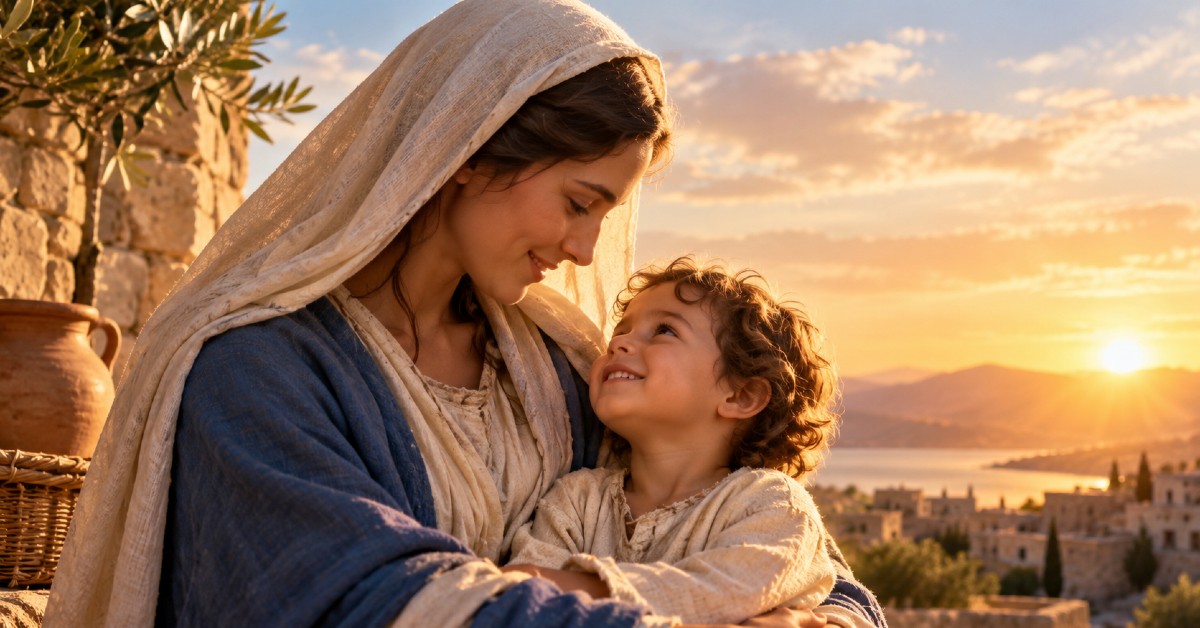
Historically, many believers sought solace in Mary, perceiving her “maternal sympathy” and seeking her intercession. By incorporating Mary into daily life, believers create a link that might otherwise feel abstract or remote. At present, many churches have “lost” the daily, tangible presence of a mother who not only exemplifies perfect obedience but also offers a human perspective on the mysteries of the Trinity. Her iconography presents her as one who helps show the way, directing attention away from herself and toward her Son, Jesus Christ.
Let us further consider the doctrinal foundation that has sustained this image. The Catechism of the Catholic Church (CCC) represents the most authoritative contemporary synthesis of teachings regarding Mary in Roman Catholicism. Here, Mary is depicted not only as the Virgin Mother of Jesus but also as the “Mother of God,” “Mother of the Church,” and one who uniquely cooperated in Christ’s saving mission, whose continual intercession supports the faithful “in the order of grace.”
The Catechism is founded on a Christological premise: “What the Catholic faith believes about Mary is based on what it believes about Christ” (CCC 487). In the first Marian dogma, Mother Mary is rightly called Theotokos, or the “Mother of God” (CCC 495), because she bears the eternal Son of God incarnate. This title protects Christ’s divinity by grounding His incarnation in a genuine human mother. Furthermore, Mary is depicted as the “New Eve,” whose faithful obedience corrected Eve’s disobedience (“Being obedient, she became the cause of salvation for herself and for the whole human race”; CCC 494, 508–511, citing Irenaeus). In these contexts, she represents an “exemplary realization” (CCC 967–968) of what a human being can achieve through human freedom and divine grace.
Apart from her Divine Motherhood, the Catechism also articulates the three other classic Marian dogmas. Regarding the Immaculate Conception, Mary was preserved free from all stain of original sin from the first moment of her conception through God’s “singular grace and privilege,” in view of Christ’s merits (CCC 490–491). In terms of Mother Mary’s Perpetual Virginity, the Church confesses her “real and perpetual virginity even in the act of giving birth,” celebrating her as Aeiparthenos (the “Ever virgin”) and interpreting the biblical “brothers” of Jesus as relatives or children of another Mary (CCC 499–500). Finally, regarding her Assumption, the Catechism states that “The Immaculate Virgin… when the course of her earthly life was finished, was taken up body and soul into heavenly glory,” a “singular participation in her Son’s Resurrection” (CCC 966).
The Catechism’s portrayal of Mary’s involvement in salvation history after Christ’s ascension is distinctive from a Protestant perspective. She is “clearly the mother of the Church” (CCC 963), and her motherhood continues uninterruptedly from the Annunciation until the fulfillment of the elect (CCC 969). Furthermore, she is referred to as “Advocate, Helper, Benefactress, and Mediatrix” (CCC 969; also 2674).
However, the Catechism emphasizes that this Marian mediation “in no way obscures or diminishes the unique mediation of Christ, but rather shows its power” (CCC 970). Her influence “flows forth from the superabundance of the merits of Christ, rests on his mediation, depends entirely on it, and draws all its power from it” (CCC 970). Therefore, Catholic teaching presents Marian cooperation and intercession as being under Christ’s singular mediation, rather than a competing alternative.
Such theology is embodied in Catholic devotion. Furthermore, her presence considerably fosters the adoration of God (CCC 971) rather than distracts from it. The Church commends Marian feasts, the rosary, and prayers such as the Hail Mary, and describes petitioning Mary to “pray for us sinners, now and at the hour of our death” as an expression of humble faith in the “Mother of Mercy” (CCC 2676–2677).
More importantly, Our Lord Himself gave His mother to all of humanity as our spiritual mother, particularly through St. John at the foot of the cross (John 19:26–27): “When Jesus therefore had seen his mother and the disciple standing whom he loved, he saith to his mother: Woman, behold thy son. After that, he saith to the disciple: Behold thy mother. And from that hour, the disciple took her to his own.”
As demonstrated in this part of the article, the Catechism presents a comprehensive Marian synthesis: Mary is the all holy, ever virgin, mother of the Church, assumed body and soul into heaven by God, and a continuing intercessor, whose veneration is regarded as a natural extension of orthodox Christology and the sacramental life of the Church. This does not mean, however, that Mary is more merciful or approachable than Jesus, or that Marian devotion is the only path to salvation. Indeed, Mother Mary has always led the faithful closer to her Son.
With this in mind, let us consider how Catholic communities practice and experience Marian devotion in the daily expressions of faith. The Catechism’s teaching on Mary is meant to move beyond the abstract and infuse ordinary Catholic spirituality. For many Catholics, Mary’s presence is woven into daily prayers, the liturgical calendar, and family traditions, making her a constant, though often quiet, companion in faith.
The simplest and most widespread form of daily prayer is the Hail Mary. Composed of biblical expressions (“Hail [rejoice], full of grace, the Lord is with you… Blessed are you among women and blessed is the fruit of your womb, Jesus”) and the Church’s supplication (“Holy Mary, Mother of God, pray for us sinners, now and at the hour of our death”), the Hail Mary embodies Catholic Marian doctrine in a brief prayer (CCC 2676–2677). Many Catholics begin and end their day with Hail Marys, recite them before meals, and use them to frame instances of anxiety or gratitude.
The rosary, a meditative cycle of Hail Mary’s and other prayers organized around “mysteries” related to the lives of Christ and Mary, is arguably the most emblematic Marian devotion. It lets believers contemplate Christ’s life from the perspective of a human mother, making the Gospel a personal, contemplative experience. The Catechism calls such Marian prayer “an epitome of the whole Gospel,” encouraging Catholics to reflect on Christ alongside Mary (CCC 971).
Furthermore, Mary is consistently present throughout the liturgy. Every Mass references her in the Eucharistic Prayer (“in communion with the most blessed Virgin Mary, Mother of God…”), and Marian feasts are prominent in the Church’s calendar: the Immaculate Conception, the Assumption, the Annunciation, and others. These feasts encourage Catholics to see Mary’s narrative as a crucial part of the Church’s commemoration of salvation history. Beyond the official calendar, many parishes promote Marian devotions, such as May crownings, processions, and local pilgrimages to Marian shrines, ensuring Mary’s strong presence in communal life.
Today, Catholics seek Mary’s intercession for various matters, such as grave illness, moral conversion, family tensions, and examinations—not as a substitute for Christ but as an intercessor who prays with and for them to Him. Consecrations, or “entrustments,” to Mary, popularized by figures such as St. Louis de Montfort and reflected in papal acts, express this trust deliberately and transformatively.
In summary, Catholic doctrine aims to prevent misinterpretation. Rather than diverting them from it, the Church guides Christians through daily Marian acts toward a deeper understanding of the mystery of Christ and asserts that Marian devotion is “intrinsic to Christian worship” but “differs essentially” from the adoration of God (CCC 971). In the ideal Catholic paradigm, Mary’s importance in daily life rests on her exhortation, “Do whatever he tells you” (John 2:5), which guides the faithful to receive and respond to her Son with the same unwavering obedience that characterized her own life.
Certainly, Catholic teaching emphasizes that Jesus Christ is the sole mediator between God and humanity. Yet, because she is the mother of Christ, we continue to seek Mary’s maternal intercession, even though its power depends entirely on Christ. As we have seen in this article, for individual Catholics, Mary’s maternal role “in the order of grace” denotes her position as a spiritual mother who intercedes for us in our specific challenges. Through her maternal intercession, Mary offers the faithful a beautiful example of obedience and a source of spiritual encouragement, always leading them closer to her Son, Jesus Christ.
References
Catholic Cross Reference. (2026, June 22). Catechism of the Catholic Church. Retrieved June 22, 2026, from https://www.catholiccrossreference.online/catechism
Heal, B. (2010). [Review of the book Mother of God: A history of the Virgin Mary]. The Catholic Historical Review 96(3), 499–500. https://dx.doi.org/10.1353/cat.0.0849.
Holweck, F. G. (1910). Immaculate Conception. In The Catholic Encyclopedia. New Advent. https://www.newadvent.org/cathen/07674d.htm
Roach, A. (2012). Mother of God: A History of the Virgin Mary, by Miri Rubin. The English Historical Review, 127(529), 1471–1473. https://doi.org/10.1093/ehr/ces292