

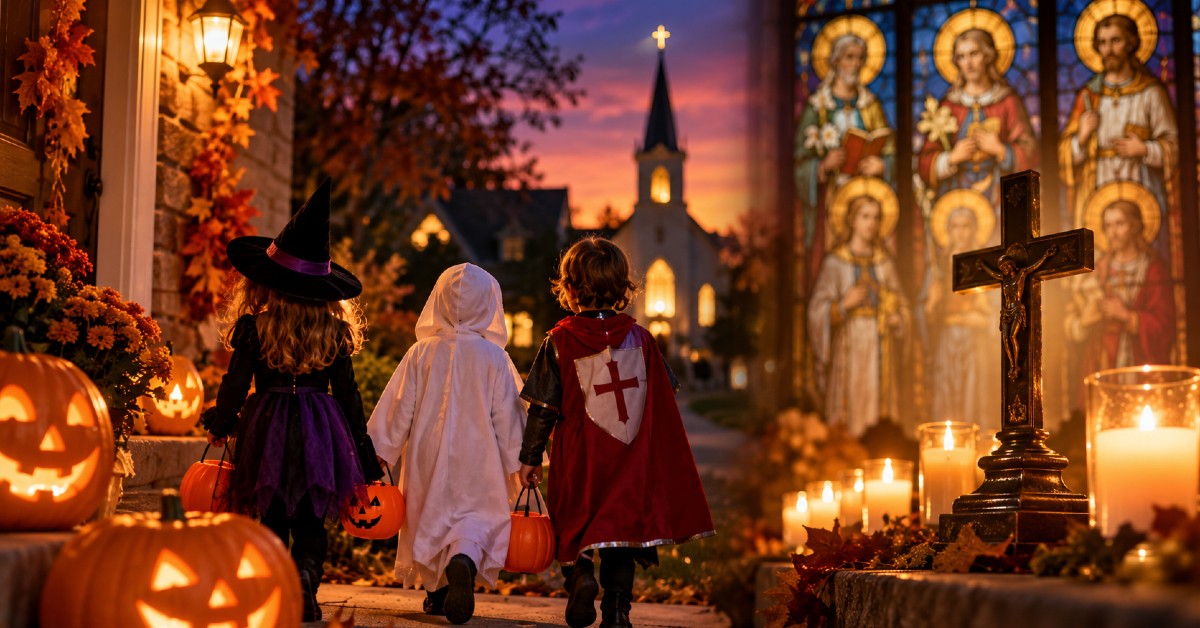
Every October, Catholic families face a familiar question: Is Halloween harmless fun, or does celebrating it conflict with the Catholic faith? With costumes, candy, haunted houses, and frightening decorations everywhere, the answer may not be as simple as some people think.
For many families, Halloween means dressing up, carving pumpkins, and taking children trick-or-treating. For others, the holiday raises serious concerns about its association with witches, ghosts, demons, and the occult.
But what does the Catholic Church actually teach about Halloween? And can Catholics participate in the festivities without compromising their faith?
The answer begins with understanding the holiday’s Christian connections and the importance of making thoughtful choices.
Halloween Has a Connection to Catholic History
Despite its modern reputation, Halloween has a significant connection to the Catholic calendar.
The word “Halloween” comes from “All Hallows’ Eve,” the evening before All Saints’ Day, celebrated on November 1. The word “hallow” is an older English term for someone or something holy, and historically, it was used to refer to the saints.
All Saints’ Day is one of the great celebrations of the Catholic Church, honoring all those who have entered heaven, including the countless saints whose names are known only to God.
The following day, November 2, Catholics observe All Souls’ Day, when the Church prays especially for the faithful departed who are undergoing purification.
Together, these observances invite Catholics to reflect on holiness, death, eternal life, and the hope of salvation through Jesus Christ.
Halloween’s history is complex, with customs influenced by Christian observances, European folk traditions, and later secular celebrations. Although some traditions have been linked to the ancient Celtic festival of Samhain, historians debate the precise origins of individual Halloween customs.
Nevertheless, Halloween’s place immediately before All Saints’ Day offers Catholics an opportunity to remember the deeper spiritual realities that the Church celebrates at this time of year.
Does the Catholic Church Forbid Halloween?
One of the biggest misconceptions about Halloween is that the Catholic Church officially prohibits its celebration.
The Church has no universal rule forbidding Catholics from dressing in costumes, carving pumpkins, attending Halloween parties, or taking children trick-or-treating.
These activities are not inherently sinful.
However, the Church does teach that Catholics must avoid practices that contradict their faith, particularly those involving the occult, attempts to communicate with the dead, or the invocation of spiritual powers apart from God.
The Catechism of the Catholic Church, paragraph 2116, explicitly rejects divination, including attempts to summon the dead or uncover hidden knowledge through supernatural means.
Paragraph 2117 likewise condemns magic and sorcery when they involve attempts to manipulate occult powers.
This distinction matters.
A child dressing as a superhero, a princess, or even a friendly ghost is not necessarily participating in anything spiritually dangerous. But engaging in séances, attempting to summon spirits, or treating occult rituals as entertainment crosses a very different line.
The Church calls Catholics to exercise discernment rather than assume that every Halloween tradition is either automatically harmless or automatically sinful.
What About Witches, Demons, and Scary Costumes?
Halloween’s darker imagery is often the greatest source of concern for Catholic parents.
Skeletons, monsters, witches, and frightening decorations have become common symbols of the holiday. Some are intended simply as playful fantasy, while others deliberately glorify evil, violence, or occult practices.
For Catholics, the question is not merely whether something looks frightening. It is whether participating in it encourages attitudes or behaviors that conflict with Christian faith and morality.
The Church recognizes the reality of evil and the existence of demons. At the same time, Catholics believe that Jesus Christ has conquered sin and death through His Passion and Resurrection.
Christians therefore have no reason to glorify evil or treat spiritual darkness as something worthy of admiration.
Parents may reasonably choose to avoid costumes that celebrate demonic imagery, mock sacred things, or present cruelty and violence as entertainment.
But there is also an important distinction between fictional storytelling and genuine occult involvement.
Not every scary costume, ghost story, or plastic skeleton represents a rejection of Catholic teaching.
Catholic families can evaluate these traditions according to their children’s ages, their intentions, and the values they wish to reinforce.
Can Catholics Go Trick-or-Treating?
For most families, trick-or-treating is simply a neighborhood activity in which children wear costumes, visit homes, and collect candy.
There is nothing inherently contrary to Catholic teaching about participating in this tradition.
In fact, Halloween can provide an opportunity for families to build friendships, spend time together, and strengthen relationships within their communities.
Catholic parents might choose costumes that are imaginative, joyful, or inspired by positive role models.
Some families even encourage children to dress as their favorite saints, introducing them to the extraordinary men and women who dedicated their lives to Christ.
A child dressed as St. Francis of Assisi, St. Joan of Arc, or St. Michael the Archangel can turn an ordinary costume into an opportunity to share the Catholic faith.
Others may prefer traditional costumes that have no religious significance at all.
Neither approach is required by the Church.
What matters is that families participate in ways that respect their beliefs and avoid activities that genuinely contradict them.
Why Some Catholic Families Choose Not to Celebrate
Although Halloween is not forbidden, some Catholics choose to avoid it entirely.
Their concerns may involve the commercialization of frightening imagery, the normalization of occult symbolism, or the increasingly graphic and violent nature of certain Halloween attractions.
Others simply believe that the holiday’s modern emphasis distracts from the Christian significance of All Saints’ Day and All Souls’ Day.
These concerns deserve respect.
Catholic parents have a responsibility to guide their children in faith and morality, and different families may reach different conclusions about which activities are appropriate.
Some parishes and Catholic schools offer All Saints’ parties, saint-themed costume celebrations, prayer gatherings, or family events as alternatives to conventional Halloween festivities.
Such celebrations can help children experience the joy of their faith while learning about the saints.
However, Catholics should also avoid judging other families simply because they make different decisions about ordinary Halloween activities.
A family that allows its children to collect candy is not necessarily compromising its faith, just as a family that declines to participate is not necessarily acting out of fear.
Charity and respect should guide these conversations.
Halloween Can Be an Opportunity to Teach Children About Heaven
Perhaps the greatest opportunity Halloween presents to Catholic families is the chance to discuss what the Church teaches about life, death, and eternity.
Modern culture often treats death as something frightening, mysterious, or entertaining.
The Catholic faith offers a profoundly different perspective.
Christians believe that death does not have the final word.
Through His Resurrection, Jesus Christ opened the way to eternal life, and the saints remind us that holiness is possible for ordinary people who respond to God’s grace.
All Saints’ Day celebrates the victory of God’s grace in the lives of those who now share in heavenly glory.
All Souls’ Day reminds Catholics of their responsibility to pray for those who have died.
These celebrations provide meaningful opportunities for families to talk about heaven, the communion of saints, prayer for the dead, and the promise of the Resurrection.
Parents can make these teachings part of their Halloween traditions by praying together, reading about a favorite saint, attending Mass on All Saints’ Day, or remembering deceased loved ones.
In this way, the days surrounding Halloween can become more than a season of costumes and candy. They can become an opportunity to strengthen faith and deepen family traditions.
So, Should Catholics Celebrate Halloween?
The Catholic Church does not require families to celebrate Halloween, nor does it universally forbid them from doing so.
The decision belongs to individual families, guided by Catholic teaching, informed conscience, and responsible parental judgment.
Catholics are free to enjoy innocent traditions such as costumes, pumpkin carving, and trick-or-treating. They are also called to reject genuine occult practices and anything that deliberately glorifies evil or undermines their faith.
Ultimately, the most important question is not whether a Catholic family celebrates Halloween, but how that family chooses to celebrate.
Halloween does not have to become a celebration of darkness. For Catholics, it can instead become an occasion to remember the light of Christ, the witness of the saints, and the promise of eternal life.
And as October 31 gives way to November 1, the Church reminds the faithful of a truth far greater than anything Halloween can offer: holiness is real, heaven is our hope, and Jesus Christ has already conquered death.
Catholic References
- Catechism of the Catholic Church, paragraphs 2115–2117 — Divination, magic, and occult practices.
- Catechism of the Catholic Church, paragraphs 946–962 — The Communion of Saints.
- Catechism of the Catholic Church, paragraphs 988–1019 — The Resurrection of the Body and Christian hope.
- The Catholic liturgical calendar — All Saints’ Day, November 1, and the Commemoration of All the Faithful Departed, November 2.
Your support brings the truth to the world.
Catholic Online News exists because of donors like you. We are 100% funded by people who believe the world deserves real, uncensored news rooted in faith and truth — not corporate agendas. Your gift ensures millions can continue to access the news they can trust — stories that defend life, faith, family, and freedom.
When truth is silenced, your support speaks louder.