
France is confronting a widening wave of unrest as student demonstrations, public-sector strikes and increasingly violent clashes with police converge with a broader economic and political crisis.
Hundreds of thousands of demonstrators took to the streets Tuesday, while schools and universities across the country faced blockades and disruptions. The turmoil, which began with student anger over conditions in French schools, has expanded into a national confrontation over government spending, public services and the future of the country’s extensive social welfare system.
According to The New York Times, thousands of students have blockaded schools to protest deteriorating facilities, overcrowding and teacher shortages. Teachers and other public employees are also protesting proposed wage freezes as the French government struggles to pass a budget and control its mounting debt.
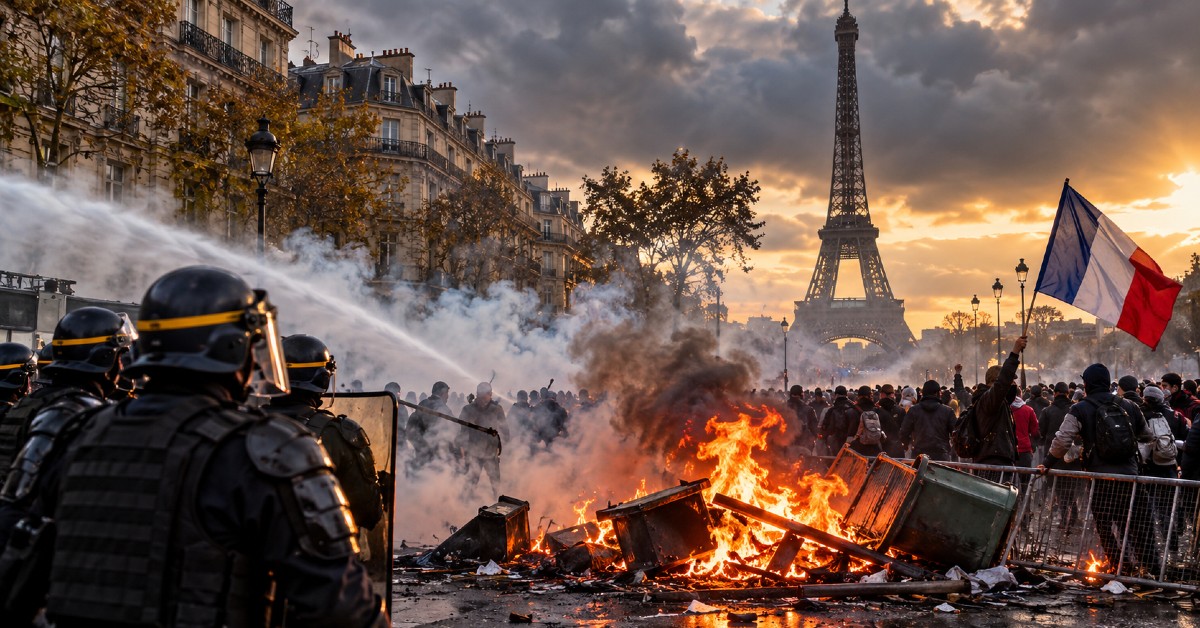
The protests have increasingly been accompanied by serious violence.
The U.S. Sun reported that approximately 450,000 people participated in demonstrations Tuesday, citing organizers, including about 100,000 in Paris. Police have used tear gas and water cannons as fires, barricades and clashes have spread through several cities.
Among the most troubling incidents, a one-year-old child was taken to a hospital after allegedly being struck by a firework outside a barricaded school in Saint-Cyr-l’École near Paris, according to The U.S. Sun. A high school student was arrested in connection with the incident.
The outlet also reported that a student suffered devastating injuries Monday when an explosive blew off his hand. At another Paris school, approximately 100 students had to be rescued after a fire was set at the entrance while teachers and students were inside.
The violence has prompted growing concern even among officials in communities at the center of the demonstrations.
“The urgent need today is for de-escalation,” Saint-Denis Mayor Bally Bagayoko told French radio network RTL, according to The U.S. Sun.
Yet the unrest is unfolding against problems extending far beyond the schools.
According to The New York Times, France carries approximately $4 trillion in public debt, equivalent to about 119 percent of the country’s annual economic output. Rising government bond yields are making that debt increasingly expensive to service, with annual debt costs projected to reach roughly $100 billion in 2027.
France must simultaneously contend with growing pension and health care expenses from an aging population, higher military expenditures and elevated energy prices.
Prime Minister Sébastien Lecornu’s government has proposed tax increases alongside freezes in spending on programs including housing assistance and family allowances, according to The New York Times. Those proposals have intensified a political struggle over how France can preserve generous public services while bringing its finances under control.
Harvard economist Kenneth Rogoff told The New York Times that financial markets are signaling concern, even if France has not yet entered a full-scale debt crisis.
“France’s position looks unsustainable and the bond markets are saying that, but they’re not screaming it yet,” Rogoff said. “It’s a slow-motion train wreck.”
The political stakes are particularly high because France is approaching a presidential election next spring. President Emmanuel Macron is nearing the end of his time in office, while Marine Le Pen and her National Rally party have emerged as a major force in French politics.
Jean-Yves Camus of the Jean Jaurès Foundation described the atmosphere to The New York Times using the French expression “fin de règne,” or the end of a reign.
“The regime is at the end of its term and does not seem to have a plan for the next seven months,” Camus said.
For Catholics, the scenes emerging from France carry a particular human dimension beyond arguments over budgets, elections and political parties. Violence involving young people, attacks on schools, injuries to police and protesters, and an incident involving an infant demonstrate how rapidly legitimate social grievances can become overshadowed by actions that endanger innocent human life.
Catholic social teaching recognizes both the responsibility of government to pursue the common good and the right of citizens to participate in public life and raise concerns about injustice. At the same time, human dignity cannot be separated from the means used to pursue political or economic change. Violence against innocent people cannot become an acceptable instrument of protest.
France’s crisis therefore presents a challenge deeper than balancing a national budget. The country must confront how to protect vulnerable families, educate its young people and maintain social solidarity while acknowledging economic realities that increasingly limit what the government can afford.
Michel de Rosen, a French businessman and author, told The New York Times that this conflict lies at the heart of the anger now gripping the country.
“We’re a country that can no longer do what it wants to do,” he said.
As demonstrations continue and France moves toward a consequential presidential election, restoring peace will require more than controlling crowds or passing a budget. It will require political leaders, citizens and institutions to seek solutions that recognize fiscal responsibility while protecting human dignity, solidarity and the common good.
Your support brings the truth to the world.
Catholic Online News exists because of donors like you. We are 100% funded by people who believe the world deserves real, uncensored news rooted in faith and truth — not corporate agendas. Your gift ensures millions can continue to access the news they can trust — stories that defend life, faith, family, and freedom.
When truth is silenced, your support speaks louder.