
A remarkable discovery in southwestern China is giving scientists an unusually detailed look at Denisovans, an extinct group of ancient humans whose existence was once known almost entirely through genetic evidence.
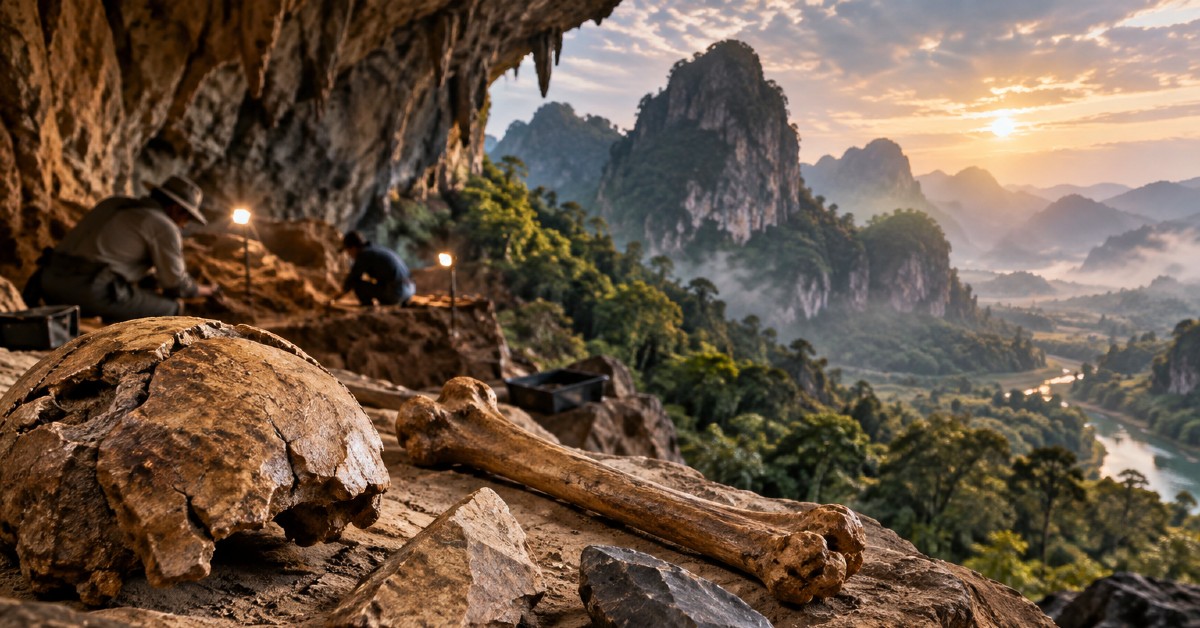
Researchers working at Bianfu Cave in Yunnan Province uncovered three Denisovan bones, four teeth and more than 1,360 stone tools alongside tens of thousands of animal bone fragments. According to National Geographic, the findings are described in two newly published studies in the journal Nature and provide some of the clearest evidence yet connecting Denisovan remains with the tools they made and used.
For Catholics, discoveries involving ancient human populations can raise fascinating questions about human origins. The Catholic faith does not require Christians to reject scientific investigation into humanity’s biological past. Rather, the Church teaches that scientific study of human origins can be pursued while maintaining the essential truth that every human person ultimately owes his or her existence to God and possesses a spiritual soul created by God.
The new discoveries are especially significant because Denisovans have remained mysterious since scientists first identified them through DNA obtained from a small finger bone discovered in Siberia.
“We have many sites, but we often don’t know who is the maker of these tools,” archaeologist Hao Li of the Institute of Tibetan Plateau Research in Beijing told National Geographic.
At Bianfu Cave, researchers were able to make a much stronger association between Denisovan remains and artifacts. The tools include scrapers, choppers and hammerstones, providing researchers with evidence of how these ancient humans performed everyday tasks.
Evolutionary geneticist Svante Pääbo, whose laboratory sequenced the first Denisovan DNA in 2010 but who was not involved with the new research, praised the discovery.
“It is wonderful that we are finally getting some direct insights into how they lived,” Pääbo told National Geographic.
Researchers were unable to recover DNA from the newly discovered bones. Instead, according to National Geographic, scientists examined collagen proteins preserved in the remains. Differences in the amino acid composition of these proteins allowed the research teams to identify the fossils as Denisovan.
Pääbo acknowledged the limitations of the available evidence while expressing confidence in the conclusion.
“It is the best that can be done and I am quite convinced that these are Denisovan remains,” he said, according to National Geographic.
The bones have been dated to approximately 167,000 to 134,000 years ago, while the stone tools found at the cave span a much longer period, from approximately 190,000 to 70,000 years ago.
The discovery itself came under extraordinary circumstances. Geochronologist Qingfeng Shao said the fossils were uncovered during work connected with restoring vegetation at a former limestone quarry.
“Most of the cave had already been destroyed,” Shao told National Geographic.
Among the most intriguing remains are skull fragments considerably thicker than those of modern humans. Researchers also recovered part of a radius, the forearm bone running along the thumb side of the arm. Its anatomy suggests that Denisovans may have been capable of producing greater force than modern humans when rotating the forearm into a palm-up position, according to National Geographic.
The stone artifacts offer another window into Denisovan life. Researchers found that many tools appear to have been produced relatively simply. In some cases, Denisovans apparently struck sharp flakes from stones, used them and discarded them rather than extensively shaping them into standardized forms.
Animal remains found at the cave include deer and buffalo, indicating that Denisovans lived amid substantial animal resources in the region during periods that included Ice Age conditions.
The discovery also expands scientists’ understanding of where Denisovans lived. Their earliest known remains came from Siberia, but evidence has increasingly indicated that Denisovan populations occupied a much broader portion of Asia.
Their biological legacy also survives.
Many people living today carry Denisovan ancestry because ancient Denisovans interbred with ancestors of modern human populations. According to National Geographic, Denisovan genetic heritage can be found among populations including Tibetans and Indigenous peoples of the Philippines, Papua New Guinea and Australia, as well as in other populations around the world.
The Bianfu Cave discoveries therefore offer more than another collection of ancient fossils. They provide a rare glimpse into the physical characteristics, technology, environment and daily activities of a population whose genetic legacy remains present in living people.
Ancient protein expert Frido Welker of the University of Copenhagen, who was not involved in the new studies, told National Geographic that the discovery could significantly advance Denisovan research.
“I think this is incredibly important for furthering our understanding beyond their genetic impact on modern human genomes,” Welker said.
For Catholics, continuing discoveries about humanity’s distant biological history need not diminish the uniqueness or dignity of the human person. Science can investigate ancient bones, genetics, tools and populations across immense stretches of time. Faith addresses the deeper truth of the human person: that humanity’s existence ultimately comes from God and that the spiritual dimension of man cannot be reduced to fossils or DNA.
As scientists continue piecing together the Denisovan story, Bianfu Cave may prove to be one of the most important sites yet discovered for understanding the ancient populations whose history eventually became intertwined with our own.
Your support brings the truth to the world.
Catholic Online News exists because of donors like you. We are 100% funded by people who believe the world deserves real, uncensored news rooted in faith and truth — not corporate agendas. Your gift ensures millions can continue to access the news they can trust — stories that defend life, faith, family, and freedom.
When truth is silenced, your support speaks louder.