
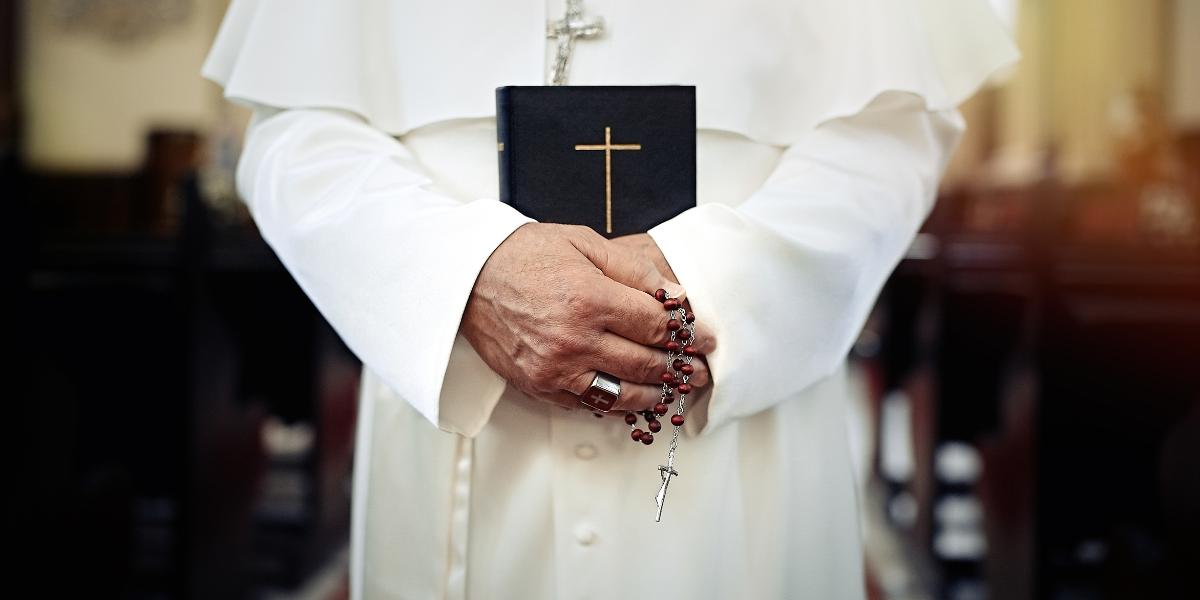
Cardinal Raymond Burke is reminding Catholics that respect for the pope does not mean every statement made by a pontiff carries the same doctrinal authority — while strongly warning the faithful never to lose reverence for the papal office established by Christ.
The Wisconsin-born cardinal addressed the subject in the opening installment of a new video series exploring Rome’s Seven Pilgrim Churches. According to LifeSiteNews, the series was produced by the Shrine of Our Lady of Guadalupe in La Crosse, Wisconsin, and features Cardinal Burke alongside Father Chad Ripperger and Sean Pilcher, with narration by David Bates of “Pints with Jack.”
The first episode centers on St. Peter’s Basilica, the church built over the tomb of St. Peter, providing the setting for a discussion about the papacy, the humanity of individual popes, and the enduring authority of the office entrusted to Peter.
“There’s been a fair amount of contention around the certain statements and certain actions of the pope, of the Roman pontiff,” Burke said, according to LifeSiteNews.
The cardinal acknowledged that Catholics can sometimes become confused when they disagree with something a pope has said or done. He stressed that Catholics must distinguish between a pope speaking personally and the pope exercising his teaching office.
“And sometimes the pope speaks as a man. And sometimes he speaks as the vicar of Christ on earth,” Burke said. “And if the pope makes a spontaneous remark to some reporter or something, this is not the doctrine of the faith. And one could legitimately object to something that the pope said.”
That distinction is consistent with the Church’s understanding that not every papal statement is an exercise of papal infallibility. The Second Vatican Council teaches in Lumen Gentium that the faithful must consider such factors as the pope’s manner of speaking, the character of the document, and the frequency with which a particular doctrine is proposed when discerning the authority of his teaching.
Burke noted that historically popes often exercised considerable restraint when speaking publicly because of the possibility that their personal views could be confused with authoritative Church teaching.
“In the past, popes were very hesitant to speak,” Burke said. “They spoke very little because they didn’t want the faithful to be in any way confused with regard to what might be their own personal ideas and opinions and what they, as head of the Apostolic College, would proclaim.”
According to LifeSiteNews, Burke emphasized that Catholics may recognize and respectfully object when a particular papal statement or action appears problematic, noting that difficulties involving individual popes are not unprecedented in Church history.
At the same time, Burke drew a firm line between disagreement with a particular statement and disrespect for the papacy itself.
“We must never, ever lose respect for the office of St. Peter, the office conferred by Christ himself,” Burke said. “Christ willed this. It’s divinely willed for the life of the Church that there be St. Peter as that firm, principal foundation of the unity of the Church.”
The cardinal further emphasized that the papal office does not depend upon the personal holiness or effectiveness of an individual pontiff.
“Even if there were popes who did not fulfill their ministry in a worthy way,” Burke said, “nevertheless, the office of the Vicar of Christ on Earth stands and will always stand in the Catholic Church.”
The episode also turns to the life of St. Peter himself as an illustration of how God works through human weakness. Bates reflects on Peter’s denial of Christ and his later reconciliation with the risen Lord, connecting that history with the Apostle’s tomb beneath St. Peter’s Basilica.
“Peter’s yes became the foundation of the Church,” Bates said. “The pilgrim who kneels here kneels at the place where frailty and faith meet, where God builds his Church from broken stones.”
For Catholics navigating debates over papal statements today, Burke’s message ultimately points beyond individual controversies. Catholics may distinguish between personal remarks and authoritative teaching, but the office of Peter remains something greater than the man who temporarily occupies it — a visible foundation of unity that Catholics believe was established by Christ for His Church.
Your support brings the truth to the world.
Catholic Online News exists because of donors like you. We are 100% funded by people who believe the world deserves real, uncensored news rooted in faith and truth — not corporate agendas. Your gift ensures millions can continue to access the news they can trust — stories that defend life, faith, family, and freedom.
When truth is silenced, your support speaks louder.


Exactly
Remember it is not a sin to have opinions and principles that dont align with the popes opinions and principles.