

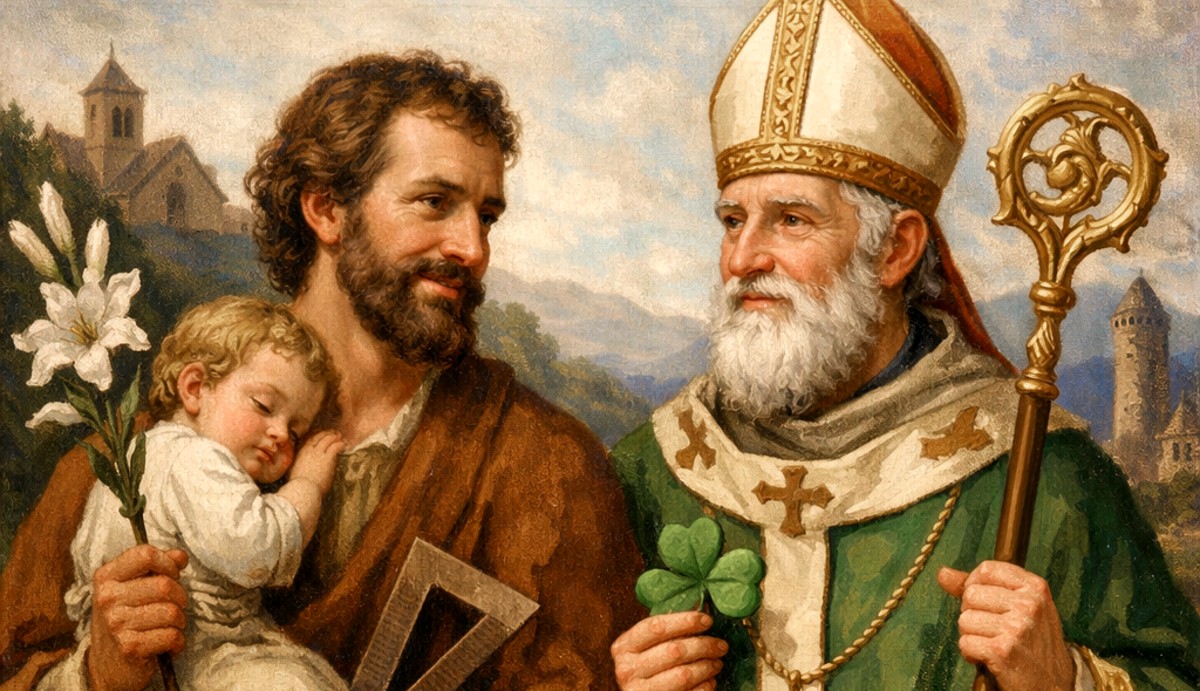
As I look out my window, I see rain turn to snow, while yesterday it reached 80 degrees and my four-mile walk seemed like a dry desert with crocus heads peeking out light color. I think of Saint Patrick in his Confession “before daybreak, was roused to prayer in, snow, in frost, in rain,” from Antrim’s forest or mountain, with a change of climate notable in the Emerald Isle. By contrast, I see Saint Joseph guiding Mary, first to Bethlehem, next to Egypt and finally back to Galilee, all in torrid and thirsty terrain.
Climate change or not, both scenes depict men of great valor, venture and vincible character.
Mid-March “blossoms” with Patrick and Joseph in the Catholic Church liturgical calendar (March 17 and 19, respectively) responding to the divine Gift of the Annunciation, the coming of Christ to us, liturgically celebrated a week later. All three remembrances celebrate the honor and dignity to women with a counter-cultural twist from pagan demeaning of others.
First the new greening, anticipating Spring.
In Patrick’s authentic Latin Confessio he speaks more about the divine inspiration that led him to escape from his captivity as a shepherd slave in Ireland to Gaul (north of France) and back to western Britain. Soon afterwards he took on a “night vision” from a certain Victoricus, who presented Patrick a letter from “the Voice of the Irish” in turn begging him “to come and walk once more with us” (Confessio, 23).
He was “broken in heart” and would be roused with a new determined mission: Return to Ireland. Consecrated bishop by Germanus of Auxerre specifically for that mission, Patrick, now shepherd of a new flock, in 432 returned to a land, he describes, “where they never had the knowledge of God but until now only worshipped idols and abominations – now there has lately been prepared a people of the Lord, and they are called children of God.” In his Confessio he singles out with praise young women who received inspiration to remain virgins and consecrate themselves to God, contrary to the parent’s wishes and even clan reproaches.
Still, Patrick’s valor against the tide of mistreatment of women is advanced especially in his “Letter to Coroticus,” likely a raider who kidnapped “baptized women” as well as men. Patrick urges Christians not to associate with or aid Coroticus’ men until they repent, do penance and stop “dividing out defenseless baptized women as prizes for worldly gain.” So he cries out:
You hand over the members of Christ as it were to a brothel.[Nota] What hope have you in God? Who approves of what you do, or who ever speaks words of praise? God will be the judge, for it is written: ‘Not only the doers of evil, but also those who go along with it, are to be condemned’ (14)
The Catholic Father of Ireland abhorred slavery and degrading the dignity of women, especially recognizing that all are called to be God’s children with what the Church would call later an “indelible mark.” His inspiration and valor were divine.
Two days later comes Saint Joseph’s solemnity, the model of what men should be, also divinely inspired and “visited.” Four hundred years before Patrick, God’s grace favored him to take Mary as his bride, to complete the betrothal, despite a logical unsettling of mind relative to her pregnancy, and to assure him amidst the “unknown,” in journey and adherence to God’s Plan. It was not any “unfaithfulness” that stirred his mind about Our Blessed Lady, but rather mystery – human and supernatural. His soul prompted a protective solution, not according to the prevaling and enforceable Law neighbors expected. God blessed his predisposition by verifying and revealing the Incarnation to him. A Child is born, a Son is given.
Joseph now moves into another realm with Mary Immaculate, to whom Joseph silently and surely offers greatest homage – and protection and provision. In the backdrop of Herod’s horrific slaughter of the innocents, the dream angel (Matthew 2:13-18) intensifies Joseph’s surrender to the Will of God by flight from the Promised Land, ironically to the land of captivity commemorated each Passover – Egypt! And in doing so he becomes the “savior of the Savior.” Tipped off again in a dream, he leads Mary and Jesus years later to Nazareth, safe from Herod’s wrath. Obedience to God, virile valor, protection and provision – life-bearing entities.
On March 25 we will celebrate the Annunciation of the greatest of human events – the Incarnation – God is with us! Setting into meaningful disposition and action in the heart of Joseph and much later, Patrick, the response to human life and divine call to protect and provide. Every child that is conceived is a reflection of that Infinite Gift that Jesus is. The work of God to bring into being another human life is forever sacred.
And yet current culture soundings indicate “scared” more than “sacred” arises in the mind of many youth today. Scared of the responsibility of fathering or mothering a child rather than a pup or car. There is a growing disdain for one’s offspring, as the prism of the saving Incarnation is displaced by the focus of self-satisfaction here and now. Contraception and free sex become the programmed antidotes to the “scare” or the “inconvenient bother.” When that fails, abortion, and now conveniently by chemical means, promoting more control with do-it-yourself aloneness. Where is the man, the father, in all of this? More than not he is non-protector, non-provider and reflects Herod rather than Patrick or Joseph in dealing with supposed crisis or concocted “threat.”
Our culture paints a picture of a spiritually challenged society, especially in the need to stand up and pivot for protection, provision, and responsibly cherishing all life, from conception to natural death. But let us reflect on the men, Joseph and Patrick, who against the prevailing winds of their day first adhered lovingly to the Will of God and His plan, and then modeled by action the resourceful ingredients to promote Life and the rescue of mothers from terror, slavery or death – which the “health care” and “women’s rights” deception abortion really renders.
And let us thank God for the courage of young men and women who radiate their love of God in their protection of others and their thankfulness to their parents who bore and raised them in love.
Fr. Denis Wilde, OSA, Ph.D., is a full-time pastoral associate for Priests for Life. A concert pianist, he was formerly an associate professor of music at Villanova University.
Your support brings the truth to the world.
Catholic Online News exists because of donors like you. We are 100% funded by people who believe the world deserves real, uncensored news rooted in faith and truth — not corporate agendas. Your gift ensures millions can continue to access the news they can trust — stories that defend life, faith, family, and freedom.
When truth is silenced, your support speaks louder.

Thank you Father Denis for this insightful article on these two of our most beloved Saints! God bless you and looking forward to reading more from you!
The line from Patrick’s Letter to Coroticus – “You hand over the members of Christ as it were to a brothel” – really stands out. It’s striking how he explicitly connects the trafficking of baptized women to an offense against Christ himself. Given the pagan norms of his time, that was a remarkably counter-cultural defense of women’s dignity. Do you think this aspect of Patrick’s social teaching gets enough attention today?