
Pope Leo XIV delivered a powerful message about human dignity, economic justice, and the responsibility of political leaders during his historic visit to Argentina, urging the nation’s leaders to remember that the well-being of ordinary people must come before economic interests.
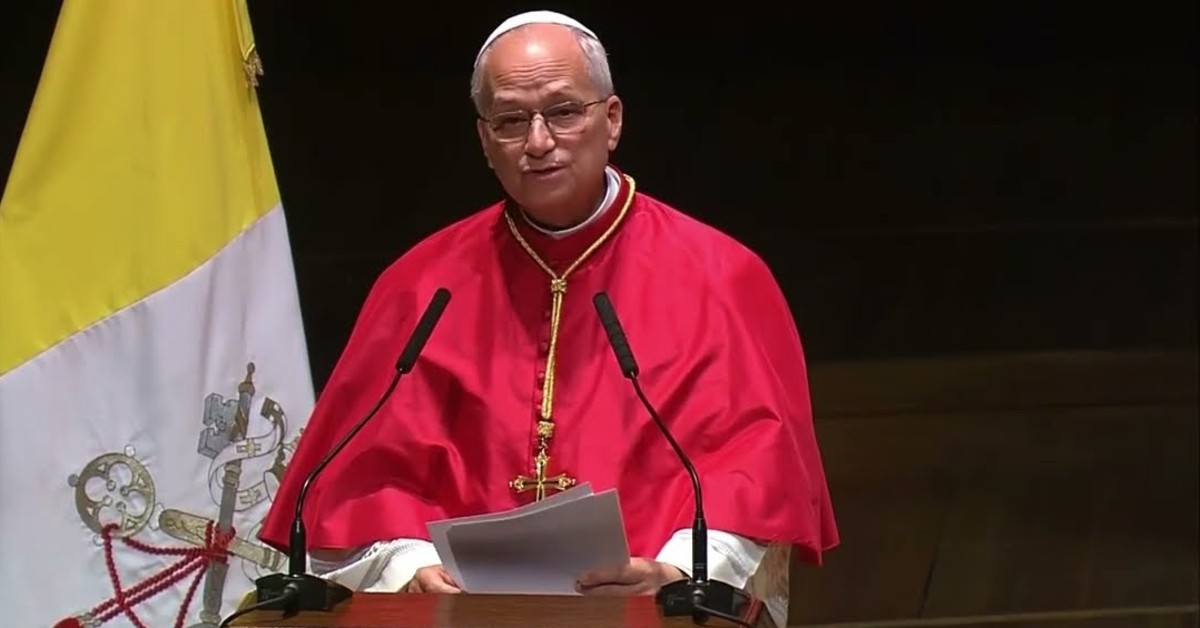
Speaking Sunday at the Palacio Libertad in Buenos Aires, the Holy Father addressed politicians and diplomats in a country deeply divided over economic reforms, government spending, and the treatment of its most vulnerable citizens.
According to The Washington Post, the Pope’s remarks drew enthusiastic applause from political opponents of Argentine President Javier Milei, whose administration has implemented sweeping reductions in government spending and social assistance programs.
At the center of the Pope’s message was a fundamental principle of Catholic social teaching.
“An economy must be at the service of the person, not the person at the service of the economy,” Pope Leo declared.
The statement received one of the strongest rounds of applause during his address, according to The Washington Post, reflecting the significance of his words in a nation struggling with difficult economic and political questions.
Although Pope Leo did not directly criticize Milei or his administration, his remarks came amid growing controversy over government policies affecting retirees, people with disabilities, and struggling families.
Milei has pursued aggressive spending reductions, including vetoing increases in pension payments and disability benefits.
The Holy Father drew attention to the people who often bear the greatest burden during periods of economic uncertainty.
“I think of families facing an uncertain future, the unemployed, the elderly who for years contributed to society, and all those who, despite hard work, nonetheless struggle to meet their household’s needs,” Pope Leo said.
His message reflected the Church’s longstanding teaching that economic policies must respect the dignity of every human person, particularly those who are poor, elderly, disabled, or otherwise vulnerable.
A Papal Visit Carrying the Legacy of Pope Francis
Pope Leo’s arrival in Argentina carried special significance for the country’s Catholic population.
Argentina was the homeland of Pope Francis, who never returned to his native country after his election to the papacy.
According to The Washington Post, Francis had frequently suggested that Argentina’s deeply divisive political environment contributed to his decision not to return.
His relationship with President Milei had been particularly contentious. Before becoming president, Milei publicly insulted Francis, calling him an “imbecile” and a “lefty,” among other accusations.
Yet the atmosphere surrounding Pope Leo’s visit appeared notably different.
Milei welcomed the Holy Father and described the occasion as “truly overwhelming,” according to The Washington Post. He also acknowledged the legacy of Pope Francis while greeting his successor.
During his remarks, Pope Leo spoke about the importance of responsible political discourse, emphasizing the need for the “careful use of words” in a democratic society.
He also reminded political leaders of their responsibility to confront historical wrongdoing.
“It is up to each generation to discern what deserves to be preserved, to confront past injustices,” the Pope said.
His words carried particular significance in Argentina, where debates continue over the country’s military dictatorship and the forced disappearances that occurred during the 1970s and 1980s.
Defending the Vulnerable Through Words and Actions
Beyond his public remarks, Pope Leo’s itinerary has attracted considerable attention because of his planned meetings with groups affected by Argentina’s economic and social policies.
According to The Washington Post, the Holy Father is scheduled to visit a center serving people with disabilities, meet with labor activists, and speak with prominent business leaders.
The visit to the disability center has been interpreted by some Argentine Church observers as a meaningful gesture amid government reductions in social benefits.
Diego Mauro, a Church historian at the Universidad Nacional de Rosario, told The Washington Post that the visit represents continuity between Pope Leo and his predecessor.
“It’s also a clear sign of continuity with Francis’s papacy, because it’s what he would have done, too,” Mauro said.
The Pope’s decision to meet with people from different sectors of Argentine society also reflects his emphasis on dialogue and the importance of recognizing the dignity of every individual, regardless of economic circumstances.
Following the papal address, Milei told Argentine television network LN+ that he supported the Pope’s calls for dialogue and cooperation, while disputing the way his political positions have been characterized.
“I think debates should be intellectually honest, and in Argentina they are not intellectually honest,” Milei said, according to The Washington Post.
Remembering the Faith of Pope Francis
For many Argentine Catholics, Pope Leo’s visit is more than a diplomatic occasion. It is also an opportunity to remember Pope Francis and the spiritual legacy he left behind.
Speaking to officials in Buenos Aires, Pope Leo acknowledged the connection between his journey and the life of his predecessor.
The Holy Father said he was “in some sense retracing” the steps of Francis, who had treasured the people, places, and faith of his homeland.
According to The Washington Post, large crowds have welcomed Pope Leo throughout his visit, with many Catholics recognizing similarities between his concern for the vulnerable and the priorities of Pope Francis.
Myrna Florentin, a volunteer organizer who helps feed impoverished residents of Buenos Aires, expressed that connection in an interview with the newspaper.
“We see Leo as Francis’s brother,” she said.
Florentin also emphasized the importance of the Church’s social teachings, which call Catholics to defend human dignity and care for those in need.
Pope Leo’s personal connection to Latin America has also resonated with the Argentine faithful.
Born in Chicago, the Holy Father spent years serving as a missionary and bishop in Peru, eventually becoming a Peruvian citizen. His familiarity with Latin American communities and fluent Spanish have helped strengthen his connection with Catholics throughout the region.
His current journey includes a planned return to Chiclayo, Peru, where he previously served as bishop before Pope Francis brought him to Rome in 2023.
A Message Beyond Political Divisions
Pope Leo’s visit comes during a demanding 12-day journey through South America, undertaken less than a month after surgery to remove a malignant nodule and part of his lung.
Despite his recent medical procedure, the 71-year-old pontiff has maintained a busy schedule of public appearances, meetings, and religious celebrations, according to The Washington Post.
While political observers have examined his remarks for criticism of Argentina’s government, the Holy Father has emphasized that his mission extends beyond political disagreements.
Asked before the trip whether his visit to Argentina would primarily focus on Pope Francis, Leo acknowledged the importance of his predecessor’s legacy but said the central purpose was to spread the Church’s message.
For Catholics, the Pope’s remarks in Buenos Aires offer a reminder that the Church’s concern for economic justice is rooted in its understanding of the human person.
Catholic social teaching holds that economic progress cannot be measured solely by financial indicators or government budgets. It must also consider whether families can provide for their children, whether workers can live with dignity, and whether society protects those who cannot easily provide for themselves.
Pope Leo’s message did not offer a specific political program or endorse a particular party. Instead, it challenged leaders to consider the human consequences of their decisions.
In a country marked by economic uncertainty and political division, the Holy Father’s appeal placed a central Catholic principle before the nation’s leaders: every person possesses an inherent dignity that must never be sacrificed in the pursuit of economic goals.
Your support brings the truth to the world.
Catholic Online News exists because of donors like you. We are 100% funded by people who believe the world deserves real, uncensored news rooted in faith and truth — not corporate agendas. Your gift ensures millions can continue to access the news they can trust — stories that defend life, faith, family, and freedom.
When truth is silenced, your support speaks louder.