
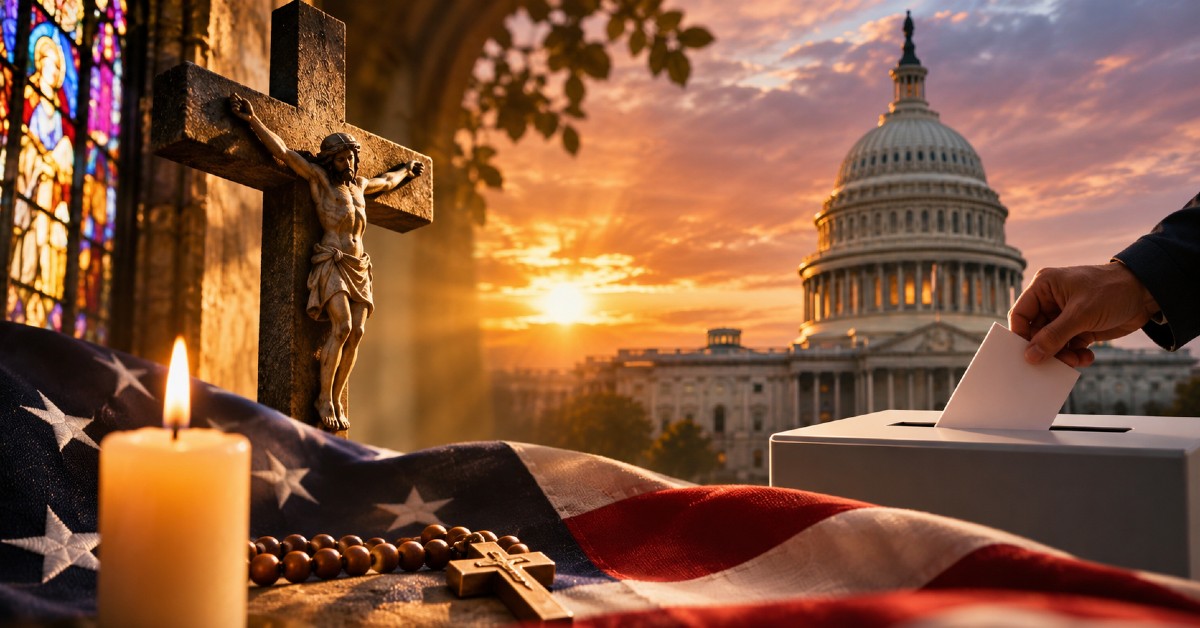
As Americans head to the polls in one of the most consequential political contests of the year, Catholics face an important question: How should faith guide their decisions in a deeply divided nation?
Americans are casting their ballots today, November 3, in the 2026 midterm elections, a nationwide political contest that will determine control of Congress, reshape state governments, and influence the direction of the United States during the final two years of President Donald Trump’s second term.
With political tensions running high, economic pressures affecting millions of families, and contentious debates surrounding abortion, immigration, religious freedom, and international conflicts, the stakes extend far beyond Washington.
For Catholics, Election Day also presents an opportunity to reflect on the relationship between faith and public life, the dignity of every human person, and the responsibility to participate in society with a properly formed conscience.
The Catholic Church does not endorse political parties or candidates. Instead, it calls the faithful to evaluate political questions through the principles of Catholic moral and social teaching.
As the nation votes, that responsibility is especially relevant.
Control of Congress Hangs in the Balance
All 435 seats in the U.S. House of Representatives and 35 seats in the U.S. Senate are being contested in this year’s elections. Voters in 36 states are also choosing governors, while numerous state and local races and ballot initiatives address issues that could affect American communities for years to come.
Republicans currently control both chambers of Congress, giving President Trump important legislative support for his administration’s priorities.
Democrats are seeking to regain control of one or both chambers, which could significantly change the administration’s ability to advance legislation and increase congressional scrutiny of executive policies.
Republicans, meanwhile, are campaigning to preserve their majorities and continue pursuing their agenda on taxation, immigration enforcement, economic policy, and national security.
Closely watched congressional contests stretch across states including Pennsylvania, New York, Maine, Michigan, Iowa, and Texas.
The outcome will help determine how the federal government addresses major national questions, including healthcare, federal spending, border security, and foreign policy.
Yet for Catholic voters, the significance of these elections cannot be measured solely by which political party gains power.
The Church teaches that political authority carries a responsibility to protect human dignity, uphold justice, and serve the common good.
Abortion and the Protection of Human Life
Among the most significant moral issues confronting Catholic voters is the continued national debate over abortion.
More than four years after the Supreme Court overturned Roe v. Wade, abortion policy remains a major issue in elections across the country.
This year, voters in several states are considering measures that could change abortion laws or constitutional protections.
Missouri voters are considering whether to repeal constitutional protections for abortion established in 2024, while measures in Idaho and Virginia address abortion rights and restrictions.
For the Catholic Church, the sanctity of human life remains a foundational moral principle.
The United States Conference of Catholic Bishops (USCCB) has consistently taught that human life must be protected from conception until natural death and that abortion constitutes a grave moral wrong.
The bishops have also emphasized the importance of supporting mothers, children, and families through healthcare, adoption assistance, economic opportunity, and social services.
Catholic teaching calls for a consistent commitment to human dignity, including care for the elderly, people with disabilities, the poor, and others who are vulnerable.
As voters consider candidates and ballot measures, the Church encourages Catholics to examine how public policies affect both the protection of human life and the conditions necessary for families to flourish.
Immigration, Border Security, and Human Dignity
Immigration remains another defining issue in the 2026 midterm elections.
The Trump administration’s immigration enforcement policies have generated intense debate over border security, deportations, detention practices, and the treatment of migrant families.
Supporters of stricter enforcement emphasize national sovereignty, public safety, and the government’s responsibility to uphold immigration laws.
Critics raise concerns about due process, family separation, detention conditions, and the treatment of people seeking refuge.
Catholic teaching recognizes both the right of nations to regulate their borders and the obligation to respect the inherent dignity of migrants and refugees.
The USCCB has called for immigration policies that uphold the rule of law while protecting families, ensuring humane treatment, and recognizing the needs of people fleeing violence or persecution.
For Catholics, the immigration debate raises questions about how a nation can balance lawful immigration enforcement with the Gospel’s call to welcome the stranger.
These questions do not always produce simple political answers, but they require serious moral consideration.
Economic Anxiety and the Struggles of American Families
Beyond the most divisive political issues, many Americans are approaching Election Day with concerns about the cost of everyday life.
Housing affordability, grocery prices, healthcare expenses, employment, and the broader economy have become central campaign issues.
For working families, these concerns are not abstract political arguments. They directly affect the ability to provide food, maintain stable housing, raise children, and plan for the future.
Catholic social teaching places particular emphasis on the dignity of work, just wages, the protection of families, and the needs of the poor.
The Church recognizes private property and economic freedom while also teaching that economic systems must serve human beings rather than treating people merely as instruments of profit.
As voters consider competing economic proposals, Catholic principles invite reflection on whether policies protect vulnerable people, promote meaningful work, support families, and contribute to the common good.
The Church’s concern for the poor does not belong exclusively to any political party. It is a fundamental part of the Christian responsibility to love one’s neighbor.
Religious Freedom and the Rights of Conscience
Religious liberty is another issue of particular importance to Catholic Americans.
Questions surrounding religious institutions, healthcare requirements, education, parental rights, and the ability of faith-based organizations to operate according to their beliefs continue to shape public policy debates.
The Catholic Church teaches that religious freedom is rooted in the dignity of the human person and includes the right to live according to one’s sincerely held religious convictions.
For Catholic schools, hospitals, charities, and other ministries, these questions can have practical consequences for how they serve their communities.
At the same time, debates about religious liberty often involve competing claims concerning civil rights, access to services, and the proper relationship between religious institutions and government.
Catholics are encouraged to understand these questions carefully, respecting the dignity and rights of others while remaining faithful to the Church’s moral teachings.
War, International Conflict, and the Call for Peace
The 2026 elections are also taking place against a backdrop of serious international tensions, including the ongoing conflict involving Iran and broader concerns about American foreign policy.
Questions about military involvement, national security, humanitarian suffering, and the use of government resources have become part of the national political conversation.
Catholic teaching insists that peace is more than the absence of conflict. It requires justice, respect for human rights, and recognition of the dignity of every person.
The Church’s moral tradition also establishes strict principles governing the use of military force and the protection of innocent civilians.
For Catholic voters, foreign policy decisions carry moral consequences that extend beyond America’s borders.
The suffering of families affected by war, displacement, hunger, and violence remains an urgent concern for the universal Church.
What the Catholic Church Teaches About Voting
In its guidance Forming Consciences for Faithful Citizenship, the USCCB explains that Catholics have a responsibility to bring their moral convictions into public life.
The bishops emphasize that political participation must be grounded in a well-formed conscience, careful consideration of moral principles, and a commitment to the common good.
Importantly, the Church does not instruct Catholics to vote for a particular party or candidate.
Nor does it teach that every political issue carries identical moral weight.
Some actions, including the intentional taking of innocent human life, are intrinsically evil and must always be opposed. Other political questions require careful judgments about how best to advance justice, protect human dignity, and promote the welfare of society.
Catholics are therefore called to consider the full moral implications of political choices rather than relying exclusively on party affiliation, campaign slogans, or individual personalities.
A properly formed conscience requires prayer, education, reflection, and an honest examination of the consequences of public policy.
Political loyalty must never replace fidelity to the Gospel.
A Nation Divided, but a Church Called to Unity
The political divisions facing the United States have become increasingly visible in families, workplaces, communities, and even parishes.
Disagreements over candidates and policies can strain relationships and create tension among people who otherwise share the same faith.
Yet the Church reminds Catholics that their identity as followers of Jesus Christ must remain greater than their political differences.
Catholics may reach different prudential judgments about candidates and public policies while sharing a commitment to the same fundamental moral teachings.
Political disagreement should never become an excuse for hatred, dishonesty, or contempt for others.
The Gospel calls Christians to speak truthfully, act justly, and recognize the dignity of those with whom they disagree.
Regardless of the election results, Catholics will continue to share the responsibility of serving their neighbors, defending the vulnerable, caring for families, and working for peace.
Beyond Election Day: The Responsibility of Faithful Citizenship
When the polls close and election results begin to emerge, much of the nation’s attention will turn toward political victories, defeats, and the balance of power in Washington.
For Catholics, however, the responsibilities of citizenship do not end when a ballot is cast.
Faithful citizenship includes praying for elected leaders, holding public officials accountable, participating in community life, defending human dignity, and serving those most in need.
It also means remembering that no political party, candidate, or government can fully embody the Kingdom of God.
The Church’s mission remains unchanged regardless of which political leaders hold office.
As Americans make their voices heard in the 2026 midterm elections, Catholics are invited to approach this moment not simply as Republicans, Democrats, or independents, but as people whose deepest allegiance is to Christ.
The results of today’s elections will help shape the nation’s political future.
But the Catholic responsibility to defend life, pursue justice, care for the vulnerable, and work for peace will endure long after Election Day.
For Catholics, the most important question is not simply who will govern the nation, but how each person can help build a society that reflects the dignity, justice, and love at the heart of the Gospel.
Your support brings the truth to the world.
Catholic Online News exists because of donors like you. We are 100% funded by people who believe the world deserves real, uncensored news rooted in faith and truth — not corporate agendas. Your gift ensures millions can continue to access the news they can trust — stories that defend life, faith, family, and freedom.
When truth is silenced, your support speaks louder.


