

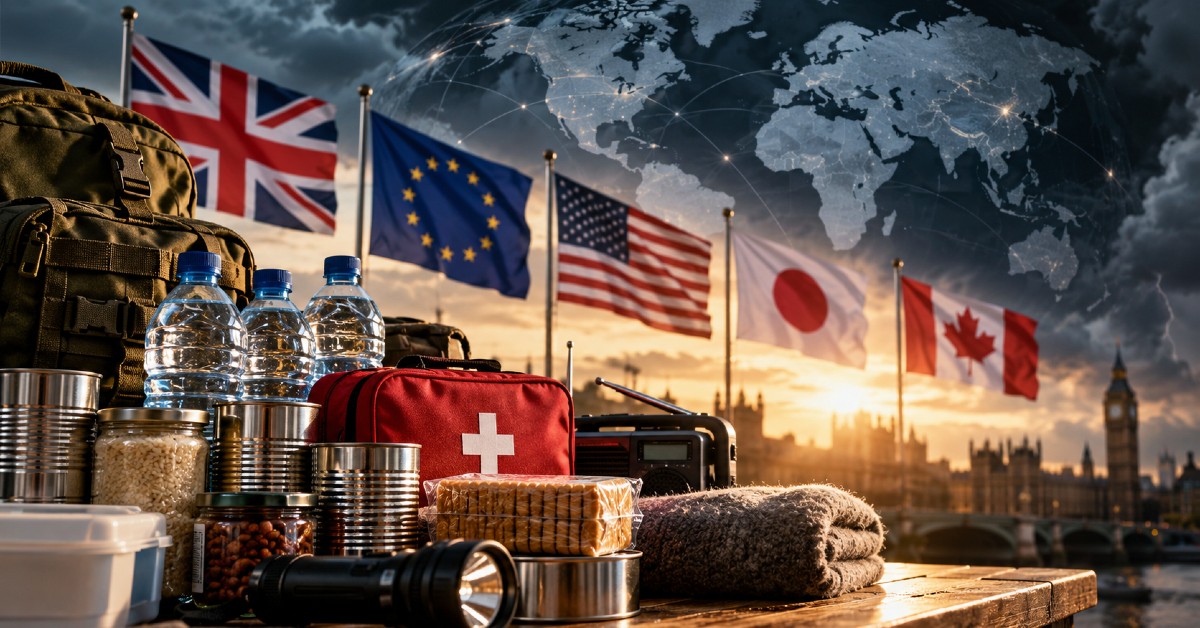
Governments across Europe, North America, and Asia are encouraging households to prepare for emergencies by keeping several days’ worth of food, drinking water, medication, and other essential supplies at home. The growing international emphasis on preparedness comes amid concerns about extreme weather, cyberattacks, geopolitical instability, and disruptions to critical infrastructure.
While the recommendations vary by country, many governments are urging citizens to become self-sufficient for at least 72 hours, with some advising households to prepare for a week or longer.
The widespread guidance has also raised questions about whether governments are responding to specific threats or simply strengthening public readiness for an increasingly unpredictable world.
According to LifeSiteNews, the emergency preparedness campaigns have attracted attention because several countries are promoting similar recommendations, despite differences in their national security concerns and disaster risks.
In the United Kingdom, the government has introduced its Be Ready campaign, encouraging households to prepare for at least three days without access to normal services.
The British government’s guidance explains that being prepared for three days can help families manage emergencies while assistance reaches those facing the greatest need.
Recommended supplies include bottled water, nonperishable food, flashlights, batteries, portable radios, medication, hygiene products, blankets, cash, and important documents.
The campaign also recommends storing approximately three liters of drinking water per person per day, with additional water needed for cooking and washing.
Officials emphasize that families do not need to purchase everything immediately. Instead, households are encouraged to gradually build their supplies during routine shopping trips and regularly check expiration dates.
Similar recommendations are being promoted across the European Union.
In March 2025, the European Commission introduced its Preparedness Union Strategy, an initiative designed to strengthen Europe’s ability to respond to emergencies ranging from natural disasters to military and cybersecurity threats.
According to the European Commission, the strategy seeks to develop guidelines that would enable citizens to remain self-sufficient for a minimum of 72 hours.
The Commission identified several challenges facing European countries, including geopolitical conflicts, cyber threats, climate change, and the increasing risk of natural disasters.
The strategy also calls for improved warning systems, public education, cooperation between civilian and military authorities, and stronger protection of essential resources such as water.
Rather than focusing on a single anticipated disaster, the European Union is promoting an approach that prepares governments and citizens for multiple potential emergencies. European Commission
Some European countries are recommending considerably longer periods of household preparedness.
Germany’s Federal Office of Civil Protection and Disaster Assistance advises residents to maintain enough food and drinking water to support themselves for up to ten days.
Its emergency guidance acknowledges that even a three-day supply can make a meaningful difference, encouraging families to begin with manageable preparations and gradually expand their reserves.
German authorities identify power failures, severe weather, flooding, and interruptions to food distribution as situations in which household supplies could become essential.
The country’s updated preparedness guidance also addresses misinformation, access to shelter, and mental health during emergencies.
Sweden has likewise placed significant emphasis on civilian preparedness.
According to guidance published by the Swedish Civil Contingencies Agency, households should be capable of managing for at least one week during a crisis or war.
Its recommendations include storing food, maintaining access to drinking water, keeping flashlights and batteries available, and preparing alternative ways to receive information when electricity or communications systems are unavailable.
Swedish authorities also encourage residents to know their neighbors and consider how they might assist one another during an emergency.
The agency’s guidance reflects the country’s broader efforts to strengthen civilian resilience in the face of both natural disasters and potential military threats.
In the United States, federal officials have long encouraged Americans to maintain emergency supplies through the Federal Emergency Management Agency’s Ready.gov initiative.
The agency recommends keeping at least three days’ worth of nonperishable food and one gallon of water per person per day for drinking and sanitation.
Other suggested items include a first-aid kit, flashlights, batteries, a battery-powered or hand-crank radio, and essential household supplies.
American emergency planning addresses a wide range of possible disruptions, including hurricanes, earthquakes, floods, prolonged power outages, and other disasters.
Unlike some of the newer international preparedness initiatives, the American guidance has been available for years, demonstrating that household emergency planning is not a new government recommendation. Ready.gov
Japan, Canada, Mexico, and the Netherlands have also encouraged residents to maintain emergency kits, according to reporting cited by LifeSiteNews.
Japan’s preparedness efforts are particularly influenced by the country’s vulnerability to earthquakes and other natural disasters. Japanese authorities have encouraged households to maintain enough supplies for several days, ideally extending their preparedness to one week.
According to the international reporting, Norway recommends approximately one week of emergency supplies, while Germany advises households to prepare for as many as ten days.
The differences reflect varying national circumstances, infrastructure concerns, and assessments of how long emergency services might need to restore normal conditions.
Despite the similarities among these recommendations, the publicly available government guidance does not establish that officials are warning of one specific, imminent global catastrophe.
Instead, the campaigns largely focus on strengthening the ability of households and communities to withstand temporary disruptions to food supplies, electricity, water, transportation, and communications.
For Catholic families, the growing attention to emergency preparedness also presents an opportunity to reflect on the Christian responsibility to care for others, particularly those who may be most vulnerable during a crisis.
The Church’s teaching on prudence encourages individuals to exercise sound judgment and take reasonable steps to protect themselves and those entrusted to their care.
Preparing for an emergency can be understood as one practical expression of that responsibility, particularly for parents caring for young children, families with elderly relatives, and households with members who depend on essential medications or medical equipment.
At the same time, the Catholic principle of solidarity reminds the faithful that preparation should extend beyond personal security.
Neighbors who are elderly, disabled, isolated, or experiencing financial hardship may be unable to maintain extensive emergency supplies or evacuate without assistance.
Parishes and Catholic communities can play an important role by encouraging neighbors to look after one another and by supporting families who may need additional assistance during emergencies.
The British government’s preparedness guidance similarly encourages residents to connect with neighbors and community organizations, recognizing that local cooperation can be essential when public services are disrupted.
For families concerned about the increasing number of government preparedness campaigns, the central message is not necessarily one of impending disaster.
Rather, the recommendations emphasize practical readiness for circumstances that can arise unexpectedly, whether through severe storms, technological failures, or broader international crises.
As governments continue strengthening emergency planning, households are being encouraged to take reasonable precautions without allowing uncertainty about the future to become a source of unnecessary fear.
For Catholics, such preparation can be accompanied by prayer, trust in God’s providence, and a commitment to protecting the dignity and well-being of others.
The message is one of preparedness rather than panic: take practical steps to protect loved ones, remain attentive to those in need, and approach an uncertain future with prudence, charity, and faith.