
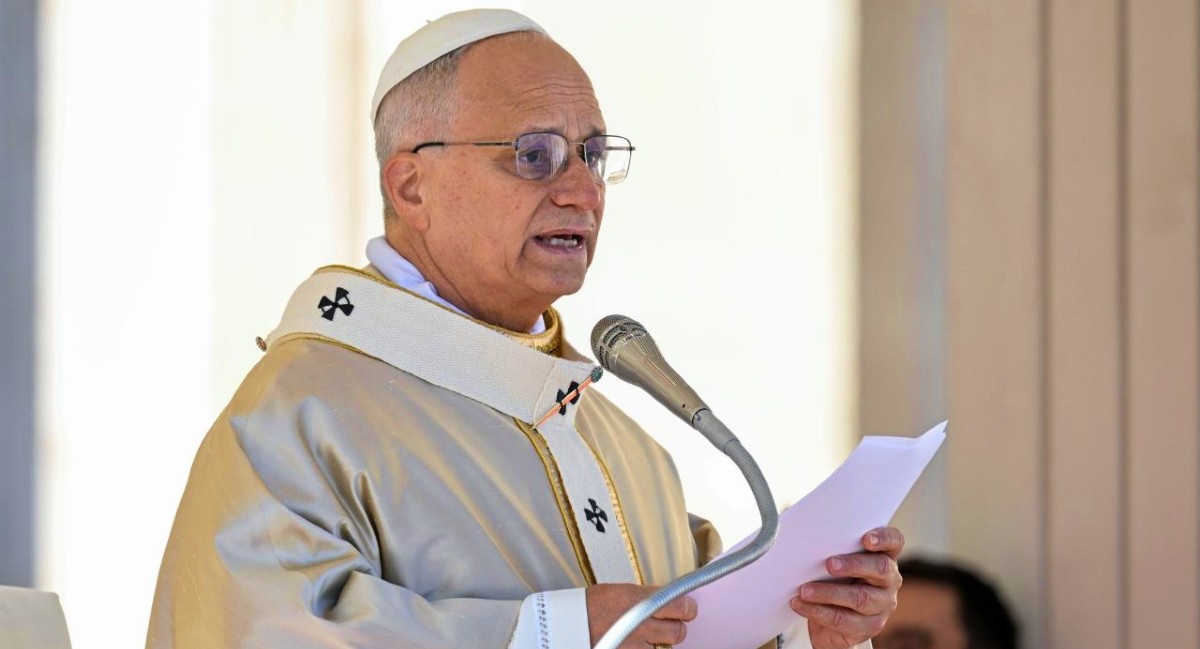
Pope Leo XIV called on world leaders to renew their commitment to combating hunger and poverty, warning that the persistence of widespread food insecurity reveals deeper failures within the international system itself.
Addressing the Executive Board of the United Nations World Food Programme (WFP) at its headquarters in Rome on Monday, the Holy Father praised the organization’s humanitarian work while urging governments to confront not only the symptoms of hunger but also the structural conditions that allow it to endure.
According to Vatican News, Pope Leo said the world must move beyond simply responding to crises and begin examining the systems that repeatedly produce them.
“Together, we share the urgent task of confronting hunger and malnutrition, while also tackling the underlying structural causes that sustain them,” the Pope said. “To meet this task effectively, we must examine the challenges before us, their underlying causes, and the paths toward lasting solutions.”
The Holy Father noted that today’s humanitarian emergencies are no longer isolated events but ongoing realities shaped by prolonged conflict, economic instability, chronic food insecurity, and increasing climate-related vulnerabilities.
He challenged leaders to consider whether the current global order is capable of addressing these problems or whether it is helping to perpetuate them.
“The issue is no longer limited to how to intervene,” Pope Leo said, according to Vatican News, but “extends to understanding why the system constantly produces the very problems it is then forced to correct.”
The Pope also expressed concern over what he described as the growing fragmentation of the international community. He warned that nations increasingly prioritize national security, economic interests, and domestic concerns while neglecting the importance of international cooperation.
According to Vatican News, Pope Leo highlighted a troubling contradiction in modern society: enormous productive capacity exists alongside expanding regions of extreme human suffering.
“It is precisely within the gap between acknowledgement in principle and prioritization in practice,” he said, “that we witness the progressive bureaucratization of solidarity alongside the quiet commodification of human life.”
The Holy Father warned that humanitarian assistance is often slowed by excessive bureaucracy while access to basic necessities can become subject to economic and political calculations rather than human need.
“This twofold dynamic creates a serious ethical challenge,” he said. “The human person is no longer consistently placed at the center of international action.”
Echoing concerns previously raised by Pope Francis, Pope Leo lamented that weapons continue to move freely around the world while aid efforts frequently encounter obstacles.
According to Vatican News, he observed that “conflicts are ‘fed’ more readily than people are nourished,” describing this reality as evidence of a profound imbalance in political and moral priorities.
The consequences of hunger extend far beyond physical suffering, the Pope said. Food insecurity weakens social stability, increases the likelihood of conflict, and contributes to migration and displacement.
For that reason, he emphasized that humanitarian action is not separate from global security but is essential to it.
“Food security is an essential component of global and integral security,” Pope Leo said.
The Holy Father also praised the World Food Programme’s efforts to address long-term needs through initiatives such as school meal programs, noting that such projects help build stronger and more stable communities.
Pope Leo further highlighted the role of the Catholic Church in reaching vulnerable populations, particularly in regions where governments or international organizations have limited access.
According to Vatican News, he pointed to the work of parishes, dioceses, Caritas agencies, and other Catholic charitable organizations that often serve communities in the most difficult circumstances.
He encouraged the World Food Programme and its partners to continue supporting these local efforts, emphasizing that cooperation among governments, international agencies, the Church, and civil society can significantly strengthen the fight against hunger.
The Pope concluded with an appeal for renewed multilateral cooperation and greater commitment from nations around the world.
“I wish to appeal to the governments and peoples of the world,” he said, “to renew and strengthen their commitment, to increase the resources dedicated to combating hunger and its root causes, and to remove the obstacles that prevent aid from reaching those in need.”
Warning that the credibility of international cooperation itself is at stake, Pope Leo urged leaders to simplify complex systems, focus on what is essential, and ensure that no person is forgotten.
He closed by praying that God would bless the efforts of those working to alleviate hunger throughout the world, “so that all may receive their daily bread and live in dignity.”
Your support brings the truth to the world.
Catholic Online News exists because of donors like you. We are 100% funded by people who believe the world deserves real, uncensored news rooted in faith and truth — not corporate agendas. Your gift ensures millions can continue to access the news they can trust — stories that defend life, faith, family, and freedom.
When truth is silenced, your support speaks louder.