

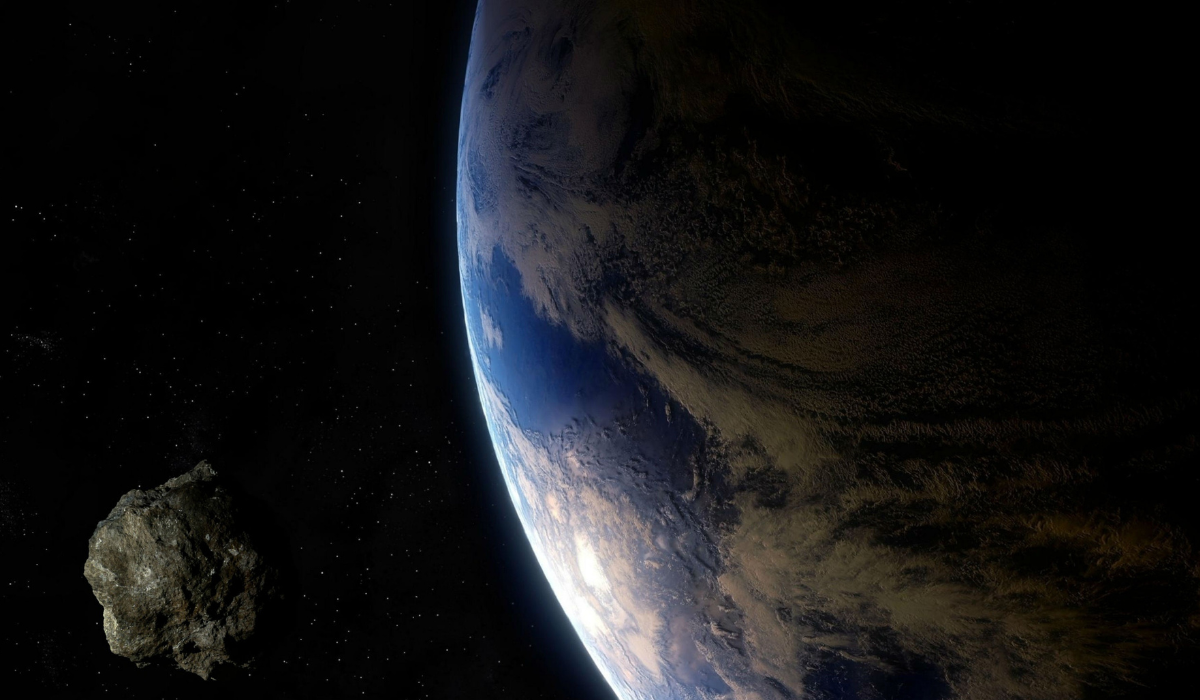
A newly discovered asteroid roughly the size of one to two school buses is expected to pass relatively close to Earth on Monday evening, but astronomers say there is no reason for alarm. According to CNN, the asteroid, named 2026JH2, will pass safely by the planet at a distance of about 56,913 miles — roughly one quarter of the distance between Earth and the moon.
The object was discovered on May 10 by astronomers at the Mount Lemmon Survey in Arizona and belongs to a category known as Apollo asteroids, which cross Earth’s orbital path around the sun. NASA’s Jet Propulsion Laboratory predicts the asteroid will make its closest approach shortly before 6 p.m. Eastern Time Monday.
While headlines about near-Earth asteroids can sound frightening, experts stressed that this type of flyby is actually quite common.
“2026JH2 will pass safely by the Earth,” Richard Binzel, professor of planetary sciences at the Massachusetts Institute of Technology, told CNN. He explained that “car-sized objects pass between the Earth and the Moon every week,” while larger objects similar in size to 2026JH2 “pass through our neighborhood several times per year.”
For Catholics, moments like this can serve as reminders of both the vastness of God’s creation and humanity’s limited understanding of the universe. Scripture repeatedly points to the heavens as signs of God’s majesty. Psalm 19 proclaims, “The heavens declare the glory of God; the skies proclaim the work of his hands.”
Scientists believe the asteroid originated in the asteroid belt between Mars and Jupiter. According to CNN, gravitational forces and collisions within that region can occasionally send objects toward Earth’s vicinity.
Astronomers are still uncertain about the asteroid’s exact size because telescopes initially measure only visible brightness. Patrick Michel, an astrophysicist with France’s National Centre for Scientific Research, explained to CNN that an asteroid can appear equally bright whether it is “bigger and darker, or smaller and more reflective.”
Current estimates place the asteroid somewhere between 49 and 98 feet wide. CNN reported that if it were on the smaller end, it would resemble the meteor that exploded over Chelyabinsk, Russia, in 2013, injuring more than 1,000 people. At the larger end, it could compare to the massive 1908 Tunguska event in Siberia. However, experts emphasized that unlike those incidents, 2026JH2 will not enter Earth’s atmosphere.
Michel told CNN that although the asteroid’s flyby is “very close,” it remains “far enough that there is absolutely nothing to worry about.”
The close approach also highlights the importance of monitoring near-Earth objects. Jean-Luc Margot, a professor at the University of California, Los Angeles, warned that scientists currently lack complete information about many smaller asteroids. According to CNN, Margot said astronomers have only observed about 1% of near-Earth asteroids in the same size range as 2026JH2.
He also noted concern about weakened planetary radar capabilities after the collapse of the Arecibo telescope in 2020 and ongoing repairs at NASA’s Goldstone antenna. “Without radar data, we are less capable of assessing the impact risk and we are more vulnerable to the impact hazard,” Margot told CNN.
Despite these challenges, scientists continue expanding efforts to detect and track potentially hazardous asteroids. According to CNN, space agencies around the world are funding new surveys to improve humanity’s ability to identify dangerous objects long before they approach Earth.
Your support brings the truth to the world.
Catholic Online News exists because of donors like you. We are 100% funded by people who believe the world deserves real, uncensored news rooted in faith and truth — not corporate agendas. Your gift ensures millions can continue to access the news they can trust — stories that defend life, faith, family, and freedom.
When truth is silenced, your support speaks louder.


All the tell tale signs of warnings from God the father of life, that we need conversion. Refusing positive response leaves us imperial of Gods chastisement! If we get a direct hit from an asteroid, consider that we were warned!
Vade retro Satana!
All the tell tale signs of warnings from God the father of life, that we need conversion. Refusing positive response leaves us imperial of Gods chastisement! If we get a direct hit from an asteroid, consider that we were warned