
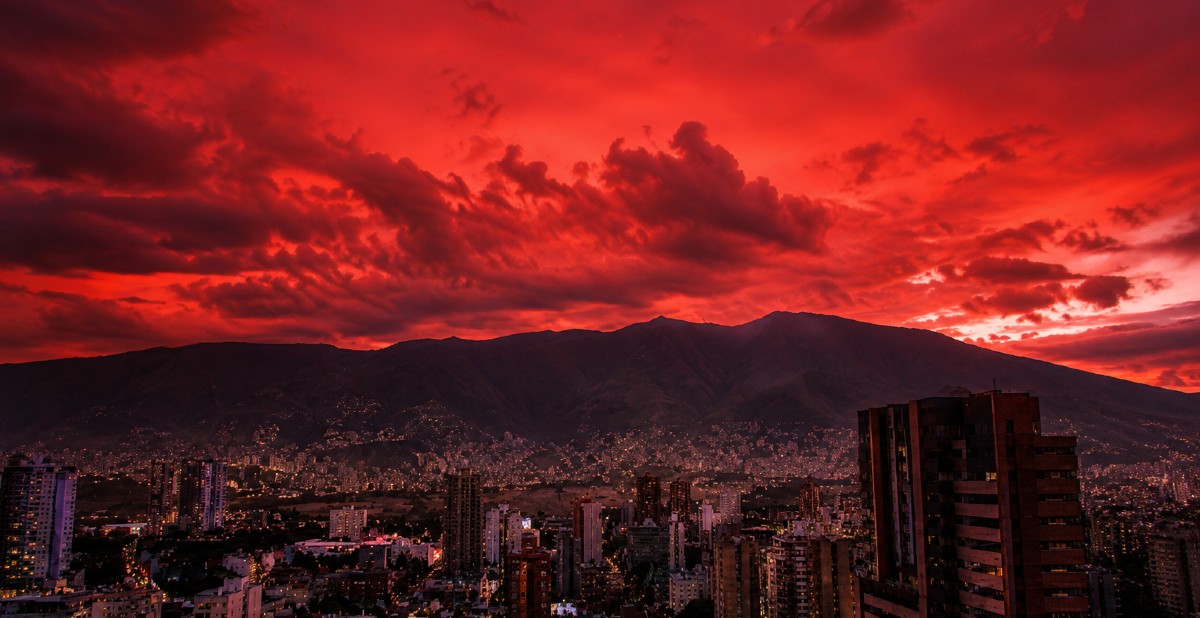
Just days after devastating earthquakes struck parts of Venezuela, an extraordinary crimson sunset over Caracas captured worldwide attention, leaving many residents wondering whether the dramatic display was connected to the recent seismic disaster.
Videos shared across social media showed neighborhoods bathed in an intense red glow as the sun slipped below the horizon. The timing of the event, coming so soon after the powerful earthquakes, led to widespread speculation that the unusual sky might be linked to seismic activity.
According to the Times of India, however, atmospheric scientists say there is no evidence connecting the blood-red sky to the earthquakes. Instead, they explain that the spectacle was a naturally occurring atmospheric phenomenon known in Venezuela as a “candilazo.”
The Times of India reports that a candilazo is the regional name for an exceptionally vivid red or orange sunset. Although the term is unique to parts of Venezuela and northern South America, the science behind it is well understood.
As the sun nears the horizon, its light travels through a much greater thickness of Earth’s atmosphere than it does during the middle of the day. During that longer journey, shorter blue and violet wavelengths are scattered away through a process known as Rayleigh scattering, allowing the longer red and orange wavelengths to dominate the evening sky.
According to NASA, “Rayleigh scattering is an important process affecting the travel of light through the atmosphere. This is particularly true in the ultraviolet region, since the amount of light that is scattered is much greater at shorter wavelengths than at longer wavelengths.”
Scientists also note that sunsets become even more vibrant when additional fine particles—including dust, smoke, sea salt, or aerosols—are present in the atmosphere. These particles further enhance the scattering of shorter wavelengths, making the reds and oranges appear even more intense.
According to the Times of India, meteorologists also point to recurring plumes of Saharan dust that travel across the Atlantic Ocean into the Caribbean and northern South America. NASA’s Earth Observatory says these dust clouds regularly reach the region, influencing air quality, cloud formation, and the appearance of sunsets.
Despite widespread online speculation, geophysicists emphasize that ordinary red sunsets cannot be used to predict earthquakes and are not considered evidence of seismic activity.
The Times of India notes that scientists have investigated rare reports of so-called “earthquake lights,” unusual luminous events that some researchers believe may involve electrical discharges generated by stress within certain rock formations before or during earthquakes. These rare phenomena, however, appear as brief flashes or localized glows and are very different from the broad crimson sunset witnessed over Caracas.
Experts also explained that the recent Venezuelan earthquakes resulted from movement along the boundary between the Caribbean Plate and the South American Plate, where shallow strike-slip faults are known to produce significant seismic activity.
For many people of faith, the breathtaking crimson sky served as a reminder of the beauty and power found within God’s creation. While its appearance inspired awe and curiosity, scientists say its cause was firmly rooted in the natural laws governing Earth’s atmosphere.
As the Times of India concluded, the earthquakes were geological, while the remarkable sunset was atmospheric—two natural events occurring close together in time but sharing no scientific connection.
Your support brings the truth to the world.
Catholic Online News exists because of donors like you. We are 100% funded by people who believe the world deserves real, uncensored news rooted in faith and truth — not corporate agendas. Your gift ensures millions can continue to access the news they can trust — stories that defend life, faith, family, and freedom.
When truth is silenced, your support speaks louder.