
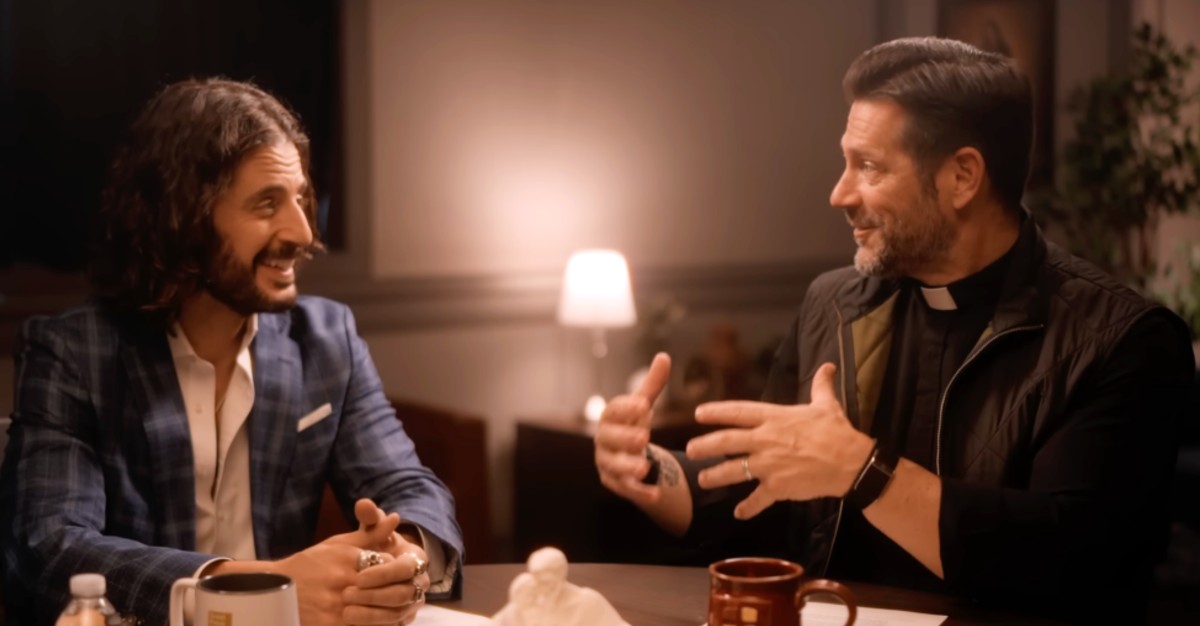
A recent podcast discussion involving actor Jonathan Roumie has renewed debate within the Catholic Church over the reception of Holy Communion, particularly the right of the faithful to receive on the tongue while kneeling.
According to LifeSiteNews, Roumie, best known for portraying Jesus Christ in The Chosen, recounted during a podcast appearance with Father Mike Schmitz that he was denied Holy Communion while kneeling at a recent Mass. Roumie said he felt “convicted” by the Holy Spirit to approach the Eucharist with greater reverence and therefore knelt to receive Our Lord on the tongue.
An Urgent Message from Sister Sara – Please Watch
Roumie explained that the priest instructed him to “get up,” and he complied. After Mass, Roumie asked the priest for an explanation. According to LifeSiteNews, the priest told him he could not allow kneeling because it would permit “everybody to do whatever they pleased.”
Schmitz appeared visibly troubled by the account and stated that lay Catholics have the right to receive Holy Communion on the tongue while kneeling, according to LifeSiteNews.
Roumie later said he sought counsel from his spiritual director, who told him that the priest “shouldn’t do that,” according to LifeSiteNews. Roumie added that the incident strengthened his resolve, saying he has “doubled down” on kneeling to receive Communion and is prepared to remain kneeling until the priest “concedes,” stating, “because I’m not going anywhere.”
The incident highlights a broader controversy that has repeatedly surfaced in recent years, particularly in the United States. While Church law permits Communion on the tongue and does not forbid kneeling, some clergy discourage or prohibit the practice, often citing pastoral norms.
LifeSiteNews reports that last month Bishop Michael Martin of the Diocese of Charlotte ordered that altar rails and kneelers no longer be used for the reception of Holy Communion. Martin stated that the faithful should receive while standing, describing it as the “normative posture,” referencing guidance from the United States Conference of Catholic Bishops. He further claimed it is “absurd” to “instruct the faithful that kneeling is more reverent than standing,” according to LifeSiteNews.
Critics of such directives point to Scripture, including Philippians 2:10, which states that “in the name of Jesus every knee should bow,” as well as to sociological research. LifeSiteNews cited a paper by Dr. Natalie Lindemann published in the Catholic Social Science Review, which found that “Church leaders may be able to promote Real Presence belief by encouraging embodied liturgical practices that convey reverence for the Eucharist.” Lindemann concluded that “reintroducing reception on the tongue, encouraging consecration bell use, and allowing the celebration of the [Traditional Latin Mass]” lead to “a much stronger belief in the Real Presence.”
According to LifeSiteNews, Bishop Martin is not alone in restricting traditional practices. Monsignor James A. Misko, formerly vicar general of the Diocese of Austin and recently appointed bishop of Tucson by Pope Leo, previously enforced the suppression of several Traditional Latin Masses and ordered the removal of Communion kneelers. LifeSiteNews reported that Misko argued standing is the norm and that kneelers could place “undue pressure on the communicant.”
Despite such measures, LifeSiteNews reports that many Catholics continue to kneel and receive Communion on the tongue as an expression of reverence. During a concelebrated Mass last summer attended by Bishop Martin and multiple bishops, large numbers of the faithful reportedly approached Holy Communion kneeling and on the tongue. Martin did not distribute Communion at that Mass.
LifeSiteNews also recalled the example of Father Fredy Leonardo Herrera Fuentes of Bogotá, who announced in 2021 that Communion in his parish would be received “only… on the tongue and kneeling down,” following what he later described as a profound mystical experience during Mass.
Roumie’s account has resonated widely among Catholics who view the issue as part of a deeper conversation about Eucharistic faith, reverence, and continuity with the Church’s liturgical tradition. As debate continues, his public testimony has brought renewed attention to a question many Catholics believe strikes at the heart of belief in the Real Presence of Christ in the Eucharist.
Your support brings the truth to the world.
Catholic Online News exists because of donors like you. We are 100% funded by people who believe the world deserves real, uncensored news rooted in faith and truth — not corporate agendas. Your gift ensures millions can continue to access the news they can trust — stories that defend life, faith, family, and freedom.
When truth is silenced, your support speaks louder.