

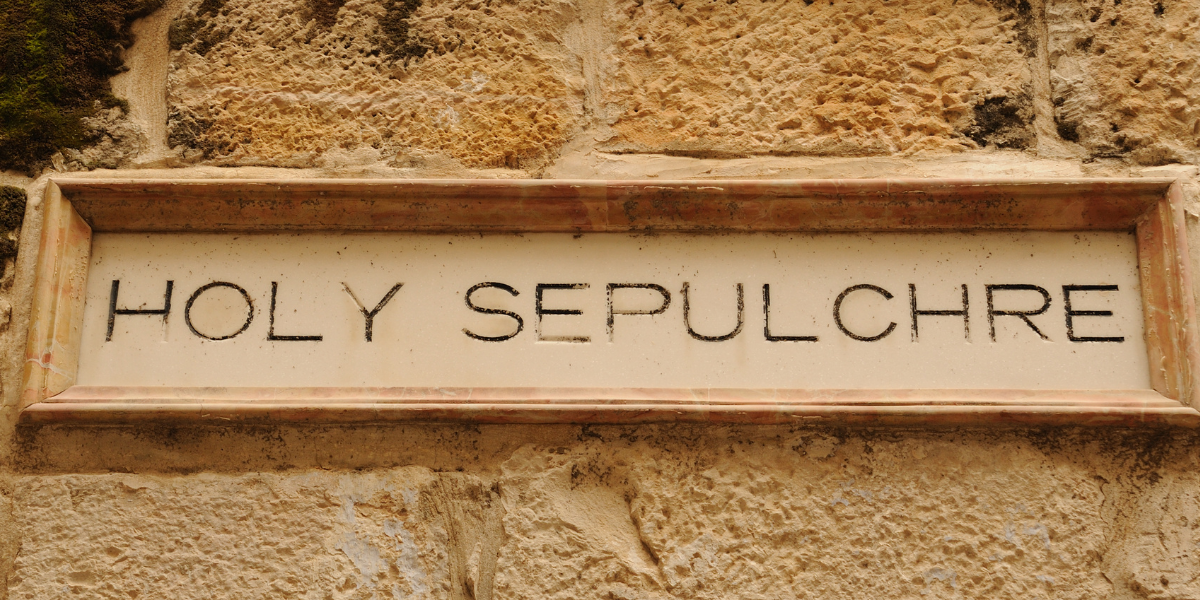
New archaeological findings beneath Jerusalem’s Church of the Holy Sepulchre are offering a remarkable glimpse into what the area may have looked like around the time of Christ — including evidence of cultivated land and ancient tombs that closely resemble the setting described in the Gospel of John.
According to LifeSiteNews, archaeologists working beneath the historic basilica uncovered evidence that the site once contained vines, olive trees and rock-cut burial places. The discoveries emerged from excavations conducted inside the church between May and November 2022, followed by years of additional investigation and analysis.
The findings are significant because the Gospel of John describes the place of Christ’s crucifixion as being near a garden containing a new tomb.
“Now there was in the place where he was crucified, a garden; and in the garden a new sepulchre, wherein no man yet had been laid,” John 19:41 states.
The archaeological work provides new physical evidence that a landscape fitting that description existed in the area before the construction of the Christian sanctuary.
“We found evidence of a funerary landscape, alongside small areas planted with vines and olive trees, as well as a pastoral area characterized by sporadic human activity,” lead archaeologist Francesca Romana Stasolla told the Daily Mail, according to LifeSiteNews.
The research does not establish that archaeologists have discovered or authenticated the particular tomb in which Jesus Christ was laid. Instead, the findings help reconstruct the ancient environment surrounding the site and demonstrate that burial areas and cultivated land existed alongside one another.
That distinction is important. Archaeology cannot by itself establish the central Christian claim that Christ rose from the dead. But the discovery provides notable historical context for the geographical details preserved in the Gospel narrative.
According to LifeSiteNews, the findings were presented in a 98-page preliminary report published in the 2025 edition of Liber Annuus, the academic journal of the Studium Biblicum Franciscanum.
The archaeological team was led by Stasolla of Sapienza University of Rome. Researchers examined portions of the north aisle and northern section of the rotunda within the Church of the Holy Sepulchre, studying successive archaeological layers to reconstruct how the location changed through different periods of history.
The excavations were connected to restoration work on the church floor and were conducted with the cooperation of the Christian communities responsible for the basilica, including the Orthodox Patriarchate, the Custody of the Holy Land and the Armenian Patriarchate.
For Christians, the Church of the Holy Sepulchre stands at the heart of the events commemorated during Holy Week and Easter. The newly analyzed archaeological evidence does not prove every detail of the Gospel account, but it provides a striking correspondence with St. John’s description of a garden and burial place near the site of Christ’s crucifixion.
Nearly two thousand years after the Gospel was written, the earth beneath one of Christianity’s holiest churches continues to reveal traces of the ancient Jerusalem landscape in which Christians believe the death, burial and Resurrection of Jesus Christ took place.
Your support brings the truth to the world.
Catholic Online News exists because of donors like you. We are 100% funded by people who believe the world deserves real, uncensored news rooted in faith and truth — not corporate agendas. Your gift ensures millions can continue to access the news they can trust — stories that defend life, faith, family, and freedom.
When truth is silenced, your support speaks louder.