

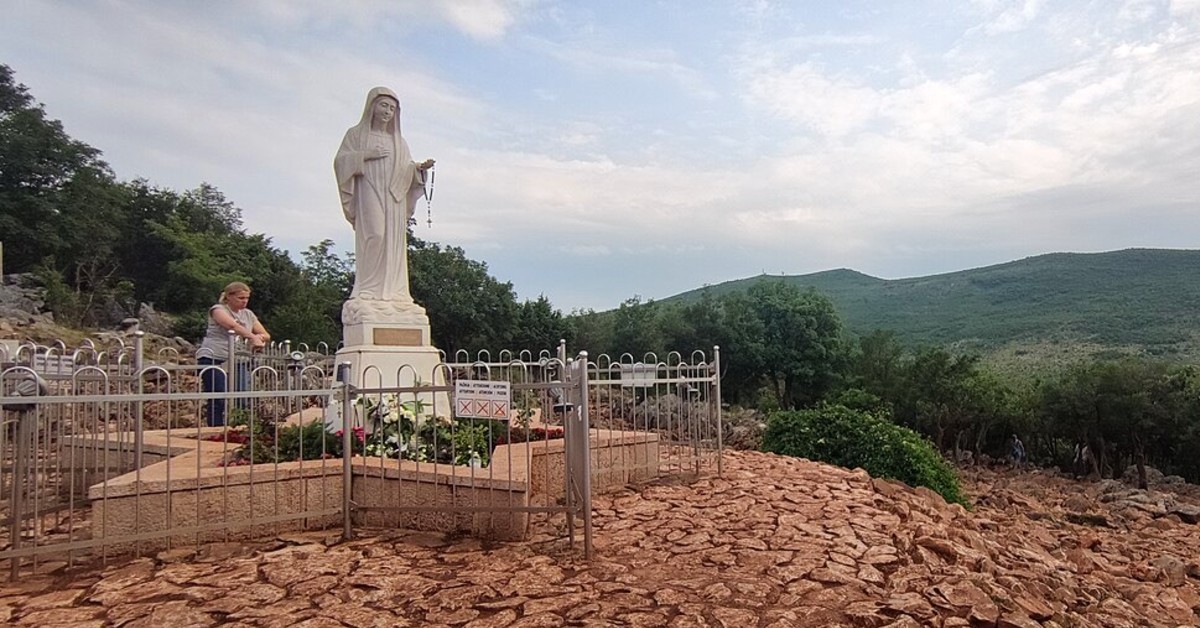
New details about a confidential Vatican consultation on Medjugorje are shedding light on just how sharply Church experts once disagreed over the alleged Marian apparitions, with six participants reportedly concluding that the phenomenon involved the direct intervention of the devil.
The information was published Aug. 17 by Italian journalist David Murgia on his blog Il Segno di Giona and subsequently reported by LifeSiteNews. It concerns a 2016 consultation involving 33 cardinals, bishops, theologians and other experts who evaluated the alleged supernatural character of events associated with Medjugorje.
According to Murgia, six of the participants — including three cardinals — reached an especially severe conclusion.
“For these six voters — three of whom were cardinals (and I want to stress this) — everything that happened and continues to happen in the small village in Bosnia and Herzegovina ‘cannot be explained without the original, direct, and foundational intervention of the Evil One,’” Murgia wrote, according to LifeSiteNews.
“Consequently, we would not be dealing with a Mariophany but with a Satanophany,” he added.
The reported judgments represent one of the strongest known assessments made during the Vatican’s years-long examination of Medjugorje, where alleged apparitions of the Blessed Virgin Mary have been reported since June 1981.
According to LifeSiteNews, the six dissenting opinions relied partly on the 1991 Declaration of Zadar issued by the Yugoslav Bishops’ Conference. They reportedly understood that declaration as having already rejected the supernatural character of the Medjugorje events.
The six participants also reportedly disputed the more favorable findings of the international commission established by Pope Benedict XVI in 2010 and led by Cardinal Camillo Ruini.
The Ruini Commission had been more receptive to the possibility of a supernatural origin, particularly regarding the earliest reported apparitions. According to LifeSiteNews, however, the six voters maintained that the commission’s assessment had been reached without complete knowledge of documentation held by the Congregation for the Doctrine of the Faith.
Their reported recommendations extended beyond simply rejecting the alleged apparitions.
According to LifeSiteNews, the six opinions called for the rehabilitation of the doctrinal and pastoral actions taken by Bishops Pavao Žanić and Ratko Perić of Mostar-Duvno, both prominent critics of the Medjugorje phenomenon.
They also reportedly urged Church authorities to protect pilgrims whose good faith they believed had been “exploited.”
Perhaps the most dramatic recommendation involved the alleged visionaries themselves. LifeSiteNews reported that the six voters favored a “damnatio memoriae,” or “condemnation of their memory,” directed toward the presumed visionaries rather than simply issuing a broad condemnation of the entire phenomenon.
The consultation took place after years of Vatican investigation.
Pope Benedict XVI established the Ruini Commission in March 2010 to examine the Medjugorje events. After the commission’s work was completed, the matter was eventually referred by Pope Francis to the Congregation for the Doctrine of the Faith.
According to LifeSiteNews, a secret consultation was held on September 17, 2016. Of the 33 participants, 21 concluded that the Medjugorje phenomena were not supernatural, nine considered them supernatural, and three concluded that their supernatural character had not been established.
Those judgments did not ultimately result in a Church declaration that Medjugorje was diabolical or even a definitive condemnation of the phenomenon.
In May 2019, Pope Francis authorized official pilgrimages to Medjugorje while making clear that the authorization did not constitute recognition of the alleged apparitions as supernatural.
The Church’s approach changed further after the Dicastery for the Doctrine of the Faith issued new norms for evaluating alleged supernatural phenomena in May 2024. Under the new framework, greater emphasis is placed on evaluating spiritual and pastoral fruits rather than ordinarily issuing declarations that a phenomenon is of supernatural origin.
In September 2024, the Dicastery published its “Note About the Spiritual Experience Connected with Medjugorje,” granting a nihil obstat to devotion associated with the site.
The document recognized what the Dicastery described as abundant spiritual fruits connected with Medjugorje, including conversions, prayer, renewed participation in the sacraments, vocations and works of charity. At the same time, the Vatican cautioned that these fruits do not establish that the alleged apparitions themselves are supernatural.
The Note also acknowledged problematic or theologically imprecise elements in some reported messages and emphasized that Catholics are not required to believe in them.
The newly reported 2016 opinions therefore should not be confused with the Church’s present judgment on Medjugorje. They represent the views of six participants in a larger confidential consultation rather than an official Vatican declaration that the phenomenon is demonic.
Nevertheless, the revelations illustrate the extraordinary range of judgments that existed within the Vatican’s examination of Medjugorje — from those prepared to recognize supernatural elements to those who reportedly believed the phenomenon could only be explained through the “original, direct, and foundational intervention of the Evil One.”
According to Murgia, the disagreement became so profound that the Medjugorje controversy risked producing an “almost schism” between competing approaches to one of the most debated alleged apparition sites in modern Catholic history.
Today, the Church permits and encourages pastoral care at Medjugorje under the 2024 nihil obstat while stopping short of declaring the alleged apparitions supernatural. For Catholics, that distinction remains essential: the spiritual fruits experienced by pilgrims may be received with gratitude, while claims concerning the supernatural origin of the alleged visions remain subject to the Church’s discernment.
Your support brings the truth to the world.
Catholic Online News exists because of donors like you. We are 100% funded by people who believe the world deserves real, uncensored news rooted in faith and truth — not corporate agendas. Your gift ensures millions can continue to access the news they can trust — stories that defend life, faith, family, and freedom.
When truth is silenced, your support speaks louder.


