

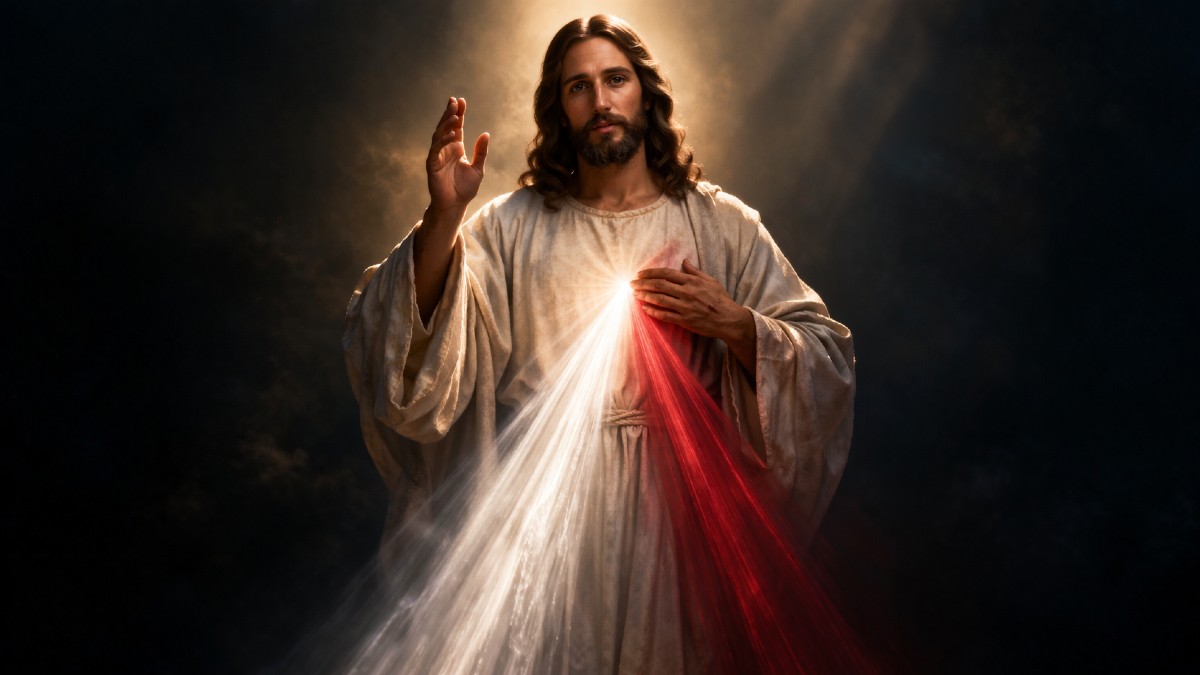
On the Second Sunday of Easter, the Church invites the faithful into one of the most profound mysteries of God’s love: Divine Mercy Sunday. Instituted for the universal Church by Pope John Paul II in the Jubilee Year 2000, this feast is not merely a devotion—it is a call to trust completely in the mercy flowing from the Heart of Christ.
At its center stands the message entrusted to St. Faustina Kowalska, a humble Polish nun who received private revelations of Jesus in the 1930s. Through her diary, the Lord revealed a message for our time: that no soul is too far gone, no sin too great, and no darkness too deep to be overcome by His mercy.
The Wound That Became Our Healing
Divine Mercy Sunday is rooted deeply in the Gospel itself. On this day, the Church proclaims the appearance of the Risen Christ to His Apostles, when He breathes the Holy Spirit upon them and says, “Whose sins you forgive are forgiven them” (John 20:23). From His pierced side—opened on the Cross—flowed blood and water, signs of the sacraments that give life to the Church.
In the Divine Mercy image, Jesus raises His hand in blessing while two rays stream from His Heart: one pale, one red. As He explained to St. Faustina, the pale ray represents the water that justifies souls, and the red ray the Blood that is the life of souls. These rays continue to pour out upon the world today, especially through the Sacraments of Confession and the Eucharist.
“Jesus, I Trust in You”
The heart of this devotion is trust. Jesus told St. Faustina, “The graces of My mercy are drawn by means of one vessel only, and that is trust.” These words echo powerfully in a world often marked by fear, uncertainty, and sin.
To trust in Divine Mercy is not to ignore sin, but to run toward Christ with it. It is to believe that His love is greater than our failures. It is to surrender control and allow His mercy to transform us from within.
This trust is beautifully expressed in the simple yet powerful prayer given to St. Faustina:
“Jesus, I trust in You.”
These five words, when prayed sincerely, become a lifeline for the soul.
The Great Promise of Mercy
Divine Mercy Sunday carries with it an extraordinary promise. Jesus told St. Faustina that souls who go to Confession and receive Holy Communion on this day, with complete trust in His mercy, will receive a complete forgiveness of sins and punishment—a grace comparable to a second baptism.
The Church, in her wisdom, also attaches a plenary indulgence to this feast under the usual conditions: sacramental Confession, Eucharistic Communion, prayer for the intentions of the Holy Father, and complete detachment from sin.
This is not a “shortcut” to holiness, but an invitation to radical conversion—to begin again, fully immersed in the mercy of God.
The Hour of Mercy
At 3:00 p.m.—the hour of Christ’s death—the faithful are encouraged to pause and remember His Passion. This “Hour of Mercy” is a privileged time to pray, especially the Divine Mercy Chaplet.
In homes, churches, and quiet hearts around the world, the Chaplet rises like a chorus of trust:
“For the sake of His sorrowful Passion, have mercy on us and on the whole world.”
In this prayer, we do not rely on our own merits, but offer the Father the sacrifice of His Son—a perfect plea for mercy that never fails.
Mercy Received Must Become Mercy Given
Divine Mercy is not meant to be kept—it must be lived. Jesus told St. Faustina that souls who receive His mercy are called to extend it to others through acts of mercy: in deed, word, and prayer.
This is the test of authentic devotion. Do we forgive as we have been forgiven? Do we show compassion where the world shows judgment? Do we bring light into places of darkness?
To celebrate Divine Mercy Sunday fully is to become an instrument of mercy in a wounded world.
A Feast for Our Time
In every generation, God raises up saints to remind us of what matters most. Through St. Faustina Kowalska and the witness of Pope John Paul II, the Church has been given a message perfectly suited for our age—a time so deeply in need of hope, healing, and forgiveness.
Divine Mercy Sunday stands as a beacon: no matter how far we have wandered, the Heart of Christ remains open.
The question is not whether God is willing to forgive.
The question is whether we are willing to trust.
And so, as the Church celebrates this great feast, we are invited to come forward with confidence, to kneel before the image of the Merciful Savior, and to whisper with faith:
Jesus, I trust in You.