
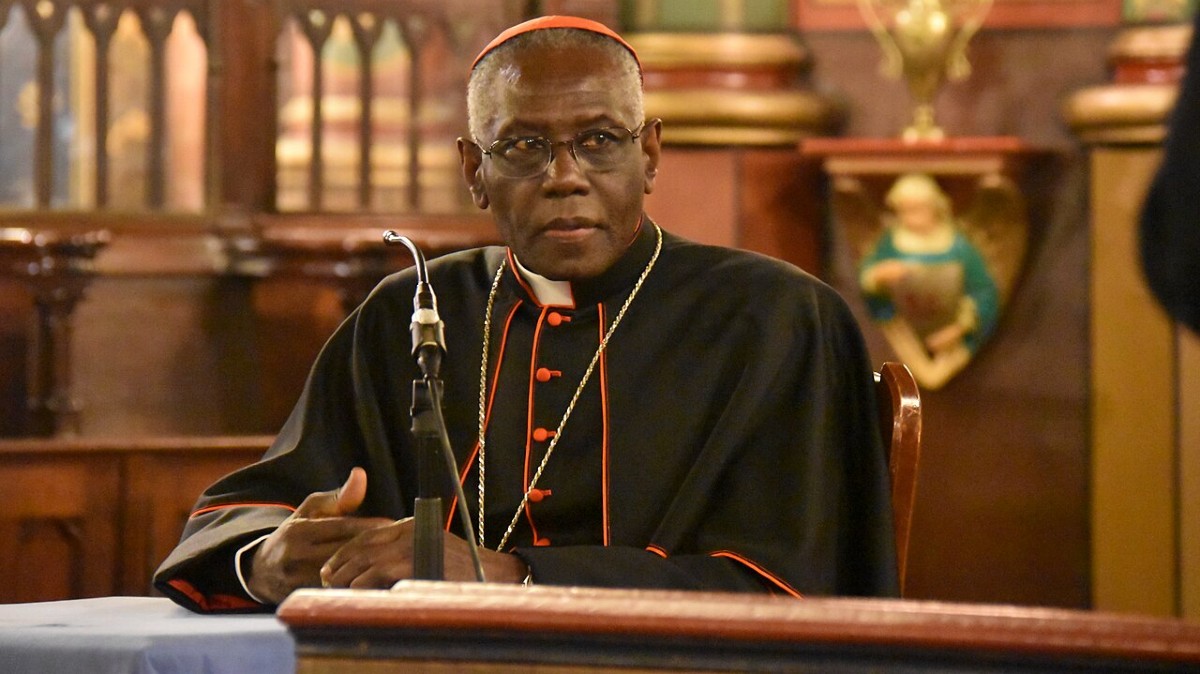
Cardinal Robert Sarah has issued a forceful defense of Catholics devoted to the Traditional Latin Mass, warning that efforts to restrict the older liturgy and create divisions over its celebration risk causing serious harm within the Church.
In a recent interview with the Italian newspaper Il Giornale, Cardinal Sarah reflected on the liturgical legacy of Pope Benedict XVI and the restrictions imposed on the Traditional Latin Mass under Pope Francis’ 2021 apostolic letter Traditionis Custodes.
According to the interview, Sarah said the wider availability of the older form of the Roman Rite following Benedict XVI’s pontificate had also influenced how some priests celebrated the newer form of the Mass.
“Many priests testify that discovering the extraordinary form has helped them celebrate Mass better,” Sarah said.
The cardinal emphasized that liturgical abuses should not be confused with the validity or legitimacy of the ordinary form of the Roman Rite. According to LifeSiteNews’ report on the interview, Sarah described abuses in the celebration of the ordinary form as “very serious acts,” while insisting they cannot be equated with the ordinary form itself.
Sarah also reflected on Benedict XVI’s decision to broaden access to the older liturgy, saying he believed the late pope wanted Catholics to have greater freedom in living their liturgical faith.
“I think that Benedict XVI’s intention also included a deeply humble and democratic attitude: to ensure its widest possible dissemination so that, over the decades, the People of God could choose which form best suited the living out of their faith,” Sarah said.
That approach changed with Traditionis Custodes, which substantially restricted celebrations according to the liturgical books in use before the reforms following the Second Vatican Council.
Sarah said he disagreed with that decision.
“It did not strike me as a wise or respectful choice,” he told Il Giornale, according to LifeSiteNews.
The cardinal went further, arguing that longstanding liturgical traditions should not simply be suppressed through administrative action.
“Access to ritual forms that have been recognized and have existed for centuries can never be artificially limited by decrees,” Sarah said. “If a rite did not serve the faith, it would die out on its own; if, on the contrary, it preserves and promotes the faith, let us not limit it, because we would be limiting the preservation and spread of the faith itself.”
Sarah also addressed Catholics who make significant sacrifices, including traveling long distances, to attend celebrations of the Traditional Latin Mass.
“I can only admire this great expression of love for God,” he said, adding that the phenomenon is becoming increasingly widespread.
For Sarah, the appropriate response is dialogue rather than conflict between Catholics attached to different forms of the Roman liturgy.
“As a Church, we cannot wage war against those who devoutly participate in Mass simply because they prefer one form over another,” Sarah said. He described such an approach as “short-sighted and entirely ideological” and concluded that it is “harmful and destructive to the Church.”
The former prefect of the Congregation for Divine Worship and the Discipline of the Sacraments also addressed resistance to Latin and Gregorian chant within parts of the Church.
Sarah suggested that some of this opposition reflects generational attitudes rather than an enduring rejection of the Church’s Latin liturgical heritage.
“It seems to me that this aversion, found in certain self-referential cultural circles, is more psychological than truly grounded,” he said, predicting that some of those attitudes will diminish as generations change.
The cardinal’s remarks present the debate over the Traditional Latin Mass not simply as a question of liturgical preference, but as a question of how Catholics with different legitimate liturgical attachments should live together within the Church.
His central appeal was for Catholics and Church leaders to reject ideological conflict and seek what he called “fraternal and peaceful dialogue,” particularly when dealing with faithful Catholics whose attachment to the older liturgy flows from devotion to God and the Mass.
Your support brings the truth to the world.
Catholic Online News exists because of donors like you. We are 100% funded by people who believe the world deserves real, uncensored news rooted in faith and truth — not corporate agendas. Your gift ensures millions can continue to access the news they can trust — stories that defend life, faith, family, and freedom.
When truth is silenced, your support speaks louder.