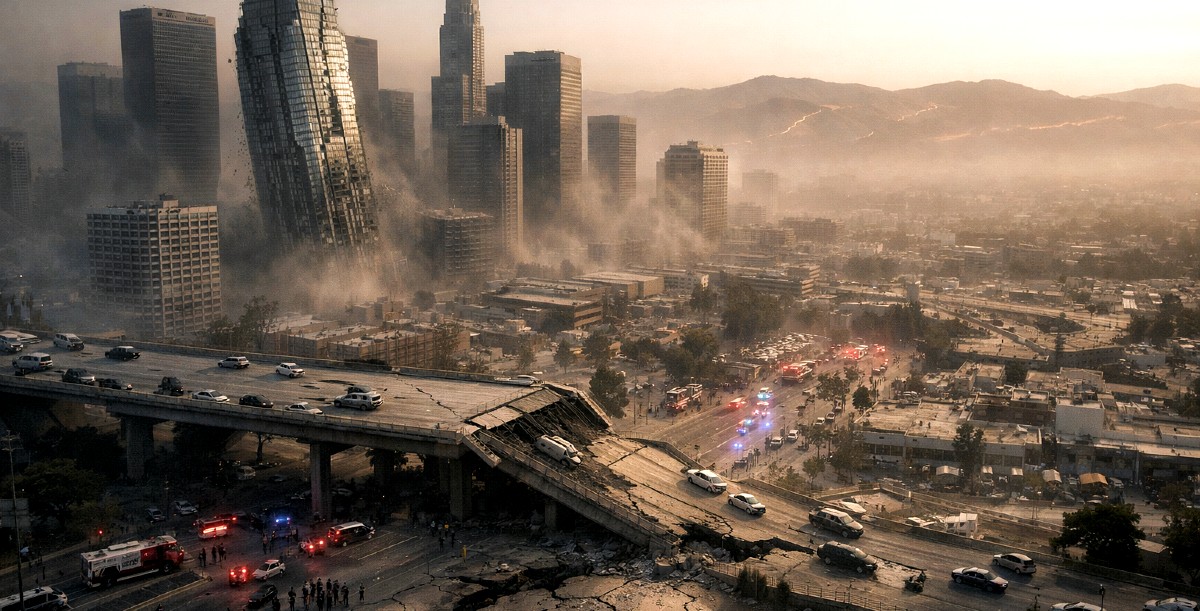


California’s iconic San Andreas Fault has remained unusually quiet for decades, but researchers say that silence should not be mistaken for safety. According to the Los Angeles Times, a new scientific study suggests that stress has continued building beneath parts of Southern California’s fault system, raising concerns about the potential for a future major earthquake.
The study, published in the Journal of Geophysical Research: Solid Earth, examined key sections of the San Andreas and San Jacinto faults near Cajon Pass in San Bernardino County. Researchers used earthquake records spanning the past 1,000 years, satellite observations, and measurements of Earth’s crust to estimate how much tectonic strain has accumulated over time. According to the Los Angeles Times, the findings indicate that some sections of the fault system are experiencing the highest levels of stress seen in the millennium-long record.
“We keep accumulating that earthquake energy, and it has to be released. And the only way it gets released is through large earthquakes,” U.S. Geological Survey geologist Kate Scharer, a co-author of the study, told the Los Angeles Times. “The small ones don’t really do it.”
Lead study author Liliane Burkhard said the computer model found that “tectonic stress has now reached higher levels than at any point in that entire record.” She added, “From the model, we see that the conditions that historically preceded large joint ruptures crossing both fault systems are now approaching.”
Scientists emphasized that the research is not predicting when a major earthquake will occur. However, according to the Los Angeles Times, the study reinforces long-standing concerns that Southern California remains vulnerable to a powerful quake capable of affecting multiple counties simultaneously. A previous U.S. Geological Survey scenario estimated that a magnitude 7.8 earthquake on the southern San Andreas Fault could result in approximately 1,800 deaths and widespread destruction across the region.
The researchers also noted that the region has experienced an unusually long period without the type of massive earthquakes that have historically relieved built-up strain. According to the Los Angeles Times, the San Andreas Fault northwest of Cajon Pass has typically produced major earthquakes every 100 to 150 years, while some southern sections have gone roughly 300 years without a large event.
Although California’s mountains, fertile valleys, and dramatic landscapes were formed by the same tectonic forces that produce earthquakes, scientists say those benefits come with unavoidable risks. According to the Los Angeles Times, researchers hope the new findings encourage residents to strengthen emergency plans rather than live in fear.
For Catholics, such reminders of nature’s power also highlight the importance of prudence and responsible stewardship. The Church has long encouraged families to prepare wisely for disasters while placing their trust in God’s providence, recognizing that faith and practical readiness go hand in hand.
Burkhard stressed that the findings should be viewed as a call to preparedness rather than panic.
“In the end, the most important message is a simple one: Let’s make sure we are prepared,” she said.
Your support brings the truth to the world.
Catholic Online News exists because of donors like you. We are 100% funded by people who believe the world deserves real, uncensored news rooted in faith and truth — not corporate agendas. Your gift ensures millions can continue to access the news they can trust — stories that defend life, faith, family, and freedom.
When truth is silenced, your support speaks louder.