
An extraordinary discovery inside a 1,500-year-old Christian church in Turkey is offering new insight into how early believers understood the Garden of Eden, the importance of virtue, and humanity’s journey toward eternal salvation.
A newly published study suggests that an elaborate floor mosaic, originally uncovered more than two decades ago, may have served a purpose far greater than decoration. Its imagery could have provided early Christians with a visual reminder of the spiritual qualities needed to live according to God’s will.
According to the Daily Mail, researchers have reexamined the ancient mosaics inside the Church of the Four Rivers at Hadrianoupolis, identifying possible theological meanings rooted in Scripture and early Christian teachings.
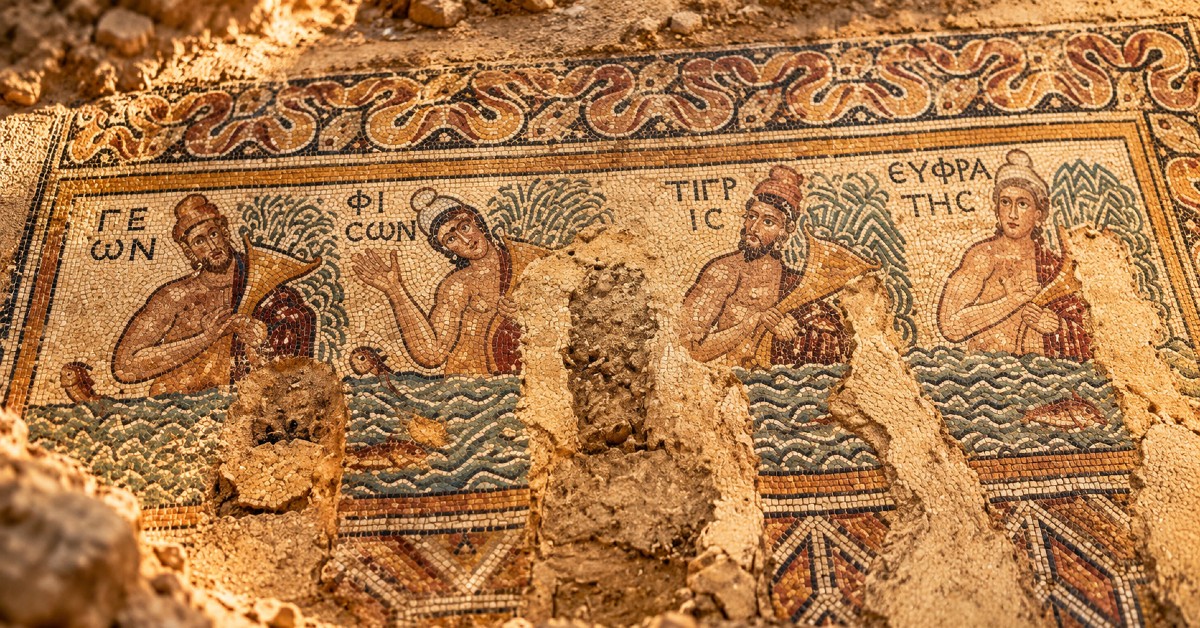
The artwork depicts four human figures representing the biblical rivers of Paradise: the Pishon, Gihon, Tigris, and Euphrates. Each figure holds a horn of plenty, with streams of water flowing into a common pool.
The imagery reflects the description of Eden found in Genesis 2:10–14, where Scripture describes a river flowing from the garden before dividing into four branches.
But researchers believe the ancient Christian artists may have intended to communicate something even more profound.
Four Rivers, Four Virtues, and the Christian Journey
According to the study, published in July and reported by the Daily Mail on October 14, the four rivers may symbolize the cardinal virtues of prudence, justice, fortitude, and temperance.
These virtues hold a central place in Catholic moral teaching, guiding believers toward lives shaped by wisdom, righteousness, courage, and self-control.
The researchers drew upon ancient interpretations of Scripture, including the writings of early Christian thinkers such as St. Ambrose of Milan, St. Augustine of Hippo, and St. Jerome.
Particularly significant is the interpretation associated with Philo of Alexandria and St. Ambrose, who connected the four rivers of Paradise with the four cardinal virtues.
The study suggests that this symbolism may have transformed the church floor into a spiritual lesson for those entering the sacred building.
“For the Early Byzantine viewer, walking upon these mosaics was not just a physical act but a symbolic journey through the virtues required to attain salvation,” the researchers wrote.
The study also identifies possible associations between individual rivers and particular virtues, including the Pishon with prudence and the Tigris with temperance.
Researchers described the arrangement as “a moral instruction embedded in the very floor of the sacred space.”
For Catholics today, the interpretation offers a fascinating connection to the Church’s enduring teaching on the virtues.
The Catechism of the Catholic Church identifies prudence, justice, fortitude, and temperance as the four cardinal virtues, which shape moral conduct and help believers choose what is good.
While Catholic teaching emphasizes that salvation comes through the grace of Jesus Christ rather than human virtue alone, the cultivation of virtue remains an essential part of the Christian response to God’s grace.
The ancient mosaic may therefore reflect an early Christian understanding of the relationship between faith, moral transformation, and the hope of eternal life.
Hidden Christian Symbols Beneath the Feet of Worshippers
The possible spiritual significance of the mosaic extends beyond its depiction of the four rivers.
According to the Daily Mail, researchers also examined fish represented within the flowing water, suggesting that these images may have carried additional Christian meaning.
“The fish figures depicted within the flowing water are associated with the concepts of baptism, purification, and the divine abundance promised in the Gospels,” the study states.
The symbolism is especially meaningful within Christianity, where water is closely associated with baptism, spiritual cleansing, and new life in Christ.
For early Christians, the image of flowing water could have recalled both the abundance of Paradise and the transforming grace received through baptism.
Researchers also identified a cross-shaped design near the church’s southeastern entrance, which they suggest may have served as a protective symbol against evil.
The study proposes that early Christians sometimes adapted existing protective imagery, giving it meaning within their own religious traditions.
Together, these artistic elements suggest that the church’s interior may have been designed to communicate Christian beliefs through images that worshippers encountered during ordinary acts of prayer and worship.
A Remarkable Connection Between Scripture and Ancient Geography
The researchers also explored how the mosaic connects the biblical account of Paradise with the geography of the ancient world.
Genesis identifies four rivers associated with Eden, including the Tigris and Euphrates, both familiar waterways in the ancient Near East.
According to the Daily Mail, the study examined historical interpretations that attempted to identify the remaining rivers with recognizable geographical locations.
The Jewish scholar Saadya Gaon, for example, associated the Pishon with the Nile and placed the Gihon in Ethiopia.
The researchers suggest that including recognizable rivers alongside the biblical imagery helped connect the spiritual vision of Eden with the physical world known to early Christians.
“The inclusion of geographically distinct rivers like the Tigris and Euphrates grounds the mythical Garden of Eden in a recognizable reality, bridging the gap between the divine and the terrestrial realms,” the study explains.
However, the mosaic does not establish the historical location of the Garden of Eden. Rather, it provides evidence of how Christians in the Byzantine period may have interpreted the biblical account through art, symbolism, and theology.
The Daily Mail also reported on a separate historical curiosity involving a map contained in a 1599 Bible, which places Eden in the region of Great Armenia, near the mountains associated with Mount Ararat.
Although such historical maps reveal centuries of interest in locating Paradise, they do not constitute archaeological proof of Eden’s geographical location.
An Ancient Message That Still Speaks to Christians Today
The Church of the Four Rivers mosaic was first discovered in 2003, but its possible theological significance has received renewed attention through the recent study.
According to the researchers, similar representations of Eden’s four rivers have been identified in ancient churches in Jordan, Libya, and Greece.
However, the Hadrianoupolis mosaic is described as the only known example of its particular detailed composition in Anatolia.
Its preservation offers a remarkable glimpse into the religious imagination of Christians who lived approximately 1,500 years ago.
For these believers, sacred art may have served as much more than an ornament. It could communicate biblical truths, reinforce moral teachings, and direct the mind toward the promises of God.
The newly proposed interpretation also highlights an important distinction within Catholic theology: the virtues help Christians grow in holiness, but eternal salvation is ultimately God’s gift, made possible through Jesus Christ.
Seen through that understanding, the mosaic’s four rivers may represent not a secret formula for salvation, but a visual invitation to live a life transformed by faith and grace.
Centuries after the church’s construction, its ancient stones may still carry a message recognizable to Catholics today: the Christian journey calls believers to turn away from sin, grow in virtue, and follow Christ toward the eternal life promised by God.
Your support brings the truth to the world.
Catholic Online News exists because of donors like you. We are 100% funded by people who believe the world deserves real, uncensored news rooted in faith and truth — not corporate agendas. Your gift ensures millions can continue to access the news they can trust — stories that defend life, faith, family, and freedom.
When truth is silenced, your support speaks louder.