There was a time when tens of millions of Americans gathered around their television sets to listen to a Catholic bishop speak about God.
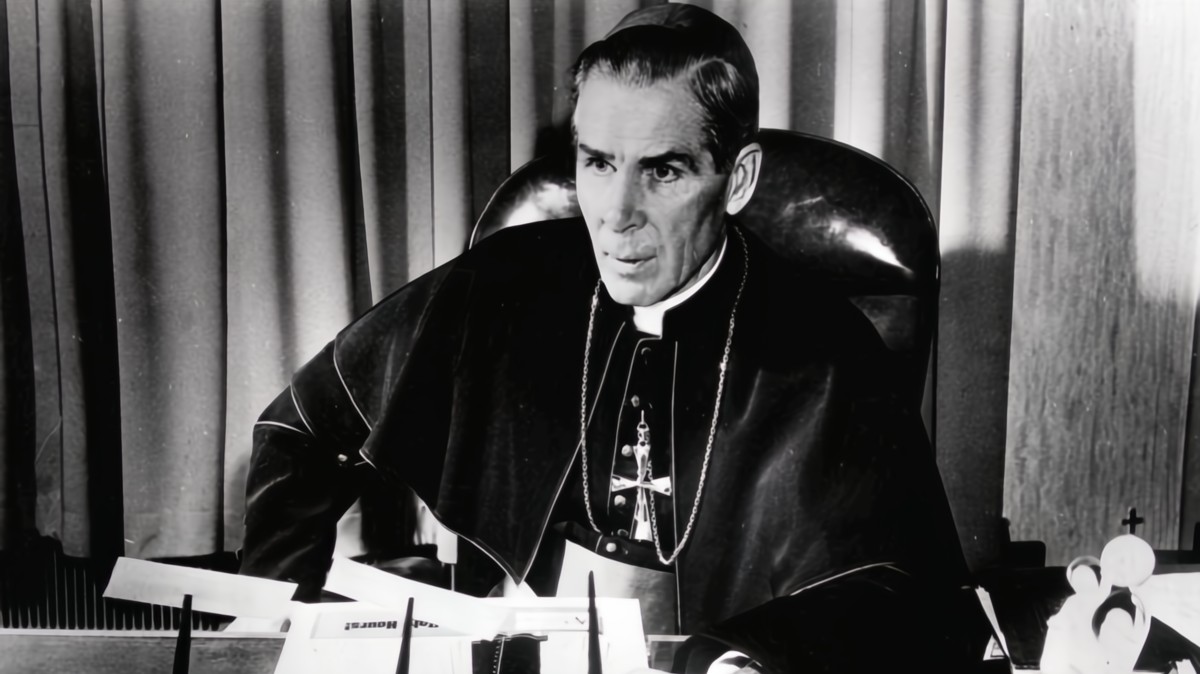
There were no elaborate sets. No flashing graphics. No carefully engineered spectacle. Often, there was little more than a priest in a cassock, a chalkboard, and a message rooted unapologetically in Jesus Christ. Yet Archbishop Fulton J. Sheen became one of the most recognizable religious figures in America.
Decades after his death, his sermons continue to circulate online, his books remain in print, and Catholics who were not even born during his lifetime are discovering the remarkable clarity with which he spoke about Christ, the Church, sin, suffering, marriage, the Eucharist, the Blessed Virgin Mary, and the human soul. And now, the Church is giving the faithful another reason to look closely at his life.
On Sept. 24, 2026, Fulton Sheen is being beatified in St. Louis, Missouri, moving the celebrated American evangelist another step along the Church’s path toward canonization. But behind the television personality and famous preacher was something much quieter. There was a priest kneeling before the Blessed Sacrament.
A Vocation That Would Reach Millions
Fulton John Sheen was born May 8, 1895, in El Paso, Illinois, the eldest of four sons born to Newton and Delia Sheen. His given first name was Peter, but he eventually became known by his mother’s maiden name, Fulton. Raised in a devout Catholic family, he developed a vocation to the priesthood and was ordained for the Diocese of Peoria on September 20, 1919.
His intellectual gifts soon became evident. Sheen pursued advanced studies in the United States and Europe, earning a doctorate in philosophy from the Catholic University of Leuven in Belgium in 1923. His education immersed him deeply in Catholic philosophy and theology, but his learning would never remain confined to lecture halls.
After returning to the United States, he eventually joined the faculty of The Catholic University of America in Washington, D.C., where he taught philosophy and theology for decades. Sheen possessed the unusual ability to take profound theological ideas and make them understandable without emptying them of their meaning. That gift would eventually carry Catholic teaching far beyond the classroom.
The Secret Behind Fulton Sheen’s Apostolate
For all his academic achievements and public success, Sheen repeatedly returned to one source of strength: Jesus Christ in the Eucharist. From the time of his priestly ordination, Sheen committed himself to making a daily Holy Hour before the Blessed Sacrament. He maintained that practice throughout his priesthood. It became so central to his spiritual life that he called the Holy Hour “the hour that makes my day.”
Long before he spoke to millions, Sheen first spent time listening to Christ. That distinction is essential for understanding him. His extraordinary public apostolate was rooted in a deeply private life of prayer. The effectiveness of his preaching cannot be separated from the hours he spent before the Eucharistic Lord.
For Sheen, evangelization was not primarily a communications strategy. It flowed from communion with Christ. His spirituality was also deeply shaped by the Cross and by devotion to the Blessed Virgin Mary. Vatican News describes the Eucharist, the Cross, and Our Lady as foundational elements of the spirituality that sustained him throughout his life.
A Catholic Voice Enters American Homes
In 1930, Sheen entered the emerging world of mass communication through radio. He became a regular voice on The Catholic Hour, bringing Catholic teaching into homes throughout the United States. At the height of its popularity, the program reached an estimated four million listeners.
Then came television. In the early 1950s, Sheen began Life Is Worth Living, the program that would transform him into a household name. The format was remarkably simple. Sheen stood before the camera, frequently accompanied only by his famous chalkboard, and spoke directly to viewers.
He addressed faith, morality, suffering, family life, human dignity and the great questions confronting modern civilization. And people listened. The television program eventually attracted an audience estimated at approximately 30 million people. In 1953, Sheen even received an Emmy Award for Most Outstanding Personality.
This was extraordinary not simply because a bishop had become a television celebrity. It was extraordinary because Sheen refused to treat Catholicism as something that needed to be hidden in order to enter the mainstream. He brought the Faith with him.
Evangelization Without Apology
Sheen understood something Catholics are still wrestling with in the digital age: new technology does not have to belong exclusively to secular culture. It can become an instrument for evangelization.
Radio was new. Television was new. Sheen used both. Today, his preaching has migrated again — this time to YouTube, podcasts, social media clips and digital archives.
The technology has changed completely. The questions of the human heart have not. People still struggle with loneliness, temptation, anxiety, suffering, identity, marriage, meaning, death and the existence of God. That may help explain why a bishop who died in 1979 can still sound remarkably contemporary.
On the eve of Sheen’s beatification, Pope Leo XIV specifically highlighted this dimension of his legacy, expressing the hope that Sheen’s example would inspire others to discover new ways of spreading the Gospel with joyful enthusiasm. The connection is also personal for the Pope. Earlier this year, Pope Leo recalled Sheen as a “light of faith, hope, and love” and said that he himself had witnessed Sheen’s evangelizing influence while growing up.
His Mission Extended Far Beyond Television
The television cameras sometimes overshadow another enormous part of Sheen’s ministry: his commitment to the missions. In 1950, he became national director of the Society for the Propagation of the Faith. The work gave Sheen a global vision of the Church.
He helped raise support for missionary territories and traveled to places where the Church was growing under difficult circumstances. His concern was not simply that Catholics in America understand their Faith, but that the Gospel reach souls throughout the world. His missionary work reflected the same conviction that drove his broadcasting career. The Gospel was meant to be proclaimed.
From Priest to Bishop
In 1951, Sheen was appointed an auxiliary bishop of the Archdiocese of New York. He also participated in the Second Vatican Council, placing him inside one of the most consequential moments in modern Catholic history.
In 1966, at the age of 71, he was appointed Bishop of Rochester, New York. His tenure there lasted only three years. In 1969, he resigned from the pastoral governance of the diocese and received the personal title of archbishop.
Retirement, however, did not mean withdrawal. Sheen continued writing, preaching and leading retreats while maintaining the life of prayer that had sustained his ministry from the beginning.
The Author Behind the Famous Voice
Television may have given Sheen his largest audience, but the written word gave his teaching remarkable permanence. He authored dozens of books during his lifetime. Among the best known is Life of Christ, his sweeping meditation on Jesus and the Gospels.
He also wrote about marriage, priesthood, peace, suffering, communism, the spiritual life and the crises confronting modern humanity. Near the end of his life, he wrote his autobiography, Treasure in Clay. The title itself captured something essential about Sheen’s understanding of priesthood and Christian discipleship. The instrument was human. The treasure belonged to God.
Suffering Near the End
The eloquent bishop who had once commanded television screens eventually encountered the frailty that comes with age. Sheen underwent open-heart surgery later in life and endured declining health. But suffering itself became part of his spiritual offering.
Rather than viewing physical weakness as rendering his life useless, he united his suffering to the crucified Christ. It was the same theology of the Cross that he had preached publicly for decades, now lived personally.
Then came one final memorable encounter. In October 1979, Pope St. John Paul II visited the United States. When the Pope encountered the elderly Archbishop Sheen in New York, Sheen attempted to kneel before him. John Paul II raised him up and embraced him.
The Pope then offered words that seemed to summarize Sheen’s entire priestly life: “You have written and spoken well of the Lord Jesus Christ. You are a loyal son of the Church.”
Two months later, on December 9, 1979, Archbishop Fulton Sheen died in New York City at the age of 84.
The Cause for Sainthood
Death did not end interest in Fulton Sheen. In 2002, his cause for canonization formally opened in the Diocese of Peoria, where he had been ordained a priest. A decade later, Pope Benedict XVI recognized Sheen’s heroic virtue, and he was declared Venerable in 2012.
Then came the miracle that would clear the way for beatification. In September 2010, a baby boy was born without a heartbeat or respiration. His parents prayed for Fulton Sheen’s intercession. The child remained without signs of life for 61 minutes before his heart began beating.
Remarkably, he survived and recovered without the devastating neurological damage doctors would ordinarily expect after such prolonged oxygen deprivation. After extensive investigation through the Church’s process for evaluating alleged miracles, the healing was accepted as medically inexplicable and attributed to Sheen’s intercession.
In 2019, Pope Francis authorized the decree recognizing the miracle, clearing the way for Sheen’s beatification.
Fulton Sheen Becomes Blessed
After years of anticipation, the moment has finally arrived. On September 24, 2026, Archbishop Fulton J. Sheen is being beatified in St. Louis.
Cardinal Luis Antonio Tagle, Pro-Prefect of the Dicastery for Evangelization, is presiding at the beatification Mass as the representative of Pope Leo XIV.
It is a remarkable conclusion to one chapter of a story that began more than a century ago in a small Illinois town. The young man who became a priest could hardly have imagined television, much less the digital world in which his sermons would one day circulate. Yet the central message never depended upon the technology. It depended upon Christ.
What Fulton Sheen Can Teach Catholics Today
Perhaps the greatest danger in remembering Fulton Sheen is reducing him to the Catholic Church’s first great television personality. His media success was remarkable. But it was not the foundation. The foundation was the Eucharist.
Before the studio came the sanctuary. Before the camera came the tabernacle. Before millions listened to Fulton Sheen, Fulton Sheen listened to Christ. That may be his most important lesson for Catholics living in an age saturated with media.
The Church needs effective communicators. It needs Catholics willing to enter new forms of media. It needs writers, teachers, filmmakers, journalists, podcasters and evangelists who understand the technologies shaping modern culture. But technique alone cannot evangelize the human heart.
Catholic evangelization must begin where Sheen’s began: with Jesus Christ. The man who spoke to millions spent an hour each day in silence before Him.
And nearly half a century after Fulton Sheen’s death, the world is still listening. Perhaps that is because Sheen understood that the Catholic evangelist’s task is not ultimately to make the world remember the messenger. It is to make the world remember Christ.
Your support brings the truth to the world.
Catholic Online News exists because of donors like you. We are 100% funded by people who believe the world deserves real, uncensored news rooted in faith and truth — not corporate agendas. Your gift ensures millions can continue to access the news they can trust — stories that defend life, faith, family, and freedom.
When truth is silenced, your support speaks louder.