

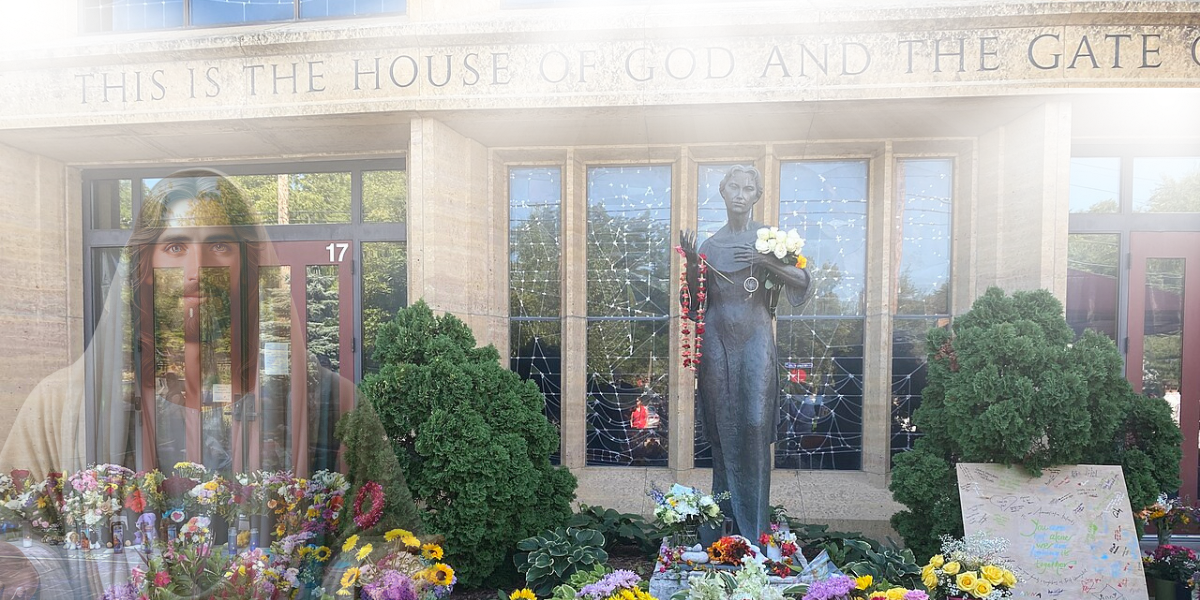
One year ago today, Charlie Kirk was assassinated while speaking to students at Utah Valley University. Within hours of his death, a word began appearing again and again: martyr.
We asked the question then: Was Charlie Kirk a martyr? It was controversial. Some immediately said yes. Others argued that the word belonged only to those explicitly killed because of their Christian faith. Still others believed it was far too soon to make such a judgment.
Now a full year has passed. The emotion of Sept. 10, 2025, is no longer fresh. We have had twelve months to watch what happened after Charlie’s death, to listen again to his final years of public witness, and to consider what he was increasingly trying to tell America. So perhaps it is time to ask the question again: Was Charlie Kirk a martyr?
What Makes Someone a Martyr?
For Catholics, martyrdom means something more specific than simply dying heroically or being murdered while living as a Christian. The word comes from the Greek word for “witness.”
The Catechism of the Catholic Church teaches that martyrdom is “the supreme witness given to the truth of the faith” and that the martyr “bears witness to Christ who died and rose, to whom he is united by charity.”
That distinction matters. Charlie Kirk was unquestionably assassinated. But was he killed for Christ? That is the harder question.
Charlie was a political figure. He founded Turning Point USA. He campaigned for conservative causes. He debated abortion, gender, marriage, education, government, and American politics. Any serious discussion of his death must acknowledge that.
But reducing Charlie Kirk’s public life to politics misses something that had become increasingly impossible to ignore: Charlie Kirk was talking about Jesus Christ.
Politics Wasn’t the Whole Message Anymore
Toward the end of his life, Charlie’s message was becoming unmistakably spiritual. He urged young people to marry and have children. He defended unborn life. He warned about pornography and the destruction of the family. He encouraged Christians to stop being ashamed of their beliefs. Again and again, he said America’s deepest problems could not ultimately be fixed through politics. America needed God.
That was not a small part of Charlie’s message hidden behind his politics. It was increasingly becoming the foundation beneath everything else. He understood that elections could change governments. Only God could change hearts.
He Told Us What Mattered Most
Perhaps the most important evidence comes from Charlie himself. Before his assassination, Charlie was asked what he wanted to be remembered for. He could have named the enormous organization he founded at 18. He could have mentioned elections, political victories, millions of followers, packed auditoriums, or the countless debates that made him famous.
He didn’t.
“I want to be remembered for courage for my faith,” Charlie said. Then he made it even clearer: “The most important thing is my faith.”
Those words were powerful when Charlie was alive. One year after his assassination, they are haunting. The most important thing is my faith.
Charlie did not know that his life would soon be measured in days. But he had already told the world how he wanted that life to be measured. Not by politics, but by faith.
Then There Was Mary
There is another part of Charlie’s final spiritual journey that Catholics cannot easily ignore. Charlie Kirk was an Evangelical Protestant, not a Catholic. Yet near the end of his life, he began speaking about the Blessed Virgin Mary in a way rarely heard from major Evangelical voices.
Charlie argued that Protestants had “under-venerated” Mary. He spoke about her as an extraordinary model for young women and defended the importance of honoring the Mother of Jesus. His wife, Erika, is Catholic, and Charlie had also begun attending Mass with her.
Then, just days before his assassination, Charlie met Bishop Joseph Brennan of Fresno. During their conversation, Kirk reportedly said he had been attending Mass. And then he said three words that took on an entirely different meaning after September 10: “I’m very close.”
We cannot know exactly what Charlie meant, and we cannot claim a conversion that never publicly happened. But we can wonder where that road might have led. Charlie was 31 years old. He should have had decades left to continue walking it.
The Question We Still Cannot Answer Easily
Was Charlie Kirk killed because he was Christian, or was he killed because of his politics? Perhaps that distinction is not as simple as it first appears.
For Charlie, the two increasingly intersected. His opposition to abortion came from a belief in the sanctity of human life. His defense of marriage came from his understanding of God’s design for the family. His warnings about America’s future increasingly centered on the country’s abandonment of God. His public positions were controversial precisely because many of them came from convictions about truths he believed were greater than politics.
That does not automatically make his assassination a Christian martyrdom. But it does make the question more complicated than simply saying, “He was a political activist.”
What Happened After His Death Matters
A martyr’s witness does not end with death. Sometimes death magnifies it, and that is certainly what happened with Charlie Kirk.
His assassination did not erase his words. Millions heard them again. Videos resurfaced of Charlie talking about Jesus, marriage, children, abortion, Mary, faith, and America’s desperate need for God. People who had known him only as a political commentator discovered another side of him.
And then his widow did something extraordinary. At Charlie’s memorial, Erika Kirk publicly forgave the man accused of killing her husband. She pointed directly to Jesus Christ and recalled Christ’s words from the Cross: “Father, forgive them.”
“The answer to hate is not hate,” she said. “The answer we know from the Gospel is love and always love.”
A bullet had produced unimaginable grief. The response was the Gospel.
So, Was Charlie Kirk a Martyr?
One year later, the most responsible Catholic answer remains more complicated than a simple yes or no. Charlie Kirk cannot simply be declared a martyr because Christians admire him, because he defended causes Catholics share, or because his death was horrific. The Church takes martyrdom seriously. It requires more than courage. It requires witness to Christ unto death.
And Charlie was not Catholic, so there is no question of the Catholic Church formally canonizing him as a martyr.
But there is another sense of the word that Christians have used for centuries: witness.
Charlie Kirk was certainly becoming a louder witness to Jesus Christ. He publicly professed his faith. He defended unborn children. He defended marriage and family. He challenged young people to reject a culture of emptiness and build lives centered on God. And when asked what he wanted his legacy to be, he chose faith above everything else.
That matters.
One Year Later, the Question Remains
Perhaps we were too quick one year ago to demand an answer. Martyr or not? Saint or sinner? Politics or faith? Human lives rarely fit so neatly into the categories we create for them.
But twelve months later, one thing has become clearer. The bullet that killed Charlie Kirk did not erase his Christian witness. It amplified it.
A year later, people are still hearing Charlie talk about Christ. They are still hearing him defend life. They are still hearing him tell young people to marry and have children. They are still hearing his unexpected words about Mary. And they are still hearing the words Charlie himself chose when asked how he wanted to be remembered: “The most important thing is my faith.”
So was Charlie Kirk a martyr?
The Catholic Church cannot give us that answer about a man who died outside her visible communion, and we should be careful about claiming something we cannot know with certainty. But one year after his assassination, perhaps the question has not gone away for a reason.
Charlie Kirk spent his final years becoming increasingly outspoken about Jesus Christ. Then someone took his life. Instead of silencing that witness, his death caused millions more people to hear it.
Maybe history will remember Charlie Kirk primarily as a political activist. Maybe it will remember him as the founder of a movement. But perhaps Christians will remember something else: a young husband and father who said the most important thing in his life was his faith — and whose voice continued pointing people toward God long after a bullet tried to silence it.
Your support brings the truth to the world.
Catholic Online News exists because of donors like you. We are 100% funded by people who believe the world deserves real, uncensored news rooted in faith and truth — not corporate agendas. Your gift ensures millions can continue to access the news they can trust — stories that defend life, faith, family, and freedom.
When truth is silenced, your support speaks louder.


Yes Charlie’s a martyr, he was rooted in Jesus and his political beliefs were rooted in Christian teaching. The gay/ trans oriented guy that killed him killed him because of his “hate” meaning how Charlie did not support LGBTQ because he knew it was wrong according to the Bible.
Pray for his family and the conversion of the guy that shot him. God bless Erika, Charlie & their babies