
Archaeologists working beneath the Church of the Holy Sepulchre in Jerusalem have uncovered evidence of ancient cultivated land dating to the time of Christ, a discovery that strikingly echoes the Gospel of John’s description of the place where Jesus was buried.
The Church of the Holy Sepulchre, one of Christianity’s holiest sites, is traditionally believed to encompass both Calvary, where Jesus was crucified, and the tomb where His body was laid before the Resurrection.
The Gospel of John specifically describes the area surrounding Christ’s tomb as a garden.
“At the place where Jesus was crucified, there was a garden, and in the garden a new tomb, in which no one had ever been laid,” John 19:41 records.
Now, archaeological work beneath the church has revealed physical evidence that the area was indeed cultivated approximately 2,000 years ago.
According to Popular Mechanics, a team led by Francesca Romana Stasolla of Sapienza University of Rome discovered evidence of ancient olive trees and grapevines beneath the church. The findings indicate that the area associated with Jesus’ burial had once been used for agriculture.
The excavations began in 2022 as part of renovation work at the Church of the Holy Sepulchre. The religious communities responsible for the church had agreed in 2019 to replace its 19th-century flooring and allowed archaeologists to investigate what lay beneath it.
“With the renovation works, the religious communities decided to also allow archaeological excavations under the floor,” Stasolla told the Times of Israel, as quoted by Popular Mechanics.
Beneath the church, archaeologists encountered an ancient quarry dating to the Iron Age. By the time of Jesus, portions of the quarry had become a burial area containing tombs cut directly into the rock.
Researchers also found that the landscape had been altered for cultivation. According to Stasolla, low stone walls were constructed and the areas between them filled with soil.
The archaeobotanical evidence proved particularly significant because of its similarity to the description preserved in the Gospel of John.
“The archaeobotanical findings have been especially interesting for us, in light of what is mentioned in the Gospel of John, whose information is considered written or collected by someone familiar with Jerusalem at the time,” Stasolla told the Times of Israel.
“The Gospel mentions a green area between the Calvary and the tomb, and we identified these cultivated fields,” she added.
The discovery does not, by itself, prove that the tomb traditionally venerated inside the Holy Sepulchre is the tomb of Jesus. However, it provides archaeological evidence that an important detail in the Gospel account corresponds with what researchers have found beneath the church.
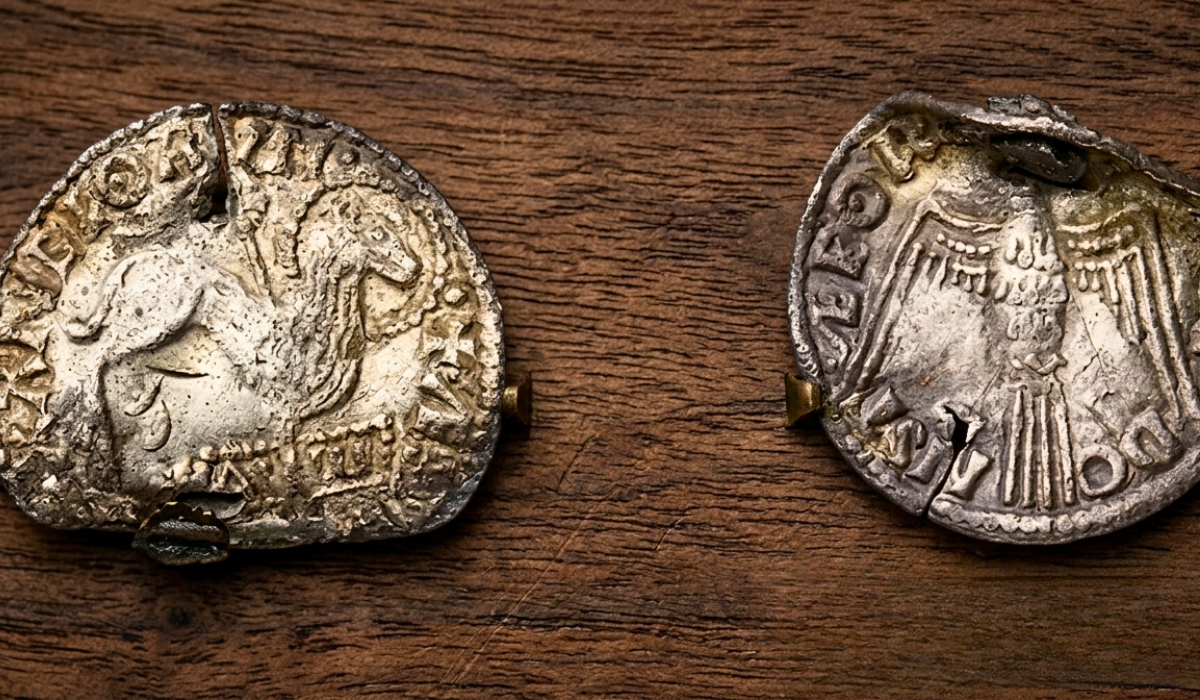
The excavations also uncovered coins and pottery dating roughly to the fourth century, when the site became the location of a major Christian church under the Roman Emperor Constantine.
Constantine, the first Roman emperor to convert to Christianity, ordered a church constructed at the location identified by early Christians as the site of Christ’s burial. After centuries of destruction, rebuilding and modification, the present Church of the Holy Sepulchre largely took shape under the Crusaders in the 12th century.
Analysis of the archaeological material is far from complete. Stasolla said that fully studying the artifacts uncovered during the project could take years.
For Catholics and other Christians, the discovery is especially noteworthy because it offers a tangible connection between archaeology and a detail recorded in Scripture nearly two millennia ago. The Gospel does not merely place Christ’s tomb near Calvary; it specifically remembers a cultivated, green space surrounding the place of His burial.
Stasolla emphasized that the archaeological work also reveals the extraordinary history of Christian devotion at the site.
“The real treasure we are revealing is the history of the people who made this site what it is by expressing their faith here,” she told the Times of Israel.
“Whether someone believes or not in the historicity of the Holy Sepulchre, the fact that generations of people did is objective,” Stasolla continued. “The history of this place is the history of Jerusalem, and at least from a certain moment, it is the history of the worship of Jesus Christ.”
The discovery cannot settle every historical question surrounding the tomb of Christ. But beneath the stones of one of Christianity’s most sacred churches, archaeologists have now found something remarkably consistent with the Gospel account: at the time of Jesus, there really was cultivated land near the place Christians have venerated for centuries as Calvary and the empty tomb.
Your support brings the truth to the world.
Catholic Online News exists because of donors like you. We are 100% funded by people who believe the world deserves real, uncensored news rooted in faith and truth — not corporate agendas. Your gift ensures millions can continue to access the news they can trust — stories that defend life, faith, family, and freedom.
When truth is silenced, your support speaks louder.