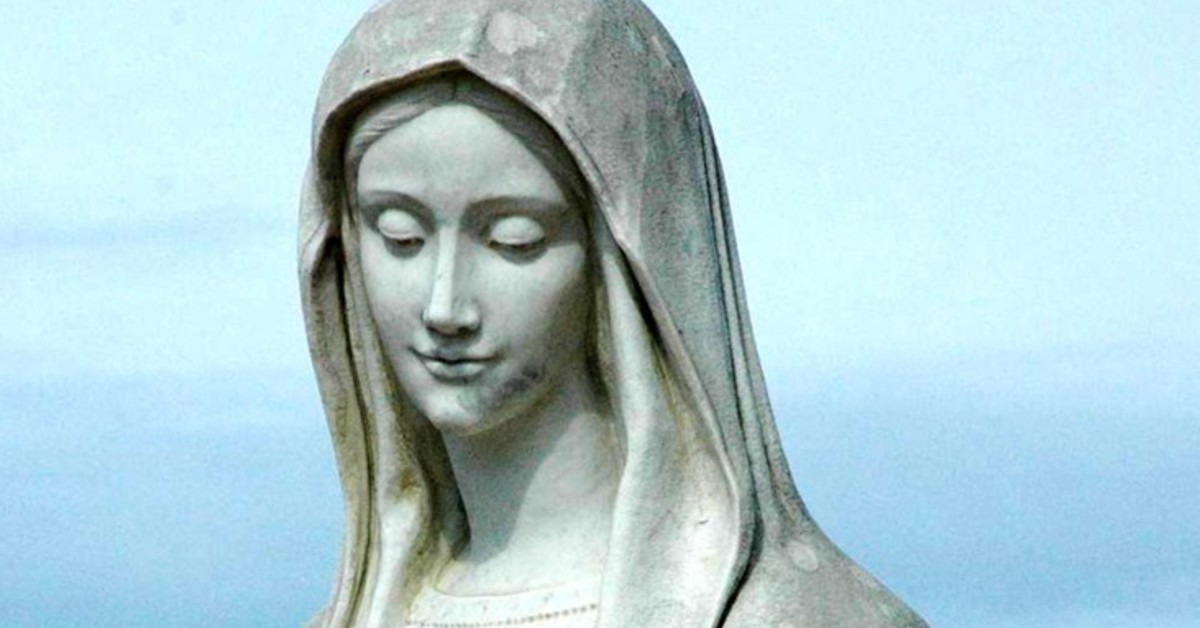

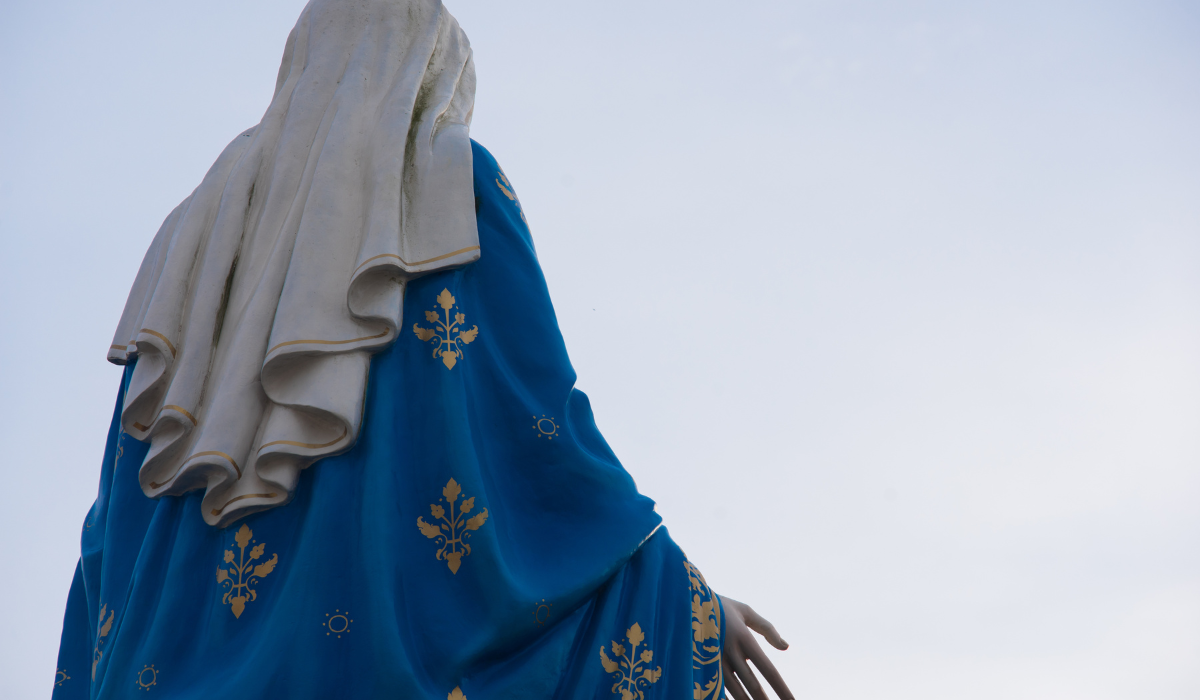
A new depiction of the Blessed Virgin Mary created for Siena’s historic Palio horse race has ignited controversy among Catholics, with critics objecting to what they describe as the image’s masculine or androgynous appearance.
The artwork appears on the Drappellone, the painted silk banner awarded to the victorious contrada, or historic district, in the Palio di Siena. The banner for the August race traditionally carries an image of the Virgin Mary, reflecting the centuries-old connection between the event and Marian devotion in the Italian city.
According to LifeSiteNews, the Municipality of Siena unveiled this year’s banner on Aug. 10. The work was commissioned by the city and created by Romanian artist Teodora Axente.
The banner depicts Siena and its districts beneath a prominent representation of the Virgin Mary. The portrayal quickly drew criticism because of facial and physical characteristics some observers regarded as distinctly masculine.
The controversy is particularly sensitive because the August Palio is connected with the Feast of the Assumption of the Blessed Virgin Mary, Siena’s patroness. On Aug. 14, the banner was brought to Siena Cathedral to receive a blessing ahead of the feast, according to LifeSiteNews.
Axente has defended the depiction as an expression of her own artistic understanding of Mary.
“This is the Madonna that I dream of, this is my vision of the Madonna,” Axente said, according to remarks cited by LifeSiteNews.
Questions about the representation of sex and gender in the artwork were also raised during an interview with Siena News. When the interviewer observed that numerous women appeared in the banner, Axente explained that she did not understand the figures as strictly male or female.
“The characters don’t refer to being a woman or a man; they are more androgynous, so they are universal characters,” she said, according to the interview quoted by LifeSiteNews.
The comments intensified criticism surrounding the banner, particularly among Catholics concerned about the proper representation of the Blessed Virgin in an image associated with a longstanding religious tradition.
Italian Catholic blog Messainlatino offered an especially severe assessment of the artwork.
“With all due reverence to the Most Holy Mary, the Drappellone of the Palio di Siena for the Assumption looks like a man – almost … a ‘cross-dresser,’ even in the hands,” the blog stated on August 14, according to LifeSiteNews.
The Archdiocese of Siena, however, defended the artwork against suggestions that the artist deliberately intended to disrespect the Virgin Mary.
In a statement published by the archdiocese, Father Enrico Grassini, director of its Cultural Heritage Office, argued that the work should be understood within the artistic and cultural background from which Axente emerged.
“Considering the cultural and educational context in which the artist works – one of the most renowned art schools in Eastern Europe, the Cluj school in Romania, where contemporary art often engages with Christian spiritual themes and traditional forms – the language of provocation seems absent from the piece,” Grassini wrote.
At the same time, the archdiocesan statement acknowledged a disconnect between the artist’s background and the particular Marian tradition surrounding the Palio.
“The artist, moreover, comes from a Christian formation rooted in the Orthodox tradition, with the resulting limitation of not fully entering into the Western developments of Marian spirituality over the last five centuries, which the Palio’s iconography instead draws upon,” the statement said.
Grassini also argued that the artist should have been better informed in advance about the religious significance attached to the commission, according to LifeSiteNews.
The debate reaches beyond questions of contemporary artistic style because the Drappellone is not simply a decorative trophy. The Palio di Siena is a centuries-old civic and religious tradition in which Siena’s historic districts compete in a horse race through the Piazza del Campo.
Held twice each year, the Palio is deeply intertwined with the identity of the city and its devotion to the Blessed Virgin Mary. The August race is associated particularly with Our Lady of the Assumption.
Each year, a different artist is commissioned to create the silk Drappellone. The winning contrada receives the banner, which traditionally incorporates Marian imagery alongside symbols associated with Siena and ultimately becomes a treasured possession of the victorious district.
That devotional dimension has made this year’s artistic controversy especially significant. For Catholics critical of the image, the dispute concerns not simply whether a contemporary artwork is aesthetically appealing, but how the Mother of God should be represented within a tradition explicitly established in her honor.
The Archdiocese of Siena, meanwhile, has maintained that the controversial depiction should not be interpreted as an intentional act of profanation.
The disagreement now places two competing understandings of the artwork at the center of one of Italy’s most recognizable Catholic civic traditions: the artist’s stated vision of an “androgynous” and universal representation, and the expectation among many faithful that an image created specifically to represent the Blessed Virgin should visibly and reverently portray Mary as the Mother of God.
Your support brings the truth to the world.
Catholic Online News exists because of donors like you. We are 100% funded by people who believe the world deserves real, uncensored news rooted in faith and truth — not corporate agendas. Your gift ensures millions can continue to access the news they can trust — stories that defend life, faith, family, and freedom.
When truth is silenced, your support speaks louder.