
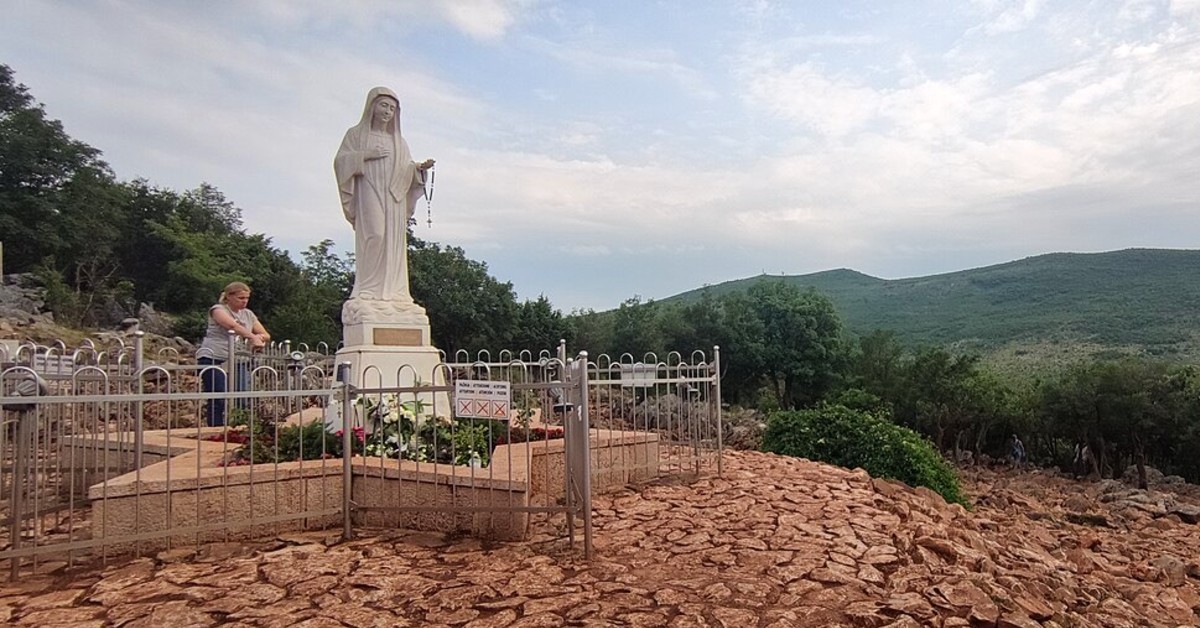
A previously undisclosed Vatican consultation reportedly found that nearly two-thirds of participants examining the alleged apparitions at Medjugorje did not consider the events to be supernatural, shedding new light on years of internal Church debate surrounding the famous pilgrimage destination.
Italian journalist David Murgia reported on August 6 that 33 cardinals, bishops, theologians, and other experts submitted assessments to the Congregation for the Doctrine of the Faith in 2016 regarding the alleged Marian apparitions that began in Medjugorje, Bosnia-Herzegovina, in 1981.
According to Murgia’s report, 21 of the 33 participants concluded that the phenomena were not supernatural, while nine judged them to be supernatural. Three others concluded that the “supernatural character had not been established.”
The reported results mean that more than 63 percent of those consulted opposed recognizing the events as supernatural.
LifeSiteNews reported that the consultation took place after Pope Francis referred the Medjugorje question to the Congregation for the Doctrine of the Faith’s ordinary “Feria Quarta” session following his examination of the findings of an earlier Vatican commission.
That earlier investigation, commonly known as the Ruini Commission, had been established by Pope Benedict XVI in 2010 to study the alleged apparitions. According to Murgia, the commission had shown greater openness toward the possibility of a supernatural character, particularly regarding the earliest reported events of 1981.
According to LifeSiteNews, the identities of those who participated in the later consultation reportedly included prominent Church leaders and theological experts, although Murgia did not reveal how individual participants voted. He said he intends to publish the individual positions at a later date.
The newly reported vote provides additional historical context for the Church’s cautious approach to Medjugorje, but it does not represent the Vatican’s current official judgment on the devotion.
In 2019, Pope Francis authorized official pilgrimages to Medjugorje, while making clear that the authorization should not be interpreted as authentication of the alleged apparitions.
The Vatican subsequently adopted a new framework for evaluating alleged supernatural phenomena.
In May 2024, the Dicastery for the Doctrine of the Faith issued new norms allowing Church authorities to recognize the pastoral and spiritual benefits associated with a devotion without declaring that the underlying phenomenon is supernatural.
The norms state that “as a general rule, it is not foreseen in these Norms that ecclesiastical authority would give a positive recognition of the divine origin of alleged supernatural phenomena.”
That approach became especially significant for Medjugorje several months later.
On September 19, 2024, the Dicastery for the Doctrine of the Faith issued its “Note About the Spiritual Experience Connected with Medjugorje,” granting a Nihil obstat for the spiritual phenomenon associated with the site.
The Vatican document recognized numerous positive fruits connected with Medjugorje, including conversions, renewed participation in the sacraments, vocations, prayer, and works of charity. At the same time, Church authorities emphasized that those spiritual fruits do not establish that the alleged apparitions themselves are supernatural.
The Dicastery also identified elements in some reported messages that require prudence, including theological imprecision, threatening or apocalyptic language, and an excessive emphasis on following and spreading messages that could risk distracting from the central place of Sacred Scripture.
The Nihil obstat therefore permits and encourages prudent pastoral engagement with the devotion without authenticating the alleged apparitions or requiring Catholics to accept the reported messages.
The distinction is important for Catholics seeking to understand the Church’s position. Approval of pilgrimages and recognition of spiritual fruits are not equivalent to a declaration that the Virgin Mary has appeared at Medjugorje.
According to LifeSiteNews, Murgia believes the newly disclosed 2016 figures demonstrate just how sharply divided Church officials were over the question. He described the controversy surrounding Medjugorje as having once threatened a profound fracture within the Church, “almost a schism,” between those seeking rejection of the phenomenon and those who believed at least some of the earliest events warranted greater openness.
For now, the Catholic Church continues to approach Medjugorje with both pastoral openness and doctrinal caution. Catholics may participate in approved pilgrimages and benefit from the prayer, Confession, Eucharistic devotion, and conversion associated with the site, while remaining free from any obligation to believe that the reported apparitions or messages are of supernatural origin.
Your support brings the truth to the world.
Catholic Online News exists because of donors like you. We are 100% funded by people who believe the world deserves real, uncensored news rooted in faith and truth — not corporate agendas. Your gift ensures millions can continue to access the news they can trust — stories that defend life, faith, family, and freedom.
When truth is silenced, your support speaks louder.