

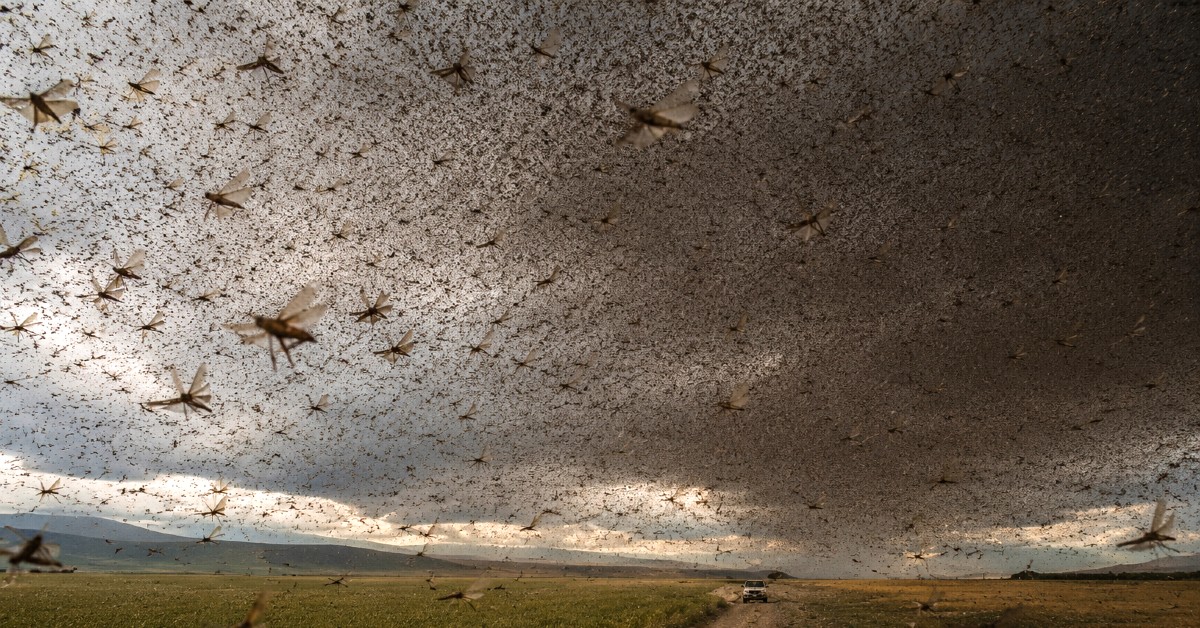
A massive swarm of locusts turned daylight into an eerie spectacle in Russia’s Republic of Dagestan this week, reminding many observers of the destructive power of nature and the importance of protecting the food sources upon which countless families depend.
According to Metro, millions of locusts swept across farmland in the Kizlyar district of Dagestan on Sunday, filling the sky so densely that residents feared the insects were moving toward nearby communities. Videos shared online showed enormous clouds of the insects moving across the landscape, creating scenes that many described as reminiscent of biblical imagery.
One resident recording the event could be heard asking, “Where are they heading? What on earth is this? Thank goodness they’re not heading towards the town!”
The individual then exclaimed, “They are going to eat us alive!”
Although the dramatic scenes caused understandable concern, locusts are not considered a direct danger to people. Their greatest threat is to agriculture, where large swarms can rapidly consume crops and vegetation, placing farmers’ livelihoods and regional food supplies at risk.
According to Metro, Dagestan’s Ministry of Agriculture and Food said authorities have already carried out extensive pest-control operations to reduce the impact of the infestation.
The ministry explained the challenge facing response teams, stating, “The situation is complicated by the fact that migratory locust swarms travel from nature conservation areas and reserves, where chemical treatment is strictly prohibited by law.”
Officials added, “However, as soon as the pests move into areas where treatment is permitted, all available equipment is deployed.”
The United Nations Food and Agriculture Organization has long warned that locust outbreaks remain a serious concern throughout the Caucasus and Central Asia. According to Metro, citing the UN agency, up to 20 million people and approximately 25 million hectares of cultivated land remain at risk from locust infestations across the region.
Locusts are capable of traveling remarkable distances, reportedly covering up to 93 miles in a single day, allowing swarms to spread rapidly across national borders. To improve response efforts, Kazakhstan and Uzbekistan have recently cooperated in using unmanned aerial systems, including drones, to monitor and combat migrating swarms.
Three primary species continue to affect the Russian Federation, the Caucasus, and Central Asia: the Italian locust (Calliptamus italicus), the Moroccan locust (Dociostaurus maroccanus), and the Asian Migratory Locust (Locusta migratoria).
For Christians, scenes like these naturally recall the biblical accounts in which locusts appear as signs of hardship and calls to repentance. While today’s infestation is understood through modern science and agriculture rather than as a supernatural event, it nevertheless serves as a reminder of humanity’s dependence on God’s creation and the need to pray for those whose crops, livelihoods, and food security may be threatened by natural disasters.
Your support brings the truth to the world.
Catholic Online News exists because of donors like you. We are 100% funded by people who believe the world deserves real, uncensored news rooted in faith and truth — not corporate agendas. Your gift ensures millions can continue to access the news they can trust — stories that defend life, faith, family, and freedom.
When truth is silenced, your support speaks louder.


