

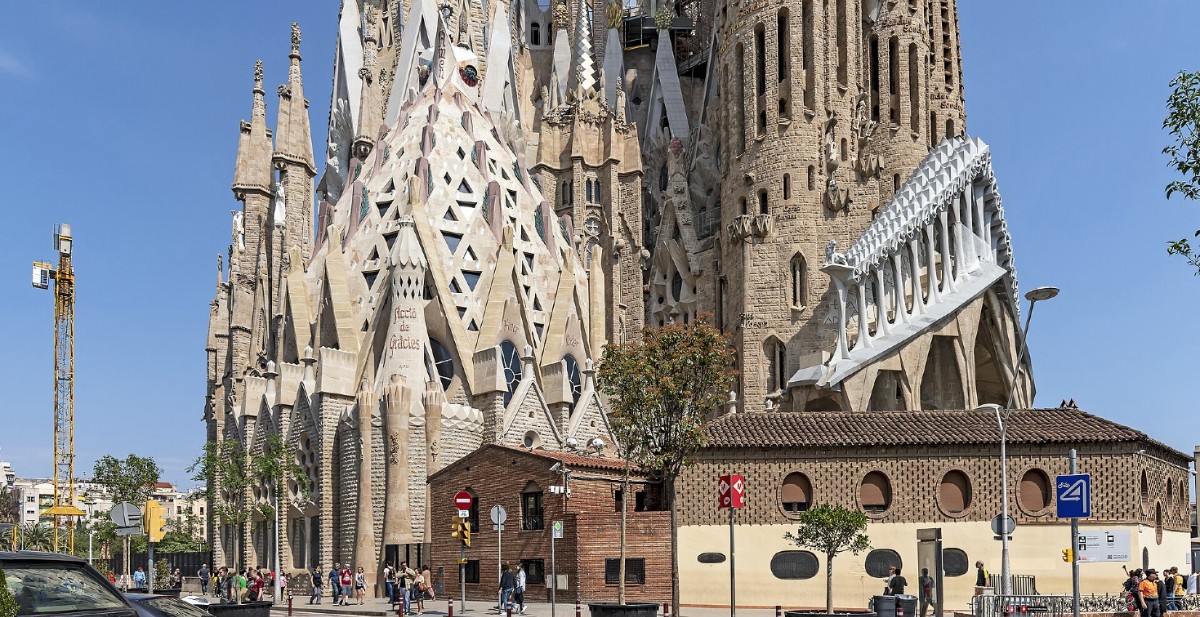
After more than a century of labor, prayer, and perseverance, a defining milestone has been reached at the Basílica i Temple Expiatori de la Sagrada Família in Barcelona. Workers recently secured the upper arm of a massive cross atop the Tower of Jesus Christ, bringing the basilica to its full exterior height of 566 feet.
According to Popular Science, the newly completed apex now makes the Sagrada Família taller than Germany’s Ulm Minster by roughly the length of a school bus. The cross—constructed from glass, ceramic tile, and stone sourced from Catalonia—was crafted in sections by artisans in Germany before being transported to Spain and carefully assembled. The structure is large enough to contain an interior spiral staircase and is designed to fulfill Antoni Gaudí’s intention that the cross shine day and night.
The church, unlike any other in the world, first broke ground in 1882. Its visionary architect, Antoni Gaudí, blended Gothic inspiration with Catalan art nouveau in a design that would consume the final decades of his life. Gaudí devoted more than 40 years to the basilica and spent his last 15 years working exclusively on the project. Yet when he died in 1926, less than a quarter of the church had been completed.
Our Important Lenten Message – Please Watch
This year marks the centenary of Gaudí’s death—making the installation of the cross a providentially timed tribute to the man whose faith and imagination shaped Barcelona’s skyline.
The road to this moment was not without suffering. In 1936, during the Spanish Civil War, portions of the basilica and many of Gaudí’s original plans and models were destroyed. According to Popular Science, progress since 1940 has relied on private funding, careful study of salvaged designs, and even modern computer modeling to interpret Gaudí’s vision faithfully.
The basilica’s 18 spires each carry profound symbolic meaning: twelve represent the Apostles, four honor the Evangelists, one is dedicated to the Virgin Mary, and the tallest now glorifies Jesus Christ. Gaudí even conducted acoustic studies so that wind-driven tubular bells inside the towers would resonate within the church itself—a reminder that sacred architecture, for him, was both theological and experiential.
Not everyone has admired the masterpiece. Popular Science notes that author George Orwell once criticized the basilica harshly, calling it “one of the most hideous buildings in the world” in his memoir Homage to Catalonia, even remarking, “I think the Anarchists showed bad taste in not blowing it up.” Yet despite such criticism, millions of pilgrims and visitors each year testify to the structure’s spiritual power and beauty.
Although the exterior now stands complete, significant interior work remains. Attention will turn to artistic elements, including a suspended Agnus Dei (Lamb of God) sculpture by Italian artist Andrea Mastrovito. According to Popular Science, the glass-fragment work will hang from the interior side of the cross within a hyperboloid structure—continuing Gaudí’s marriage of geometry and theology.
If construction proceeds as planned, the basilica is expected to be fully completed by 2034—152 years after the first stones were laid.
Gaudí himself understood the magnitude of the undertaking. When asked whether he worried about how long the project would take, he reportedly replied, “My client is not in a hurry.”
For Catholics around the world, the nearing completion of the Sagrada Família stands as more than an architectural achievement. It is a visible sign of faith sustained across generations—a testimony that what is built for the glory of God may take time, but is never rushed in eternity.
Your support brings the truth to the world.
Catholic Online News exists because of donors like you. We are 100% funded by people who believe the world deserves real, uncensored news rooted in faith and truth — not corporate agendas. Your gift ensures millions can continue to access the news they can trust — stories that defend life, faith, family, and freedom.
When truth is silenced, your support speaks louder.


