
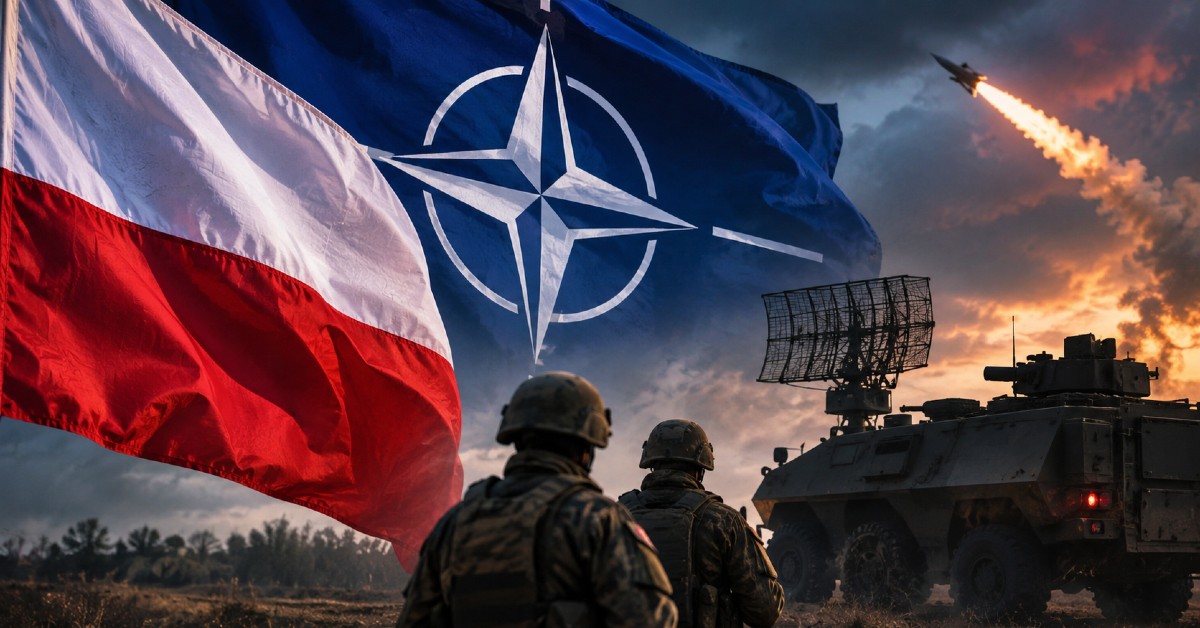
A dangerous escalation in the war between Russia and Ukraine has raised new concerns across Europe after Polish authorities confirmed that two Russian missiles and a drone entered NATO airspace on Friday, November 20, 2026.
The incident has intensified fears that the ongoing conflict could spread beyond Ukraine, placing neighboring countries and their civilian populations at greater risk.
According to Metro, an explosion was reported at approximately 6:35 a.m. local time near the village of Chmielek in southeastern Poland, close to the Ukrainian border. One Russian missile reportedly crossed into Polish territory and exploded approximately 28 miles from Ukraine.
Emergency responders, including police officers and firefighters, were dispatched to the area as authorities investigated multiple fallen objects near the border.
Poland Calls for Additional NATO Support
Polish Defence Minister Władysław Kosiniak-Kamysz announced that Poland would request additional NATO forces and military resources to strengthen Operation Eastern Sentry, an initiative intended to reinforce security along the alliance’s eastern flank.
According to Metro, Kosiniak-Kamysz described the incident as “not accidental,” pointing to its timing alongside a military exercise conducted by the coalition of the willing.
Polish Prime Minister Donald Tusk ordered an emergency meeting involving government ministers, military officials, and national security leaders to assess the situation and determine Poland’s response.
Meanwhile, Polish military officials sought to reassure residents living near the affected areas.
Lt. Col. Jacek Goryszewski, spokesperson for the Polish Armed Forces Operational Command, told Metro, “The object fell in fields near a forest and caught fire.”
He added, “There is no threat to residents of nearby farms or to the forest area.”
Despite those assurances, the incident has renewed concerns about the vulnerability of communities living near the Ukrainian border.
European Leaders Condemn Russian Incursion
The reported violation of Polish airspace prompted strong reactions from European officials, who warned that Russia’s military actions were increasingly threatening countries beyond Ukraine.
According to Metro, British Prime Minister Andy Burnham described the Russian missile incursion as “utterly unacceptable.”
British Defence Secretary Wes Streeting also expressed concern about the growing regional consequences of the war.
“This is very serious and I will meet Polish friends shortly. The impact of Russia’s illegal war is being felt across Ukraine and increasingly in neighbouring countries,” Streeting said.
“The UK stands in solidarity with our allies.”
Ukrainian President Volodymyr Zelensky also criticized Russian President Vladimir Putin, suggesting that the latest military action followed unsuccessful diplomatic encounters involving American President Donald Trump and Chinese President Xi Jinping.
According to Metro, Zelensky characterized those meetings as “weak meetings” and suggested that Putin’s actions reflected his continued efforts to challenge the international order.
Could the Missile Strike Trigger NATO’s Collective Defense Agreement?
The incident has also raised questions about whether Poland could seek formal action under NATO’s founding treaty.
Article 5 of the North Atlantic Treaty establishes the principle of collective defense, under which an armed attack against one NATO member is considered an attack against all members.
However, an airspace violation does not automatically trigger Article 5, and any collective response would depend on decisions made by NATO members.
According to Metro, Poland could instead consider invoking Article 4, which allows member nations to request formal consultations when they believe their territorial integrity, political independence, or security is threatened.
Such consultations would allow NATO allies to evaluate the incident and coordinate an appropriate response without automatically committing the alliance to military action.
The distinction is significant because any direct confrontation between Russia and NATO could carry consequences far beyond Eastern Europe.
Growing Tensions Along Poland’s Border
Friday’s incident follows other reported security concerns involving Russian activity near Polish territory.
Earlier in November, Polish authorities reported preventing what they described as an attempted Russian provocation near the border with Kaliningrad, the Russian territory situated between Poland and Lithuania.
According to Metro, Prime Minister Tusk said Polish Border Guard officials had detected individuals moving with flashlights near the border.
“We quickly mobilised the appropriate forces and resources there and managed to prevent any attempted provocation,” Tusk said.
The report also described a separate incident in late September in which a Russian Mi-8 helicopter reportedly crossed approximately 1,000 feet into NATO airspace from Kaliningrad.
Polish authorities viewed that incursion as a deliberate test of NATO defenses, further contributing to concerns about the country’s security.
A Renewed Call for Peace as Europe Faces Growing Uncertainty
For Catholics, the escalating tensions serve as another reminder of the devastating human consequences of war and the urgent need for peace.
While military leaders consider security measures and diplomatic responses, families living near conflict zones face the uncertainty of whether violence could reach their homes and communities.
The Catholic Church has consistently emphasized the importance of protecting innocent human life, pursuing peaceful solutions to international disputes, and recognizing the dignity of every person affected by armed conflict.
The Catechism of the Catholic Church teaches that peace is more than the absence of war. True peace requires justice, respect for human dignity, and a commitment to the common good.
As Poland strengthens its defenses and NATO evaluates the latest developments, the possibility of a wider European confrontation remains a serious concern.
For the faithful, the unfolding crisis is an invitation to pray for the people of Poland and Ukraine, for the protection of innocent civilians, and for world leaders to pursue diplomatic solutions that prevent further bloodshed.
With tensions continuing to rise along NATO’s eastern border, the need for restraint, responsible leadership, and lasting peace has become increasingly urgent.
Your support brings the truth to the world.
Catholic Online News exists because of donors like you. We are 100% funded by people who believe the world deserves real, uncensored news rooted in faith and truth — not corporate agendas. Your gift ensures millions can continue to access the news they can trust — stories that defend life, faith, family, and freedom.
When truth is silenced, your support speaks louder.