
A Catholic community in France is mourning the destruction of a sacred relic of St. Nicholas, the beloved fourth-century bishop whose generosity and compassion inspired the modern tradition of Santa Claus.
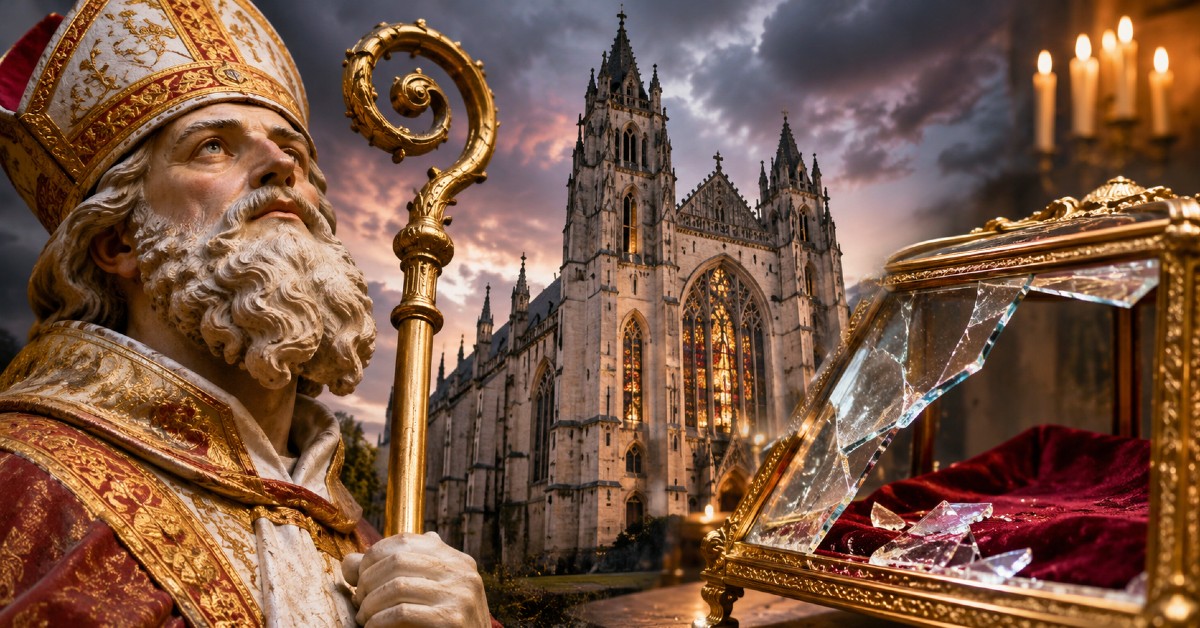
The relic, a fragment of bone believed to belong to the saint, was stolen from the Basilica of Saint-Nicolas-de-Port in northeastern France and reportedly burned and crushed by a man who objected to the Catholic practice of venerating relics.
According to a November 9 report by the Daily Mail, clergy discovered the theft on November 2 after a display case containing the relic was broken into. Police subsequently identified and arrested a suspect who reportedly confessed to destroying the sacred remains.
The man allegedly told investigators that he acted spontaneously out of a “desire to destroy” the relic because he considered the veneration of saints’ remains to be a form of idol worship.
For the Catholic faithful, however, the destruction represents far more than the loss of a historic religious artifact. It is an attack on a centuries-old tradition of honoring the saints and remembering their witness to Christ.
In a statement reported by the Daily Mail, priests of the Saint Nicolas in Lorraine Parish confirmed the suspect’s confession.
“The police investigation made it possible to identify and arrest the perpetrator. He admitted having broken the display case, then burned and crushed the relic.”
The priests also expressed the spiritual significance of the loss for generations of Catholics who have visited the basilica.
“Beyond the heritage value of this object, what touches us today is, above all, a profound attack on our history, our faith and the devotion of generations of pilgrims.”
The incident comes at a particularly painful time for the community, just weeks before the December 6 Feast of St. Nicholas, a celebration deeply rooted in the religious and cultural traditions of northeastern France and much of Europe.
A Sacred Connection to Nearly 1,000 Years of Catholic History
The Basilica of Saint-Nicolas-de-Port has been a major destination for Catholic pilgrims for centuries, preserving a connection to one of Christianity’s most beloved saints.
According to the Daily Mail, that history dates to 1098, when a knight named Aubert de Varangéville brought a relic of St. Nicholas from Bari, Italy, to the Lorraine region of France.
Tradition identifies the relic as a finger bone from the saint’s right hand, known as the “dextre bénissante,” or “blessing right hand.”
The relic’s arrival transformed the town into an important pilgrimage destination during the Middle Ages. Among its most notable visitors was St. Joan of Arc, who reportedly prayed there in 1429 before traveling to Chinon to meet the future King Charles VII.
Devotion to St. Nicholas became even more deeply established in Lorraine following the Battle of Nancy in 1477, when Duke René II defeated Charles the Bold. The duke subsequently declared St. Nicholas the region’s patron saint and commissioned the construction of the magnificent Gothic basilica.
Over the centuries, the church survived wars, revolution, and periods of religious upheaval. During the French Revolution, its precious gold reliquaries were melted down, and the building was temporarily transformed into a “Temple of Reason.”
Despite these challenges, the basilica remained a place of Catholic worship and pilgrimage.
Basilica’s Most Important Relic Remains Safe
Although the destruction has deeply affected the local Catholic community, church preservation officials have confirmed that the basilica’s principal relic of St. Nicholas was not harmed.
According to a November 7 statement from the Association Connaissance et Renaissance de la Basilique, cited by the Daily Mail, the principal relic remains safely preserved in the basilica’s treasury inside an arm-shaped reliquary.
The smaller bone fragment targeted in the recent attack had been placed beneath a statue of St. Nicholas in the basilica’s patronal chapel during the early 2000s.
The distinction offers some reassurance to pilgrims who have traveled to Saint-Nicolas-de-Port for generations to honor the saint.
The basilica is preparing for its traditional torchlight procession on December 5, the eve of the Feast of St. Nicholas. The annual celebration holds special significance throughout Lorraine and other European communities where devotion to the saint remains strong.
Why Catholics Honor the Relics of Saints
The destruction has also drawn attention to an important distinction in Catholic teaching: the difference between worship and veneration.
The Catholic Church teaches that worship belongs to God alone. Honoring saints and their relics is not worshiping human remains or treating physical objects as divine.
Instead, relics are respected because of their connection to holy men and women who lived lives of extraordinary faith and devotion to Jesus Christ.
This practice reflects the Catholic belief in the dignity of the human body, the communion of saints, and the resurrection of the dead.
For Catholics, the bones of a saint are not simply historical remains. They are a tangible connection to someone whose life bore witness to God’s grace.
The destruction of a relic therefore carries profound spiritual meaning, particularly when the act is motivated by hostility toward the religious devotion surrounding it.
The Real St. Nicholas Behind Santa Claus
Long before Santa Claus became associated with Christmas gifts and holiday celebrations, St. Nicholas was remembered as a Christian bishop whose life was marked by extraordinary charity.
Born around 270 AD, Nicholas served as Bishop of Myra, in what is now Turkey, and is traditionally believed to have died in 343 AD.
He became especially beloved for his generosity toward the poor and his willingness to help those facing hardship.
One of the most famous stories associated with the saint describes how he secretly provided gold to three impoverished young women, helping protect them from a life of exploitation.
His reputation for anonymous generosity eventually contributed to the gift-giving customs that developed into the modern Santa Claus tradition.
Yet for Catholics, St. Nicholas remains much more than the historical inspiration for a Christmas figure. He is honored as a bishop, a defender of the vulnerable, and a model of Christian charity.
His legacy continues to inspire acts of generosity, especially during the Advent and Christmas seasons.
A Legacy That Cannot Be Destroyed
The recent attack also recalls the remarkable journey of St. Nicholas’ remains across centuries and continents.
According to the Daily Mail, sailors transported his bones from Myra to Bari, Italy, in 1087. Portions of those remains later reached other European churches, including the sanctuary at Saint-Nicolas-de-Port.
Interest in the saint’s original burial place continues today.
In 2022, researchers investigating St. Nicholas Church in Demre, Turkey, announced the discovery of remains of an earlier church beneath the surviving Byzantine structure.
Osman Eravsar, then head of the provincial cultural heritage preservation board in Antalya, described the discovery to Demirören News Agency.
“The first church was submerged with the rise of the Mediterranean Sea, and some centuries later, a new church was built above.”
He added, “The tiling of the floor of the first church, on which Saint Nicolas walked, has been unearthed.”
These discoveries highlight the enduring historical and religious importance of a saint whose influence has extended far beyond his lifetime.
As Catholics prepare to celebrate the Feast of St. Nicholas on December 6, the destruction of one of his relics serves as a painful reminder of the vulnerability of sacred places and religious heritage.
Yet while a physical relic may be lost, the saint’s legacy of charity, compassion, and Christian faith remains.
For the faithful who continue to honor St. Nicholas, his example offers a lasting reminder that holiness is not measured by what survives in a reliquary, but by a life devoted to Christ and the love of others.
Your support brings the truth to the world.
Catholic Online News exists because of donors like you. We are 100% funded by people who believe the world deserves real, uncensored news rooted in faith and truth — not corporate agendas. Your gift ensures millions can continue to access the news they can trust — stories that defend life, faith, family, and freedom.
When truth is silenced, your support speaks louder.