

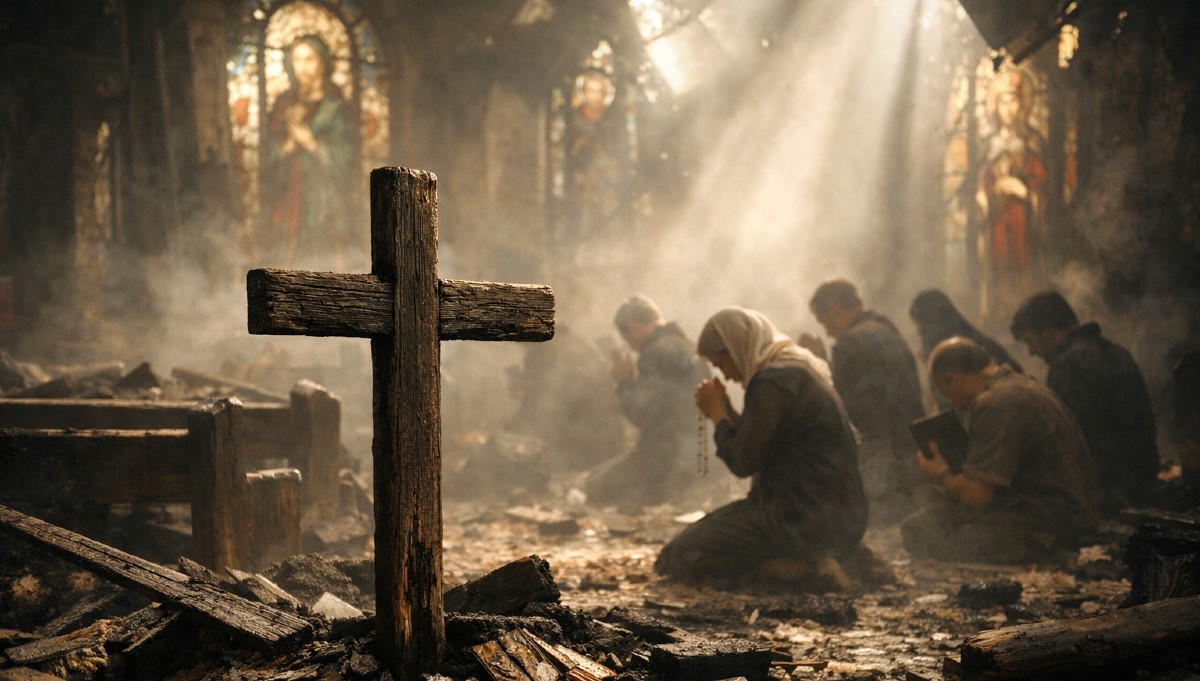
Christians remain the most persecuted religious group in the world, with hundreds of millions facing violence, discrimination, and restrictions on religious freedom, according to remarks delivered by a Vatican representative at the United Nations.
During an event held March 3 alongside the 61st Regular Session of the United Nations Human Rights Council, Archbishop Ettore Balestrero, the Holy See’s Permanent Observer to the United Nations, addressed the growing crisis of anti-Christian persecution across the globe.
Speaking at the event titled “Standing with Persecuted Christians: Defending the Faith and Christian Values,” the archbishop presented sobering statistics about the challenges Christians face today.
“Almost 400 million Christians worldwide face persecution or violence, making them the most persecuted religious community in the world. This means that 1 in 7 Christians is affected,” Balestrero said, according to Vatican News.
The violence directed at Christians has also taken a deadly toll. Balestrero noted that “almost 5,000 Christians were killed for their faith in 2025, which equates to an average of 13 per day,” according to Vatican News.
Beyond killings, many Christians suffer other severe forms of persecution. These include forced exile, false imprisonment, destruction of property, and attacks on places of worship.
Our Important Lenten Message – Please Watch
Balestrero explained that believers in many parts of the world are subjected to “murder, forced exile, enslavement, false detention, the dispossession of their property, arson of churches, and other injustices and hate crimes” because of their faith, according to reports cited by LifeSiteNews.
The archbishop also warned that persecution does not always appear in violent forms. In some regions, Christians experience what he described as “silent” persecution through social pressure, legal challenges, or restrictions on religious expression.
“These include prosecutions for silent prayer near abortion facilities or for quoting a Bible verse on social issues,” Balestrero said, according to LifeSiteNews.
Recent reports from Europe highlight the troubling trend. The Observatory on Intolerance and Discrimination against Christians in Europe (OIDAC Europe) documented 2,211 anti-Christian hate crimes across the continent in 2024, including vandalism, arson, and other attacks on churches, according to the organization’s 2025 report cited by LifeSiteNews.
In addition, the report recorded 274 attacks on individuals during the same period.
Several incidents illustrate the growing hostility toward Christian institutions. In Lourdes, France, the entrance of Sacré-Cœur parish was vandalized with graffiti containing the phrases “À mort Jésus-Christ” (“Death to Jesus Christ”) and “Sale race de Jésus-Christ” (“Dirty race of Jesus Christ”), according to LifeSiteNews.
Acts of desecration have also occurred in Rome. Human waste was discovered in multiple areas of San Nicola di Bari Church in Ostia, including the altar. In another incident in the Italian capital, urine and human excrement were found throughout a Catholic chapel located inside the city’s main train station, Termini, a location frequently visited by pilgrims traveling to Rome, according to LifeSiteNews.
Elsewhere in Europe, arsonists set fires inside the historic St. Peter Catholic Church in Philippsburg, Germany, damaging an altar cloth and a table near the front of the church, according to reports cited by LifeSiteNews.
Christians in other regions face different but equally troubling pressures. In India, where Christians represent a small minority, believers often face harassment and intimidation during worship services or prayer gatherings.
Anti-conversion laws in some areas are frequently used to target Christian communities, and mobs have been known to disrupt prayer meetings, creating an atmosphere of fear that discourages Christians from openly practicing their faith, according to LifeSiteNews.
Even in Western countries, Balestrero warned that Christians sometimes experience growing marginalization. He pointed to the “gradual marginalization or exclusion” of Christians from social and professional life, which can “narrow or in fact annul the rights legally recognized to the predominantly Christian population,” according to LifeSiteNews.
The archbishop stressed that governments have a responsibility to safeguard religious liberty.
“It is the State’s duty to protect freedom of religion or belief, which includes preventing third parties from violating this right,” Balestrero said, according to Vatican News.
He added that governments must ensure protection for believers who are threatened because of their faith.
“This protection has to safeguard believers who are targeted, before, during, and after an attack,” he said, according to Vatican News.
Ultimately, Balestrero emphasized that defending religious freedom is not merely a political matter but a fundamental human obligation.
“A State should promote freedom of religion or belief, first and above all because it is a fundamental human right,” he said, according to Vatican News.
As the global Church continues to face persecution in many parts of the world, the archbishop’s message served as a call to governments and the international community to defend the dignity and rights of all believers.
Your support brings the truth to the world.
Catholic Online News exists because of donors like you. We are 100% funded by people who believe the world deserves real, uncensored news rooted in faith and truth — not corporate agendas. Your gift ensures millions can continue to access the news they can trust — stories that defend life, faith, family, and freedom.
When truth is silenced, your support speaks louder.