

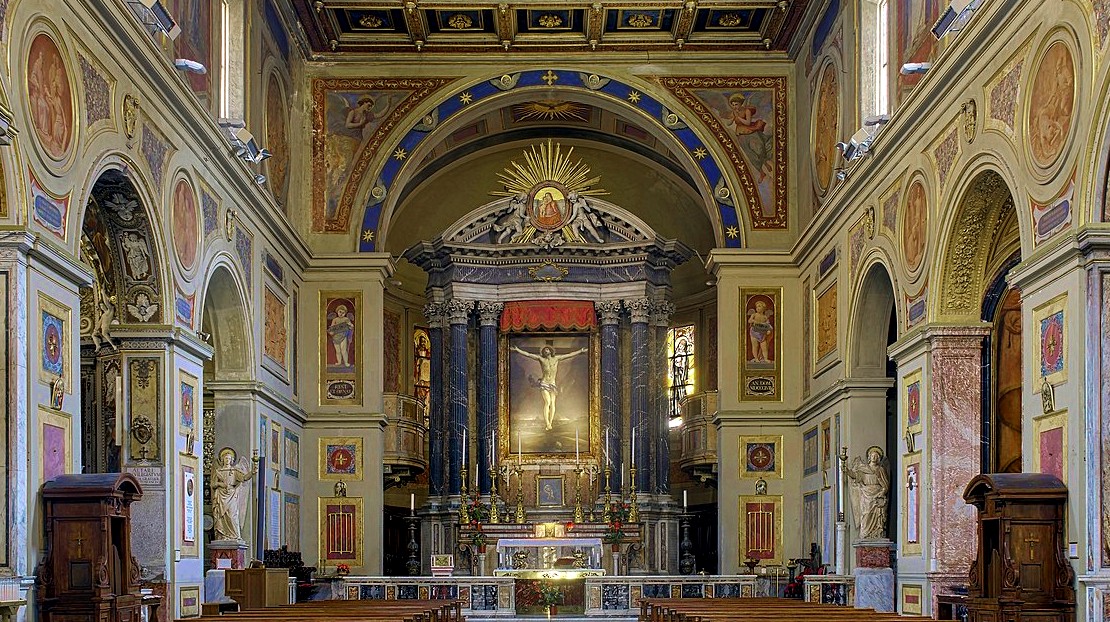
A recently restored chapel inside Rome’s Basilica of San Lorenzo in Lucina has become the center of national debate after observers claimed that an angel depicted in a fresco bears a resemblance to Italian Prime Minister Giorgia Meloni. What had long been a quiet corner of prayer within one of Rome’s oldest churches is now drawing crowds, scrutiny, and serious questions about the intersection of sacred art, politics, and reverence.
According to reporting by the New York Times, attention surged after an Italian newspaper pointed out that the angel’s face closely resembles the prime minister and that the figure holds a scroll shaped like the outline of Italy. The revelation prompted a wave of reactions, from amused curiosity to sharp criticism, and turned the chapel into an unexpected destination for tourists and locals alike.
The parish priest, Father Daniele Micheletti, said he had not noticed any resemblance before the controversy erupted. “It’s just a tempest in a teacup,” he told the New York Times, adding that the chapel had never been a focal point within the church before the recent attention.
The chapel’s modern decorations date back several decades. Father Micheletti recalled that around 1985, the space was assigned to monarchists who installed a bust of Umberto II, Italy’s last king, along with a commemorative plaque. Around 2000, frescoes were added depicting sites linked to the Italian royal family, including two angels flanking the bust. Over time, water damage necessitated restoration, which was completed shortly before Christmas last year, according to the New York Times.
An Urgent Message from Sister Sara – Please Watch
The renewed artwork went largely unnoticed until the Italian newspaper La Repubblica published a front-page story highlighting the alleged likeness. Opposition lawmakers quickly weighed in. Irene Manzi, a member of parliament, described the restoration as “unacceptable,” arguing that it violated laws protecting Italy’s cultural heritage, according to the New York Times.
Church authorities also responded. Cardinal Baldassare Reina, the second-ranking official of the Diocese of Rome after Pope Leo XIV, said the diocese would “verify the possible responsibilities of the parties involved.” He emphasized that images rooted in Christian tradition “cannot be misused or exploited, as they are intended exclusively to support liturgical life and personal and communal prayer,” according to the New York Times.
Ms. Meloni herself responded with humor. “No, I definitely don’t look like an angel,” she wrote on Instagram, accompanied by a laughing emoji, according to the New York Times. Online, the story sparked memes and jokes, with comedians quipping that visitors were now praying for lower taxes.
The artist responsible for both the original fresco and its restoration, church volunteer Bruno Valentinetti, denied that the angel was meant to depict the prime minister. In online videos cited by the New York Times, he said the restoration faithfully reproduced what had been there before. Art experts have since been tasked with locating images of the chapel prior to restoration for comparison.
For Catholics, the debate raises deeper concerns about the purpose of sacred art. Some visitors interpreted the image as satire or political commentary, while others insisted that a church is no place for either. One law student told the New York Times that a restorer should not convey political messages in a religious setting, asking pointedly, “What are we leaving for future generations?”
Father Micheletti said he is still discerning how to proceed. While some have praised the artwork, others have called for it to be altered or removed. If objections grow louder, he acknowledged, the angel’s face may ultimately need to be repainted.
As the discussion continues, the controversy serves as a reminder that sacred spaces are not merely historical artifacts or canvases for interpretation. For the faithful, they are places set apart for worship, prayer, and encounter with God—an identity the Church continues to safeguard, even amid modern controversies, according to the New York Times.
Your support brings the truth to the world.
Catholic Online News exists because of donors like you. We are 100% funded by people who believe the world deserves real, uncensored news rooted in faith and truth — not corporate agendas. Your gift ensures millions can continue to access the news they can trust — stories that defend life, faith, family, and freedom.
When truth is silenced, your support speaks louder.


