
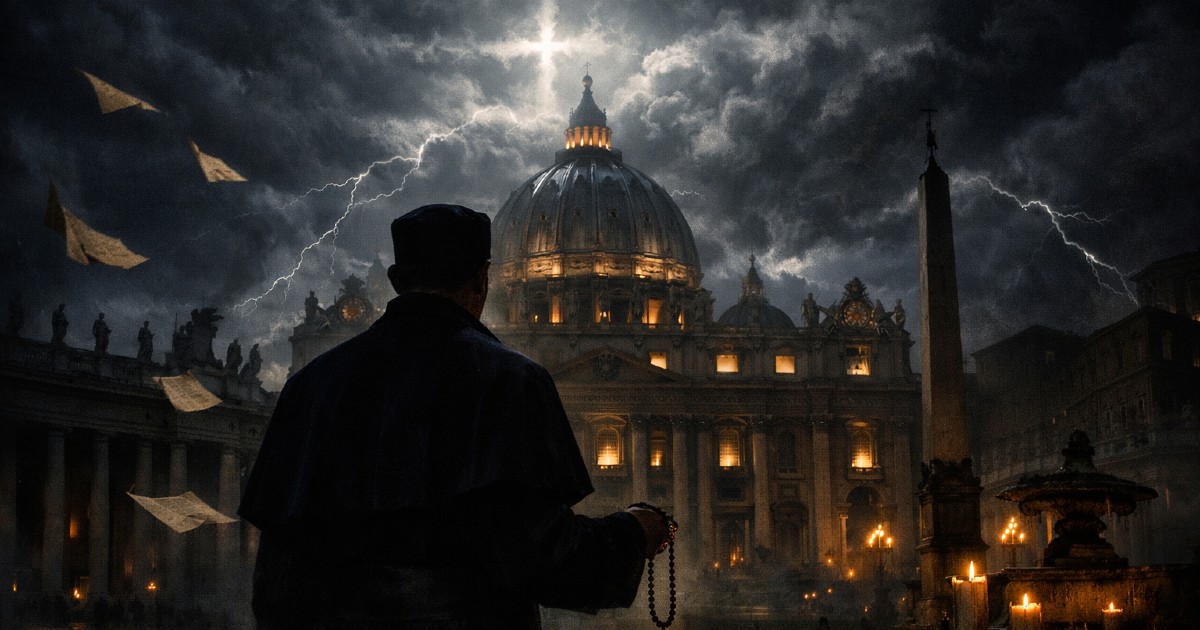
More than three decades after it was spoken, a warning from the late Jesuit priest and exorcist Father Malachi Martin is once again circulating among Catholics who are deeply troubled by the state of the Church. In a 1990 private talk later reported by LifeSiteNews, Martin reflected on corruption within the hierarchy, the Third Secret of Fatima, and the possibility that the Church could one day face what he described as a “false pope.”
According to LifeSiteNews, Martin warned that if Pope John Paul II were to die prematurely, Catholics “may have to face finally, a false pope.” He reportedly grounded this fear in the makeup of the College of Cardinals at the time, stating that 114 of the 140 voting-eligible cardinals were “liberal.” For Martin, this imbalance raised serious concerns about the direction of future papal elections.
What makes Martin’s comments so unsettling for many believers today is not merely their tone, but their theological framing. He acknowledged that Catholics were already asking anguished questions about the papacy itself: “Is he really Pope? Is he really Peter? … Has he lost his faith? Why isn’t he doing something about it?” According to LifeSiteNews, Martin emphasized that these doubts reflected confusion within the faithful rather than disbelief in the Church’s ultimate victory, insisting that while the Church might be “in shambles,” “we’ve won the war.”
Martin’s most controversial claim was his assertion that since roughly 1963, the Church hierarchy had been infiltrated by Satan. He stated bluntly that Satan “has been installed in the structure of the Church formally by Catholic Satanists,” a theme he later explored in fictionalized form in his novel Windswept House, as reported by LifeSiteNews. While the book itself is fiction, Martin consistently insisted that it reflected real spiritual battles occurring behind the scenes.
One of the more sobering aspects of Martin’s remarks concerns the limitations he believed were placed on Pope John Paul II himself. Contrary to popular images of papal authority, Martin described the Holy Father as “rather helpless,” explaining that even routine actions were heavily controlled. “He can’t send a letter,” Martin said, according to LifeSiteNews, adding that papal correspondence and episcopal appointments were filtered through multiple bureaucratic “choke points.”
Martin pointed to a striking example from 1989, when Pope John Paul II allegedly wrote to the world’s bishops urging weekly Eucharistic exposition and the rosary for two intentions: “first of all that Satan would lose his grip on the ministers of the church, priests and, number two, that the Third Secret of Fatima would not be implemented.” Martin claimed that the letter was suppressed before it ever reached the faithful, a detail that continues to disturb Catholics who believe important spiritual warnings have been withheld.
The Third Secret of Fatima looms large over Martin’s commentary. According to LifeSiteNews, Martin recalled being present in Fulda, Germany, in 1980 when Pope John Paul II confirmed that he had read the secret twice but declined to reveal it, stating only that certain punishments could be mitigated through prayer. Holding up his rosary, the pope reportedly told the faithful, “It’s the only protection you have. Say that every day of your life.”
Adding to the unease are later statements attributed to Church figures who had knowledge of the Third Secret. LifeSiteNews notes that Cardinal Mario Luigi Ciappi once said, “In the Third Secret, it is predicted, among other things, that the great apostasy in the Church will begin at the top.” Martin himself connected these warnings to the idea of a “false pope,” not as a sensational claim, but as a possible outcome of widespread apostasy.
Martin’s comments also extended to Archbishop Marcel Lefebvre and the Society of St. Pius X. He reportedly called Lefebvre “a blessing to the Church” and dismissed his excommunication as illegitimate, saying, “The excommunication is a joke.” While the canonical status of the SSPX remains a contentious issue, Martin’s remarks reflect a broader frustration among traditional Catholics who feel marginalized or silenced.
For today’s Catholic reader, Martin’s words are not an invitation to panic or schism, but a call to sobriety. Whether one accepts his conclusions or not, his insistence on prayer, fidelity, and vigilance echoes the message of Fatima itself. If nothing else, his warning challenges Catholics to examine how deeply they trust in Christ’s promise that the gates of hell will not prevail, even when the storm seems to rage from within.
According to LifeSiteNews, Martin believed that future generations would look back on Pope John Paul II as a treasure whose value was not fully understood at the time. That reflection may be just as relevant now, as Catholics grapple with confusion, division, and the enduring question of how to remain faithful in an age of uncertainty.


