
For centuries, the Church has taught that death is not an end, but a passage. Now, modern medicine and neuroscience are once again brushing up against that ancient Christian truth, and discovering that the line between brain activity and the human soul may not be so easily drawn.
According to a recent report in the Washington Post, a growing scientific debate has emerged over how to understand near-death experiences, powerful encounters reported by patients who briefly crossed the threshold between life and death and returned with strikingly similar accounts.
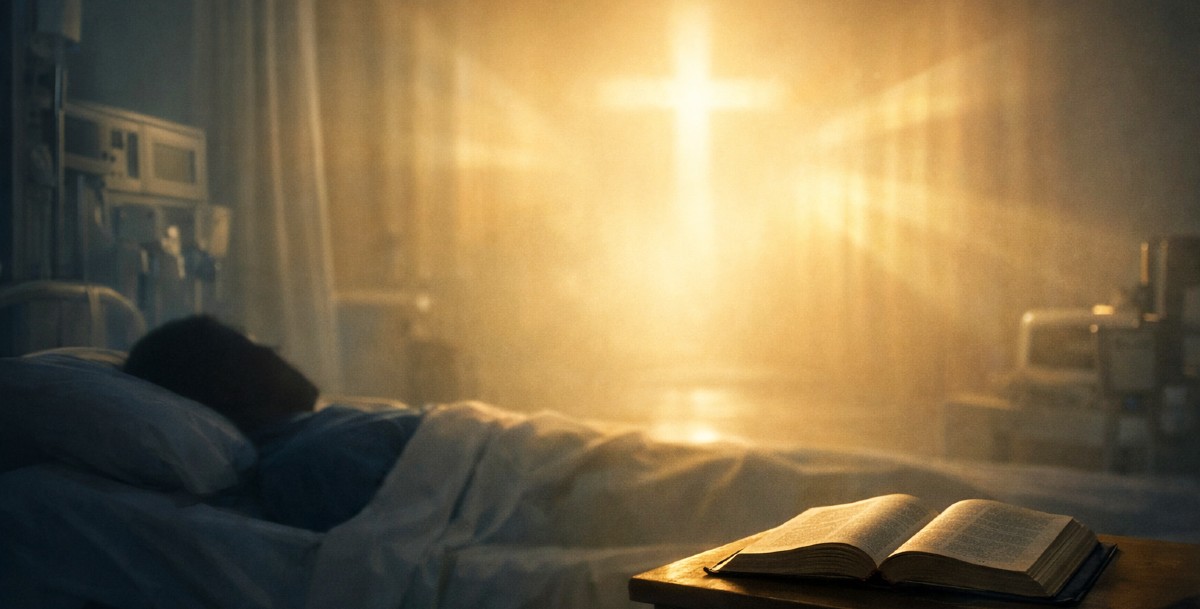
One such account comes from Miasha Gilliam-El, a nurse and mother of six, who collapsed just days after giving birth due to a rare and dangerous condition known as peripartum cardiomyopathy. As emergency workers fought to save her life, Gilliam-El later recalled experiencing something that defies easy explanation.
“The next thing I knew, I was out of my body, above myself, looking at them work on me, doing chest compressions,” she told the Washington Post. She described moving through a tunnel filled with peace, walking hand-in-hand with someone unseen, while hearing the words of Scripture: “Yea, though I walk through the valley of the shadow of death …”
An Urgent Message from Sister Sara – Please Watch
Such accounts echo themes familiar to Christians, separation from the body, profound peace, and the presence of sacred words or figures, yet scientists remain divided on what these experiences truly signify.
A team of neuroscientists led by Charlotte Martial of the University of Liège has attempted to explain these experiences through a new neurobiological framework called NEPTUNE, which links near-death phenomena to changes in oxygen levels, carbon dioxide, and electrical activity in the brain. According to the Washington Post, the model draws from hundreds of studies and suggests that elements like out-of-body sensations and encounters with light may be rooted in specific brain regions and chemical processes.
Yet not all researchers are convinced.
Bruce Greyson and Marieta Pehlivanova of the University of Virginia School of Medicine have publicly challenged the NEPTUNE model, arguing that physiology alone cannot fully account for what patients report. As cited by the Washington Post, they note that laboratory-induced illusions bear little resemblance to the deeply personal encounters described by near-death survivors, particularly visions of deceased persons who are “seen, heard, smelled, and touched.”
Greyson, a longtime researcher in this field, cautions against dismissing patient testimony outright. “Every scientific discovery begins with subjective observation that may eventually be corroborated by controlled experiment,” he said, according to the report.
For Catholics, this tension between measurable biology and lived experience is not unfamiliar. The Church has long affirmed that the human person is both body and soul, and that consciousness is not reducible to matter alone. While the Church does not formally define near-death experiences as proof of the afterlife, it also does not dismiss them, recognizing that God may permit such moments for reasons beyond human understanding.
Jeffrey Long, a radiation oncologist who has studied thousands of near-death experiences, raised the central question plainly in the Washington Post: “Do we have some evidence? And how strong is that evidence that we have life after death, that our consciousness survives bodily death?”
Even among skeptics, the power of these experiences is undeniable. Martial herself acknowledged that survivors often return transformed. “For most of them, it’s a life-transforming experience,” she said, noting that many become less afraid of death and more spiritually attentive.
Gilliam-El shared that she hesitated to speak about what she experienced, fearing disbelief. Yet her story, like many others, continues to resurface, not as a scientific anomaly alone, but as a reminder that humanity still stands before mysteries it cannot fully explain.
As Catholic believers, we know that science, when rightly ordered, does not compete with faith but can illuminate its edges. Death, as the Catechism teaches, is a separation of the soul from the body — not the annihilation of the person. That modern researchers find themselves grappling with experiences that point beyond the physical should not surprise us.
When Gilliam-El heard a commanding voice tell her “Not yet,” and felt herself return to her body, she emerged shaken, grateful, and changed, much like the saints who, across history, encountered the nearness of eternity and came back to testify.
In an age that often insists only what can be measured is real, these stories quietly insist otherwise. And for the faithful, they whisper what Scripture has proclaimed all along: life is stronger than death, and the soul’s journey does not end at the hospital door.
Your support brings the truth to the world.
Catholic Online News exists because of donors like you. We are 100% funded by people who believe the world deserves real, uncensored news rooted in faith and truth — not corporate agendas. Your gift ensures millions can continue to access the news they can trust — stories that defend life, faith, family, and freedom.
When truth is silenced, your support speaks louder.