

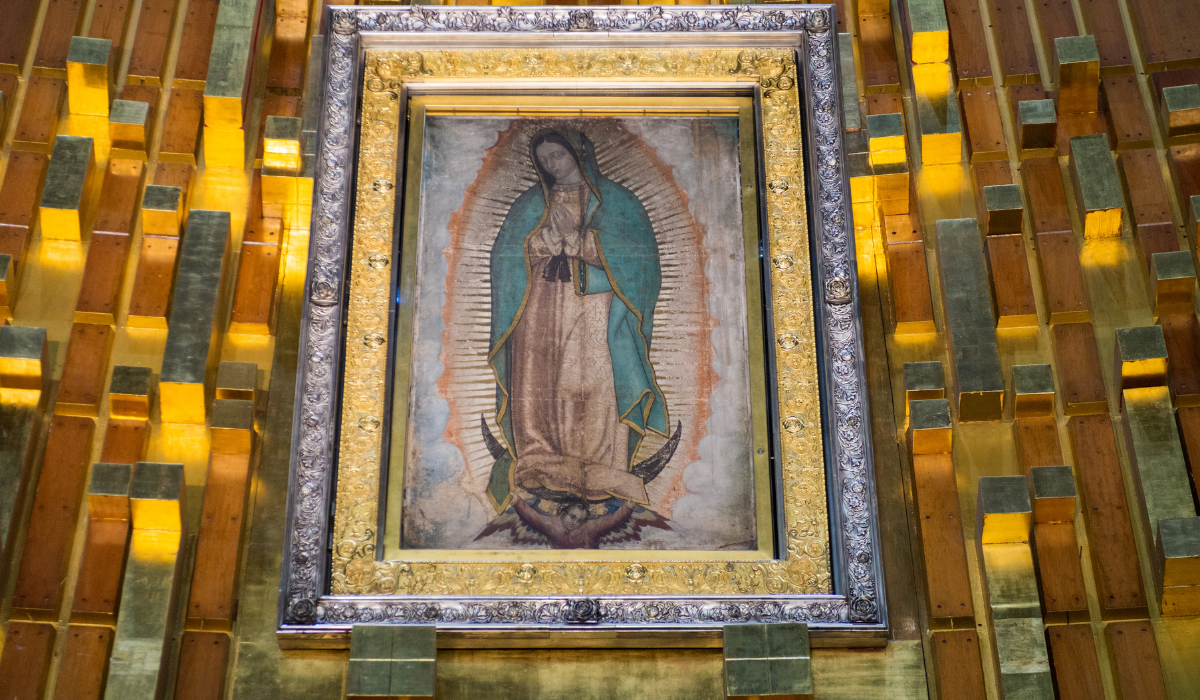
For centuries, the image of Our Lady of Guadalupe has stood as one of the most beloved and mysterious relics in the Catholic world. Now, new analysis of the tilma associated with St. Juan Diego is renewing global attention after researchers reported microscopic reflections hidden within the Virgin Mary’s eyes.
According to a report discussed by the Daily Mail, scientists studying high-resolution images of the tilma said they discovered “at least 13 tiny human figures embedded within the eye.” The figures are so small they can only be seen through digital enlargement, yet investigators believe they may resemble people who were present when the miraculous image was first revealed in the 16th century.
The tilma is a cloak traditionally believed to have belonged to Juan Diego, an Indigenous convert who reported apparitions of the Virgin Mary in 1531 near present-day Mexico City. According to Catholic tradition, the image of the Virgin miraculously appeared on his cloak when he presented it to Bishop Juan de Zumárraga, astonishing those who witnessed the event.
Our Important Lenten Message – Please Watch
The recent findings come from digital analysis of the image. According to the Daily Mail, researchers reported that the reflections inside the eye appear to show multiple figures believed to be witnesses present during the moment the tilma was first displayed.
The investigation is part of a broader effort to understand how the famous image was created. Researchers studying the tilma have long noted unusual features that do not easily align with traditional artistic methods.
According to the Daily Mail, investigators examining high-resolution scans said that “sections of the face, hands, robe and mantle appear to have been applied in a single step, with no sketches, corrections or visible brush strokes.”
Scientific study of the tilma is not new. The Daily Mail reports that the image has been examined repeatedly since at least 1751. Researchers reviewing previous studies wrote that “none of the results offered any sound scientific explanation, which up to this very day defies science and all human reasoning.”
One of the earliest modern scientific investigations occurred in 1936 when Nobel Prize–winning chemist Richard Kuhn analyzed fibers taken from the cloak. According to the Daily Mail, Kuhn reported that the pigments did not match “any known colorants derived from plants, animals or minerals.”
More detailed technological analysis took place in 1979 when biophysicist Philip Serna Callahan and art specialist Jody B. Smith used infrared photography to examine the image. Their work focused on how the colors interacted with light and how they were distributed across the fabric.
According to the Daily Mail, the infrared scans showed that large areas of color appeared unusually uniform and lacked the layering patterns typically seen in paintings. Researchers also noted that the pigments interacted with light in ways that differed from conventional paints used during the 16th century.
Another striking mystery involves the tilma’s survival. The cloth is made from fibers of the maguey cactus, a material that normally deteriorates within a few decades. Yet the original tilma has endured for nearly five centuries.
According to the Daily Mail, the cloak has survived exposure to candle smoke, humidity, dust, and repeated contact with pilgrims while maintaining its structure and color.
Replicas painted on similar cactus-fiber cloth in the 18th century deteriorated within decades, while the original remained intact. Even decorative additions made by artists later faded, leaving the original figure unchanged.
Researchers studying the image have also reported another unusual observation. According to the Daily Mail, some investigators said the colors appear to rest slightly above the surface of the fibers rather than soaking into the fabric. In close examination, “the colors disappear and only the fabric is visible,” researchers noted.
Despite these claims, skeptics caution that some findings may be the result of visual interpretation or artifacts created during digital image processing.
Nevertheless, the tilma of Our Lady of Guadalupe continues to draw intense interest from both scientists and believers. For millions of Catholics, the image remains not merely an artifact of history but a powerful sign of God’s grace and the maternal presence of the Blessed Virgin Mary in the life of the Church.
Your support brings the truth to the world.
Catholic Online News exists because of donors like you. We are 100% funded by people who believe the world deserves real, uncensored news rooted in faith and truth — not corporate agendas. Your gift ensures millions can continue to access the news they can trust — stories that defend life, faith, family, and freedom.
When truth is silenced, your support speaks louder.