
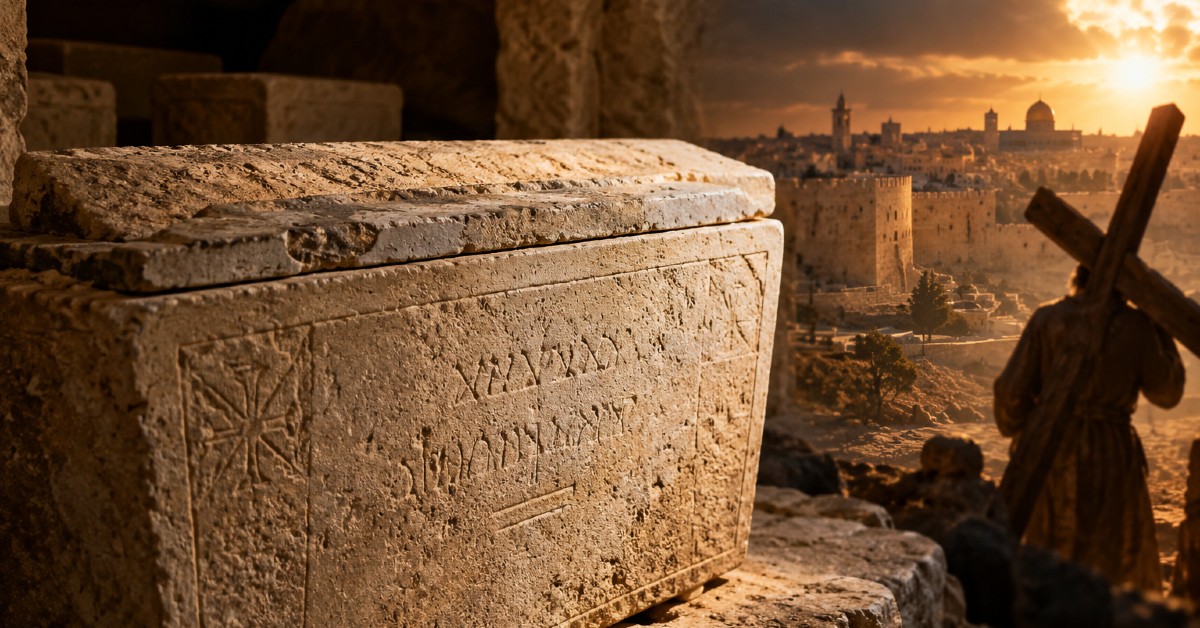
An ancient burial box discovered in Jerusalem has renewed an extraordinary question for Christians: Could it be connected to the family of Simon of Cyrene, the man the Gospels say was compelled to help Jesus carry His cross?
The limestone ossuary, a type of chest used in antiquity to hold human remains, was discovered in a Jerusalem tomb in 1941. According to the Daily Mail, inscriptions on the artifact include the names Alexander and Simon, creating a striking parallel with the Gospel of Mark.
Mark 15:21 identifies Simon of Cyrene not only by name, but also through his sons: “Alexander and Rufus.”
That detail has attracted particular attention because the ancient ossuary bears an inscription identifying an “Alexander, son of Simon.”
New Testament scholar Dr. Jeremiah Johnston told the Daily Mail that the combination of evidence makes a connection to the biblical family plausible.
“So we have a Simon, a son named Alexander, and a Cyrenian family, buried in Jerusalem in the right period, before 70 AD,” Johnston said. “Is it the same family? I think it is very plausible, if not likely.”
Another intriguing clue appears in an inscription on the lid. According to the Daily Mail, lettering interpreted as “QRNYT” has been proposed as a reference to Cyrene, the North African city from which the biblical Simon came.
That interpretation is not certain. The names themselves also present a problem for anyone hoping for definitive identification.
“Simon was the most common Jewish name of the time, and Alexander was popular too,” Johnston cautioned.
The tomb contained 11 ossuaries, according to the report, but apparently no burial box identifying Rufus, the other son named by Mark.
For Johnston, that missing piece means the evidence cannot establish the identification conclusively.
“So we cannot call it proven with certainty, but high probability,” he told the Daily Mail.
The artifact itself contains several inscriptions. According to information reported by the Daily Mail from research by Biblical Archaeology Review contributor Tom Powers, Alexander and Simon appear more than once across the ossuary, including inscriptions on its front, back and lid.
Powers has explored the possibility that the ossuary could even have contained the remains of both Alexander and Simon. Differences in the depth and style of the inscriptions led him to propose that Simon’s name may have been placed on the chest first, with Alexander’s identification added later.
That interpretation remains disputed, and the available evidence does not establish that two people were buried in the ossuary.
The dating of the tomb nevertheless places it within the historical period relevant to the Gospel account. According to the Daily Mail, pottery recovered from the tomb, including a Herodian oil lamp, supports dating its final use to the first century before Jerusalem’s destruction by the Romans in AD 70.
The possible reference to Cyrene adds another layer to the mystery.
Writing about the artifact in 2003, Powers reported that historian Tal Ilan, an expert on ancient Jewish names, considered it “very likely” that the ossuary belonged to the Alexander mentioned in Mark’s Gospel, according to the Daily Mail.
Still, similarities between an archaeological artifact and a biblical account are not the same as proof. Common names, incomplete archaeological records and uncertainty surrounding some of the inscriptions leave room for alternative explanations.
For Catholics, however, the discovery offers a fascinating glimpse into the historical world in which the Passion of Christ took place.
Simon of Cyrene appears only briefly in the Passion narrative, yet his encounter with Jesus has echoed through Christian devotion for centuries. Forced by Roman soldiers to carry the cross, Simon literally shared the burden Christ carried toward Calvary.
Johnston also pointed to the significance of Mark identifying Simon’s children by name.
“He names Simon’s sons because his first readers knew them,” Johnston told the Daily Mail. “He is pointing to living witnesses who could confirm the story.”
Whether this particular ossuary truly belonged to Alexander, Simon, or their family may never be established with certainty.
But an ancient Jerusalem burial chest bearing the names of a Simon and his son Alexander — together with a possible connection to Cyrene and a date consistent with the first-century setting of the Gospel — presents an archaeological mystery with remarkable parallels to one of the most familiar moments of Christ’s journey to the Cross.
Your support brings the truth to the world.
Catholic Online News exists because of donors like you. We are 100% funded by people who believe the world deserves real, uncensored news rooted in faith and truth — not corporate agendas. Your gift ensures millions can continue to access the news they can trust — stories that defend life, faith, family, and freedom.
When truth is silenced, your support speaks louder.