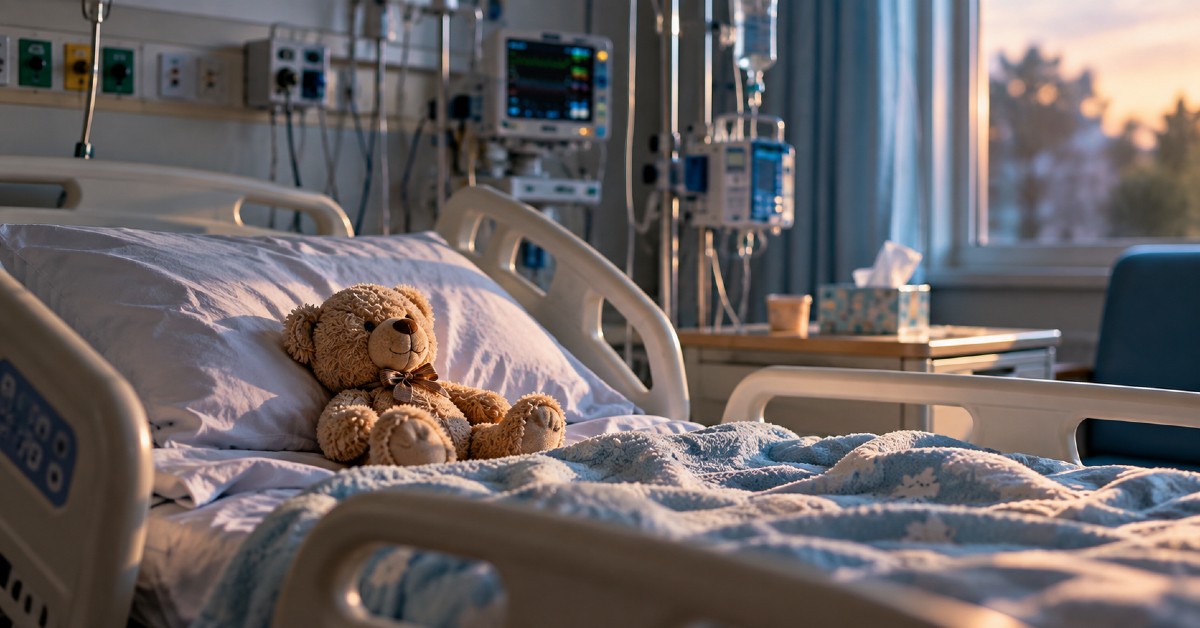
A two-year-old child is dead in the Netherlands — not simply because of devastating illness, but because adults entrusted with protecting that child concluded that intentionally ending the toddler’s life was an acceptable answer to suffering.
For Catholics, there should be no sanitizing what happened.
According to The U.S. Sun, the child, who had been born prematurely at 26 weeks, suffered from severe brain damage, cerebral palsy, visual impairment, breathing difficulties and epileptic seizures that did not respond to medication.
The child was profoundly sick. The child was suffering. But the child was still a child.
And Catholic teaching insists that suffering, disability and dependence can never erase the fundamental dignity of a human life.
The case is especially disturbing because the child was not capable of making a personal request to die. Dutch euthanasia rules ordinarily allow minors to request euthanasia beginning at age 12. Termination of the life of a child younger than 12 is treated separately as termination of life without a request.
Under a Dutch procedure for terminally ill children between the ages of 1 and 12, a physician may intentionally terminate a child’s life when stringent requirements are considered satisfied, including unbearable suffering without prospect of improvement, the absence of a reasonable alternative to relieve that suffering, and consultation with the parents.
This toddler became a test of precisely how far that principle can reach.
According to The U.S. Sun, physicians consulted earlier in the process did not initially conclude that the child’s suffering met the required threshold.
“Those physicians established that at that time the child was not continuously suffering unbearably,” the report stated, according to The U.S. Sun.
The report continued: “The epilepsy caused a great deal of discomfort, but the epileptic seizures were not continuous.”
Most strikingly, according to The U.S. Sun, those physicians believed alternatives remained.
“Their conclusion was that there were still reasonable alternatives, such as palliative options and other medications that could possibly result in better control of the epileptic seizures,” the report stated.
Those words should stop us. Reasonable alternatives. Palliative options. Other medications. Yet the child’s life was ultimately ended.
According to The U.S. Sun, another physician was subsequently consulted and determined that the toddler’s “unbearable suffering was clearly visible.” That physician concluded that the requirements for terminating the child’s life had been satisfied. The euthanasia was performed at the end of 2025.
In a report released in September 2026, the Dutch Committee for Late-Term Abortion and Termination of Life in Newborns and Children ultimately agreed that the doctor had acted with due care, according to The U.S. Sun.
The committee’s description of the child’s condition is heartbreaking.
“All facets of ‘being human’ – regarding motor skills, behavior, and personality – were severely impaired and were not going to improve,” the committee stated, according to The U.S. Sun.
It continued: “Despite all medical and non-medical interventions, the parents and the doctor observed no improvement in the child’s condition and were convinced that the child was suffering unbearably and without prospect of relief.”
But from a Catholic perspective, this is precisely where an entirely different understanding of the human person must be proclaimed.
Human dignity does not depend upon motor skills.
It does not depend upon personality, cognitive ability, independence, physical development or the ability to communicate.
A severely disabled two-year-old possesses exactly the same God-given human dignity as a healthy two-year-old.
The Catechism of the Catholic Church could hardly be clearer: “Those whose lives are diminished or weakened deserve special respect.” It teaches that direct euthanasia — deliberately ending the life of someone who is sick, disabled or dying — is “morally unacceptable.”
That distinction matters enormously.
The Catholic Church does not teach that doctors must keep a dying person alive by every technologically possible means. Treatments that are excessively burdensome, dangerous, extraordinary or disproportionate may legitimately be discontinued when death cannot reasonably be prevented.
There is an enormous moral difference, however, between allowing an unavoidable natural death and intentionally causing death.
There is a difference between saying, “We cannot cure you, but we will care for you until the end,” and saying, “Your suffering is so great that we will end your life.”
Catholic medicine answers suffering with accompaniment, pain relief, ordinary care, love and palliative care — not intentional killing. Indeed, the Catechism calls palliative care “a special form of disinterested charity.”
And perhaps nothing exposes the danger of euthanasia more starkly than its application to a two-year-old.
A toddler cannot understand a legal framework for euthanasia. A toddler cannot weigh philosophical arguments about autonomy or consent. A toddler cannot comprehend what it means to choose death.
The child is entirely dependent upon adults.
That dependence should make the child’s life more fiercely protected, not less.
This is why the Netherlands case should horrify Christians and disturb anyone who believes society has a special obligation to protect its weakest members.
Once human dignity becomes conditional upon someone’s assessment of suffering, function or prognosis, the most vulnerable people are placed in the greatest danger.
The sick need care. The disabled need protection. The suffering need compassion. And a two-year-old needs adults who will stand between that child and death.
The tragedy in the Netherlands forces the world to confront a question much larger than one heartbreaking case: When medicine cannot remove suffering, will society remain beside the suffering person — or decide that the person should be removed along with the suffering?
The Catholic answer cannot change.
Every human life, however fragile, disabled, dependent or close to death, remains a life created in the image and likeness of God.
A child’s suffering can call us to extraordinary compassion. It can call us to better medicine, deeper sacrifice, relentless pain management and loving accompaniment. It can call us to remain beside a family through circumstances almost too painful to imagine.
But it can never transform killing that child into an act of mercy.
A two-year-old should never have to prove that his or her life is worth living. That worth was already there.
Your support brings the truth to the world.
Catholic Online News exists because of donors like you. We are 100% funded by people who believe the world deserves real, uncensored news rooted in faith and truth — not corporate agendas. Your gift ensures millions can continue to access the news they can trust — stories that defend life, faith, family, and freedom.
When truth is silenced, your support speaks louder.