
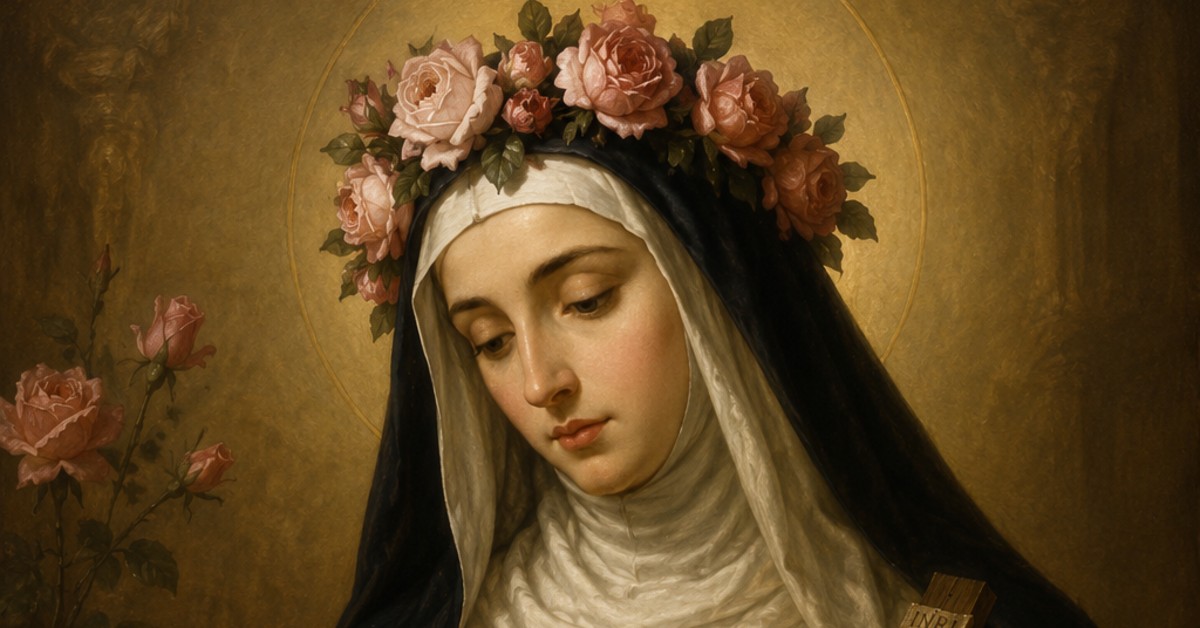
More than four centuries after the death of St. Rose of Lima, Catholics continue to draw close to the first saint of the Americas through prayer, devotion and the remarkable relics of her life preserved in Peru.
Among the most significant is her skull, which remains at the Basilica of the Most Holy Rosary at St. Dominic Convent in Lima. The relic offers pilgrims a tangible connection to a young laywoman whose extraordinary life of prayer, sacrifice and service continues to inspire the Church.
According to EWTN News, Dominican friar Father Luis Enrique Ramírez, rector of the basilica, said the saint’s skull has been kept there since the late 19th century.
“St. Rose’s skull has been here in the basilica since the late 1800s, around the time this neoclassical altarpiece was created,” Ramírez explained.
The skull is housed in a reliquary that also contains important relics of two other beloved Peruvian saints, St. Martin de Porres and St. John Macías. According to Ramírez, St. Rose’s skull wears a silver crown of roses. The crown was originally made of gold, but the original was stolen. A separate portion of the reliquary contains some of her bones.
Other reminders of her earthly life have also survived. A tablecloth embroidered by St. Rose is preserved as an example of the work she performed, while her nearby former home contains 10 objects associated with her, including a ring connected with her mystical betrothal to Christ, soil from her grave and a handwritten letter.
For Catholics, the preservation of such objects is not simply a matter of historical curiosity.
Ramírez told EWTN News that relics provide “a way for the faithful to share in the holiness of the person they venerate.”
“Being close to the saint is a very ancient tradition in the Church,” he said, explaining that venerating relics can encourage Catholics “to strive to live your life in a state of grace.”
The basilica itself preserves another extraordinary connection to St. Rose. A plaque on the floor marks the place traditionally associated with her mystical betrothal in 1617, when she consecrated herself completely to Christ after hearing the words, “Rose, be my spouse.”
According to Ramírez, Rose had been preparing to enter the Poor Clares and came to bid farewell to an image of Our Lady of the Rosary. It was there that a mysterious event occurred in which she became so heavy that she could not be lifted.
“She realized that God did not want her to be a nun but rather a laywoman,” Ramírez explained.
Rose instead became a member of the Dominican Third Order and lived her vocation in the world. That distinction remains particularly significant for Catholics today: St. Rose attained extraordinary holiness not within the walls of a monastery, but while living at home, working and serving others.
The St. Dominic Convent also contains a chapel dedicated to the saint that was established about a decade ago. Beneath its principal image of St. Rose is another first-class relic — her shoulder blade. The chapel contains paintings and devotional images connected to her spirituality, as well as a marble sculpture by Melchiorre Cafà that was present at St. Rose’s beatification ceremony at Santa Sabina Basilica in Rome in 1668, according to EWTN News.
Yet the enduring importance of St. Rose reaches far beyond the relics associated with her.
Ramírez emphasized that she worked to help support her family while maintaining an intense interior life of prayer modeled in part on St. Catherine of Siena. She also devoted herself to those who were poor, sick and suffering, offering practical assistance, comfort and care.
Her life demonstrates that deep prayer, ordinary work and service to others do not have to exist separately.
St. Rose, Ramírez said, remains “a very contemporary example” for Catholics. Her witness shows that a person can “work to earn a living,” pursue a profound life of prayer and dedicate oneself to serving those in need.
Born in 1586 and dying in 1617, St. Rose of Lima is honored as the patron saint of Peru, the Americas and the Philippines. The Catholic Church celebrates her feast on Aug. 23.
Centuries later, pilgrims who stand before her relics encounter more than artifacts from Catholic history. They encounter reminders of a woman who pursued holiness in the midst of ordinary life — and whose example continues to call Catholics to prayer, charity and a life lived in the presence of God.
Your support brings the truth to the world.
Catholic Online News exists because of donors like you. We are 100% funded by people who believe the world deserves real, uncensored news rooted in faith and truth — not corporate agendas. Your gift ensures millions can continue to access the news they can trust — stories that defend life, faith, family, and freedom.
When truth is silenced, your support speaks louder.